

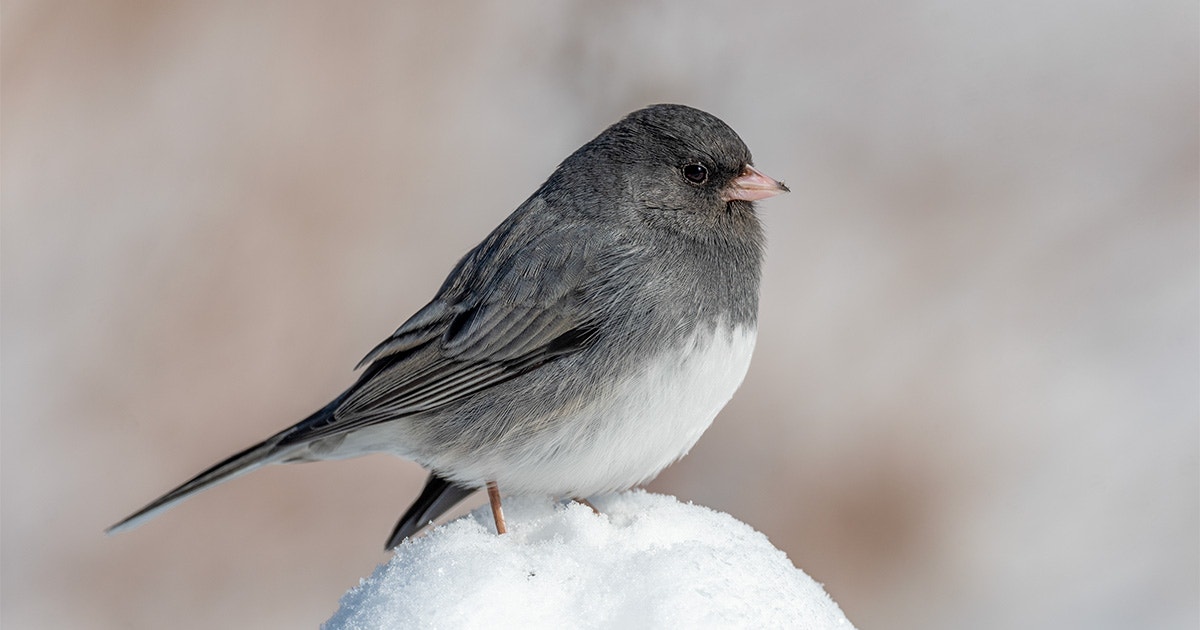
Everyone loves a junco—and for good reason. Adored for their pep and prevalence, these small songbirds are common feeder visitors across North America, easy to spot by their white outer tail feathers that flash in flight. Though juncos are famously considered a winter species, they can be found throughout the year in much of the country, including the Northeast and Appalachians, the Mountain West, and the Pacific Coast.
But where you live determines more than just whether you see juncos year-round or seasonally; it also determines what type of junco you might see. With one of the largest numbers of subspecies for any North American bird, the Dark-eyed Junco truly contains multitudes. Read on to learn more about this surprisingly diverse—and versatile—species.
1. The Dark-eyed Junco is one of the most common birds in North America, with rough estimates setting its total population at somewhere around 223 million individuals. (Perhaps unsurprisingly, the American Robin is the most abundant bird with an estimated 266 million.) While that number might seem huge, there’s actually far fewer juncos than there used to be: A 2019 study found that their population has decreased by 168 million birds since 1970.
2. Colloquially known as “snowbirds,” juncos are a welcome sign of winter when they begin appearing throughout the U.S. Southwest, Midwest, and much of the East. The name dates back to at least the 1700s, with John James Audubon himself referring to them as such in one of his original watercolors. The seasonal association is even captured in their scientific species name, hyemalis: Latin for “of the winter.” When spring rolls around, migrant populations fly to northern forests to breed and raise their young.
3. Despite their nickname, not all juncos migrate; many, particularly in the West, stay put year-round, while those in the Appalachian Mountains might simply move to lower elevations during the winter. Altitudinal migration allows birds to experience vastly different environments in a relatively small area, and it’s a tactic employed by several other bird species, including the Prairie Falcon and American Dipper. That strategy is at risk, though, as climate change heats up mountaintops.
4. Dark-eyed Juncos sport an array of snazzy looks that vary by region. More than a dozen subspecies can be found across the United States, five of which look so different that they were considered separate species until the 1970s. The Eastern United States and most of Canada is dominated by the “slate-colored” junco, which is gray with a crisp white belly. The brownish “Oregon” junco is most common in the West, which also has the pink-sided, gray-headed, white-winged, and red-backed. These subspecies breed in largely separate regions but will often overwinter together, leading to mixed flocks.
Apparently it doesn’t take long for Dark-eyed Juncos to evolve
5. The junco’s numerous plumage variations are believed to be an example of speciation, or the formation of new and distinct species through evolution. An ancestral junco—possibly a type of Yellow-eyed Junco—likely migrated north after the retreat of North America’s glaciers and then spread out until populations were geographically isolated enough to evolve new color variations. Because the subspecies can interbreed, they’re still considered the same species, but that could change if any subspecies become more isolated.
6. Apparently it doesn’t take long for Dark-eyed Juncos to evolve: One long-studied population living on UCLA’s campus has developed shorter wings and stubbier beaks, likely a better fit for the abundance of processed foods. Interestingly, likely as a result of rapid, adaptive evolution, their beaks returned to a more wild-like, seed-eating shape during two years of the COVID-19 pandemic, when junk-food availability decreased. Then, when when the students returned, the birds switched back to the shorter beaks.
7. When pizza crust isn’t part of the equation, seeds usually make up about three-quarters of these songbirds’ diet, making them a regular at backyard bird feeders. Or, more accurately, below them. Dark-eyed Juncos are typically found on the ground, hopping about in search of spilled seeds, including white proso millet and milo—unpopular seeds in mixes that most feeder birds skip but juncos happily gobble up.
8. Dark-eyed Juncos don’t just feed on the ground; they nest there, too. Females look for nooks under logs, behind rocks, hidden by overhanging grass, or even shallow holes in the dirt. Then they build a little cup of grass and leaves, sometimes lined with hair, pine needles, or fine pieces of moss. If they do nest off the ground, it won’t be anywhere far up—perhaps a low shrub or window ledge. After the females incubate the eggs, both parents work together to collect insects to feed their young.
9. Juncos often travel in flocks, and those flocks can have complex social hierarchies in which males dominate females, and older birds rule over younger ones. To avoid competition from males, females tend to migrate in their own groups and overwinter farther south. Migrating males, on the other hand, stick closer to their northern breeding grounds to ensure they lock down a good spot before any potential mates arrive.
10. Mating for Dark-eyed Juncos isn’t just about looks—it’s also about smell. Both males and females secrete a kind of oil from a gland at the tail base, and researchers have found that the birds can distinguish individuals by the odor of their oil. Those with odors that were most strongly “male-like” or “female-like” had the most chicks survive to fledging, which explains why in the study smell was the most important factor for males to attract females.
