

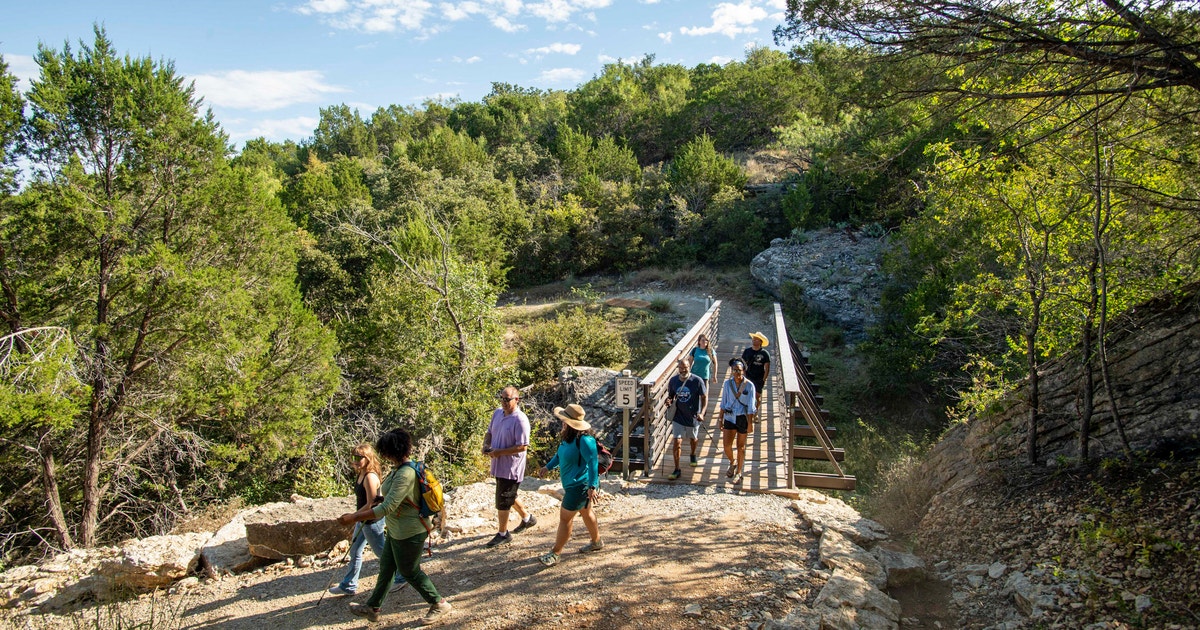
At Palo Pinto Mountains State Park, the dusty pink-and-orange glow of the Texas sunrise kisses the skyline. The mountains, which are really a series of rolling hills, are lined by the lush green of juniper trees and the specks of lingering spring wildflowers that paint the park’s trails. Where the land rolls forward and opens, the grass juts up against Tucker Lake, surrounding the glimmering water with patches of wild mesquite and cacti.
Each morning, as park interpreter Katherin Fisher makes her rounds, she perks her ears for the sounds of Palo Pinto’s most high-profile guest: the endangered Golden-cheeked Warbler. The distinctly colored bird—black backed and throated with bright yellow cheeks halved by bold black eyelines—calls out with a series of chips and a zee-zee-zee that pulses through the air. Breeding only in the hill country of Central Texas, the Golden-cheeked Warbler is one of North America’s rarest songbirds, nesting exclusively in juniper-oak woodlands like those found among Palo Pinto’s hills.
“Up on the top, there’s a lot of juniper trees,” Fisher says. “As you start going down the hill into the canyons, along the creek beds, you have cottonwoods and pecan and oak trees. Then you have pocket prairies that are full of native wildflowers.”
As Texas’s first state park in 25 years, Palo Pinto is part of a larger push for public lands in the state following approval of the Centennial Parks Conservation Fund in 2023. The fund designated $1 billion to establish new state parks and expand existing ones. Future projects set to be completed in the next three to four years include the creation of Chinati Mountains State Natural Area in West Texas, Bear Creek State Park outside of Uvalde, and Post Oak Ridge in the hill country near Austin. Fredericksburg’s Enchanted Rock State Park will be expanded up to three times its current size.
“We’re very excited that Texas Parks and Wildlife Department was able to secure this property and several others to expand or establish more habitat and recreation destinations around Texas,” says Richard Gibbons, director of conservation for Audubon Texas. “Palo Pinto is a great addition to the state park portfolio.”
According to Fisher, the Golden-cheeked is just one
“It’s extremely rewarding. You’ll see wildlife doing things that you don’t normally see,” Fisher says. “It’s just very interesting to be a part of the whole thing. Like when somebody hears a Golden-cheeked Warbler for the first time, they’re like, ‘that’s an endangered species!’ And they just heard it.”
Situated 75 miles west of the Dallas-Fort Worth metroplex, the new park, which comprises just over 4,780 acres, offers a unique snapshot of the ecological diversity the state boasts, Fisher says. From its dry hills to its lush creeks and swaths of wildflowers and prairie grasses, Palo Pinto allows visitors to experience both the arid conditions of Western and Central Texas as well as the wetter, marshy habitats of the coastal south. “This park is like the diversity in Texas wildlife and ecosystems,” Fisher says. “All of the different varieties and the micro habitats that are within the park themselves—there’s something for everybody.”
Black-capped Vireo and Black-Crested Titmouse—two more Texas highlights—can also be seen during breeding months.
Thanks to this rich mix of habitats, the park hosts an abundance of resident species while attracting many more migrating through or to nest. So far in 2026, eBirders have already reported 109 different species in the park (206 have been recorded in total), including southern summer specialties like Painted Bunting, Summer Tanager, and Mississippi Kite. And while the Golden-cheeked is the star of the park, Black-capped Vireo and Black-crested Titmouse—two more Texas highlights—can also be seen during breeding months. In the winter, Harris’s Sparrows, with their black faces and bibs, flee the frigid temperatures of northern Canada to hang out in the southern Great Plains, including Palo Pinto.
Fisher remembers feeling uncertain about how the Golden-cheeked Warblers would react to guests sharing the space as the park reached its opening days. Though they gravitate toward hardwood and rocky hillside areas that can be tough to access, the abundant juniper-oak habitat throughout the park draws the birds in close to paths and busier areas. To Fisher’s surprise, the park’s opening didn’t seem to change the birds’ behavior in any noticeable way. In fact, soon after the opening, Fisher says, the park recorded its first breeding pair for the season.
The park offer nine different trails, varying in difficulty and ranging from half a mile to just under six miles. Each winding path allows visitors to traverse a range of views and habitats, including down through the creeks and expanses of prairie grasses and atop the limestone cliffs and hills surrounding Tucker Lake. Hikers looking for a challenge can embark on the Texas and Pacific trail, which is the park’s longest route at 5.7 miles and takes visitors to the western extreme of the park, where visitors can “feel like a real cowboy.”
For newcomers to the Palo Pinto or folks getting into birding, Fisher hopes the opportunities to connect with nature are just a stepping stone to conservation. She suggests visitors start by learning about the kinds of wildlife around them, from the flowers to the birds. This, she says, encourages a sense of belonging and responsibility. “You don’t know how to protect something if you don’t know that it exists, right?”
