

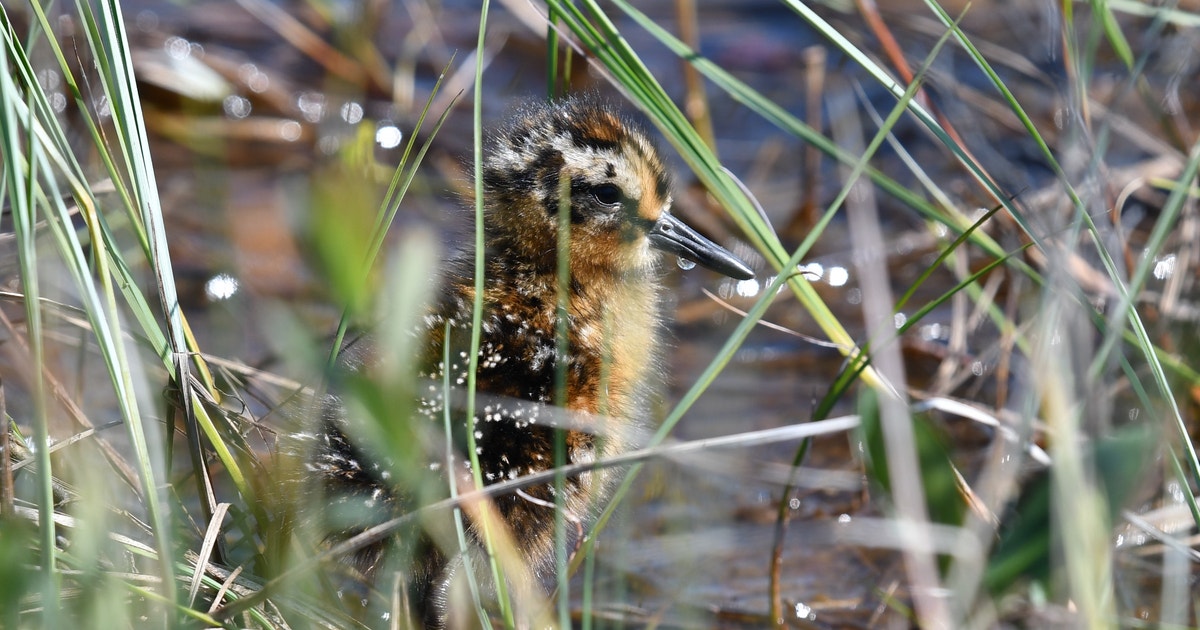
Shorebirds arriving in Alaska’s Upper Cook Inlet have a lot on their plates. Straight from a grueling 10,000-mile migration, they must make the most of the all-too-brief boreal spring and summer to try and raise chicks. Some are successful—their chicks fledge in late summer and integrate into the population. But many breeding attempts fail. Which wetland breeding grounds yield success? Even more important: Why?
Up to now, these questions have not been answered. This spring, researchers are working to identify the factors that determine success versus failure for breeding shorebirds in the wetland areas of Cook Inlet. What makes a site good for shorebird breeding? How many good sites do we have in the region? The collaborative project is led by Dr. Nathan Senner, who grew up in Anchorage and is now a professor at the University of Massachusetts Amherst. The research team will closely follow the breeding season over the next three months, incorporating multiple shorebird species and assessing wetland breeding areas around the entire Upper Cook Inlet.
A shorebird breeding season is intense. Having just touched down from migration, the birds dive right into the next stage. They partner up, carve out and defend a territory, use their bodies to press the moss into a bowl-shaped nest, lay eggs. Next comes several tense weeks of incubation, with both the nest and the incubating adult at risk from predators.
If the shorebird pair is lucky, hatching day arrives in early June. Chipping sounds come from within the four dappled eggs in their nest. Eventually, the eggs crack open, transforming into tiny balls of fluff with comically long legs.
Within hours, the parents shepherd their chicks away from the nest and into the wider world. Tied to the ground until the chicks can fly, the family stays on the move for the next three to four weeks. The chicks soon adapt to their gangly legs. They spend their time chasing down invertebrates to eat, while the parents do their best to keep the family away from disturbance and predators.
Senner and his team are figuring out the details of these critical first weeks. Where do the parents lead their chicks once they have hatched? What is the vegetation like, and how high or low are the water levels in those specific locations? And the million-dollar question: Do the chicks—these intrepid yet terribly vulnerable scraps of fluff and sinew—manage to survive there? Ultimately, chick survival is the main difference between a stable population and one that only ‘used to be here.’
That shift to the past tense is already underway for our shorebird populations, especially on the east side of Cook Inlet. Thanks to the unique boggy environment, shorebirds breed and raise chicks even smack-bang in the middle of Anchorage. This makes for a highly unusual set of ‘backyard birds’ for urban residents to observe and enjoy. But a combination of development, climate change, and the increased presence of people and pets is degrading Anchorage’s biodiverse, sheltered habitats that shorebirds have always relied on for nesting and chick-rearing.
“When I was a kid, I used to be able to walk a few blocks to see breeding Hudsonian Godwits,” says Senner, who grew up in Anchorage’s Turnagain neighborhood. “Those are gone now.”
Other species are still holding on within the city. Greater Yellowlegs and Lesser Yellowlegs, Short-billed Dowitchers, and Wilson’s Snipe all continue to nest in Anchorage’s remaining bogs. But finding a good place to lay eggs in a relatively urban setting isn’t the only challenge they face.
“In early June, you’ve got birds moving down through the roads and through people’s yards with little chicks,” says Lee Tibbitts, a retired U.S. Geological Survey biologist whose work in the late 1990s motivated the current project. As the shorebird families move between local wetlands and marshes along the coast, the chicks get trapped behind fences, ambushed by curious dogs, run over by traffic. “The chicks are just trying to get across the road,” says Tibbitts. “People don’t know to watch out.
Meanwhile, the western side of Cook Inlet is less built up and, in many places, not easy for people to access. It makes for less disturbance to peace-and-quiet-loving birds—but even in these more remote areas, the number of shorebirds has been ticking steadily downward for the past decade. This decline appears to be closely linked with the drying out of boreal bogs. Senner’s team will be collecting the data needed to definitively measure that connection between shorebird success and bog water level.
To the majority of Alaska’s human population, Cook Inlet is right on the doorstep. “The best thing about Alaska is everybody’s interested in the natural world,” says Tibbitts. “It’s why people move here. And, if they move here and they don’t know that yet, they will become interested in the natural world just because it’s everywhere.”
Our shorebirds, salt marshes, and bogs are part of what makes Cook Inlet home—and at the same time, these features make our corner of the world part of something much, much bigger. In the hemisphere-spanning jigsaw puzzle of migration, how many puzzle pieces slot in right here? Just looking at the thousands of newly returned shorebirds down on the mudflats gives a sense of the answer. As for the details, those will become clearer from the data collected this spring.
—Alice McBride is a freelance science writer/academic editor/ecologist from Maine.
