

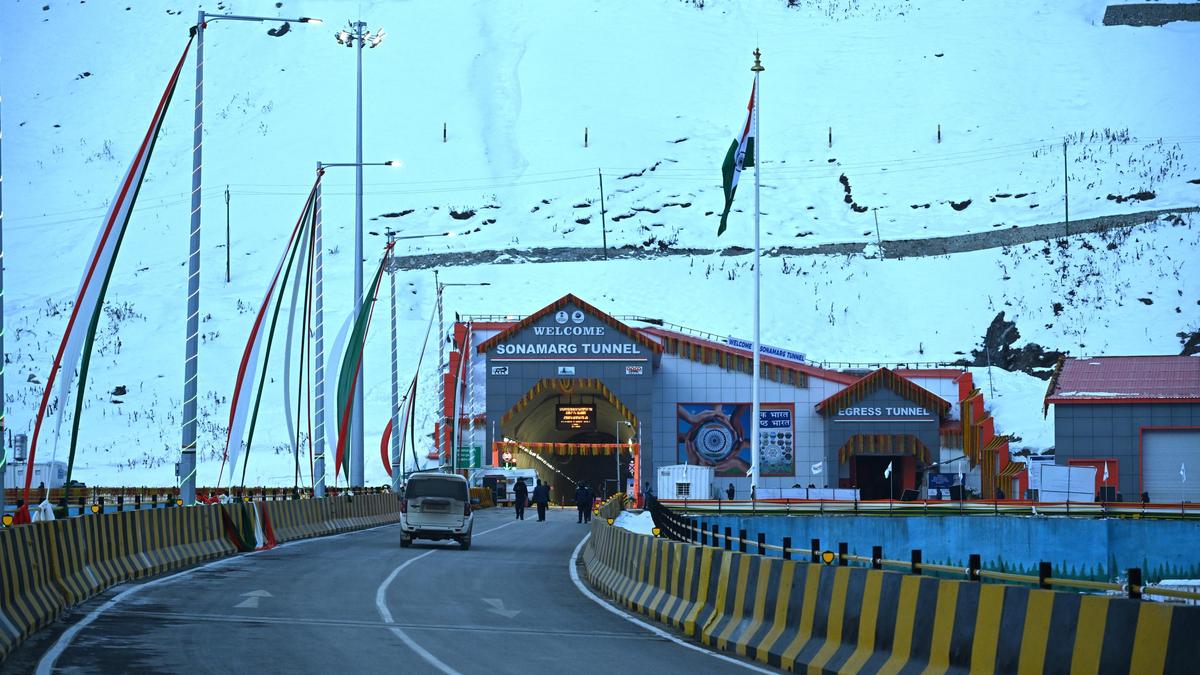
The project, considered crucial for connectivity and strategic mobility, is expected to achieve a major excavation breakthrough within the next two weeks.
| Photo Credit:
IMRAN NISSAR
Men and machinery have been working relentlessly at an altitude of nearly 12,000 feet to complete the construction of the strategically significant Zojila Tunnel, aimed at providing all-weather connectivity between Jammu and Kashmir and the cold desert region of Ladakh.
The project, considered crucial for connectivity and strategic mobility, is expected to achieve a major excavation breakthrough within the next two weeks.
Officials said only around 135 to 140 metres remain to connect the two ends of the tunnel — Baltal in central Kashmir’s Ganderbal district and Drass in Ladakh’s Kargil district.
However, they said the breakthrough would mark only the completion of excavation, while several other works, including finishing, ventilation, safety systems and road infrastructure, would continue for the next few years before the tunnel becomes fully operational by 2028.
Braving freezing winds and bone-chilling temperatures that frequently dip to minus 20 to minus 25 degrees Celsius, workers at the Zojila Tunnel site have continued construction through some of the harshest winters in the Himalayas. The extreme cold, coupled with heavy snowfall and the high-altitude terrain, has made the task particularly demanding, with men and machines functioning in conditions where even routine movement becomes difficult. The strategically important tunnel project is being executed by Hyderabad-based Megha Engineering and Infrastructures Ltd (MEIL).
Ending isolation
The completion of the tunnel will provide year-round access to the region, ending the prolonged winter closure of the Zojila Pass, which remains snowbound for nearly six months each year due to heavy snowfall.
Apart from improving civilian connectivity, the tunnel carries major strategic significance as it will ensure uninterrupted access to Ladakh, a sensitive border region, throughout the year. Officials and local leaders say the project is expected to strengthen military mobility, reduce travel disruptions during winter months, and boost trade and tourism in the cold desert region.
Nasir Hussain, a councillor at the Ladakh Autonomous Hill Development Council in Kargil, said, “Ladakh has immense potential for winter tourism. Year-round access will transform the region into one of the most sought-after winter tourism destinations”.
Published on May 15, 2026
