

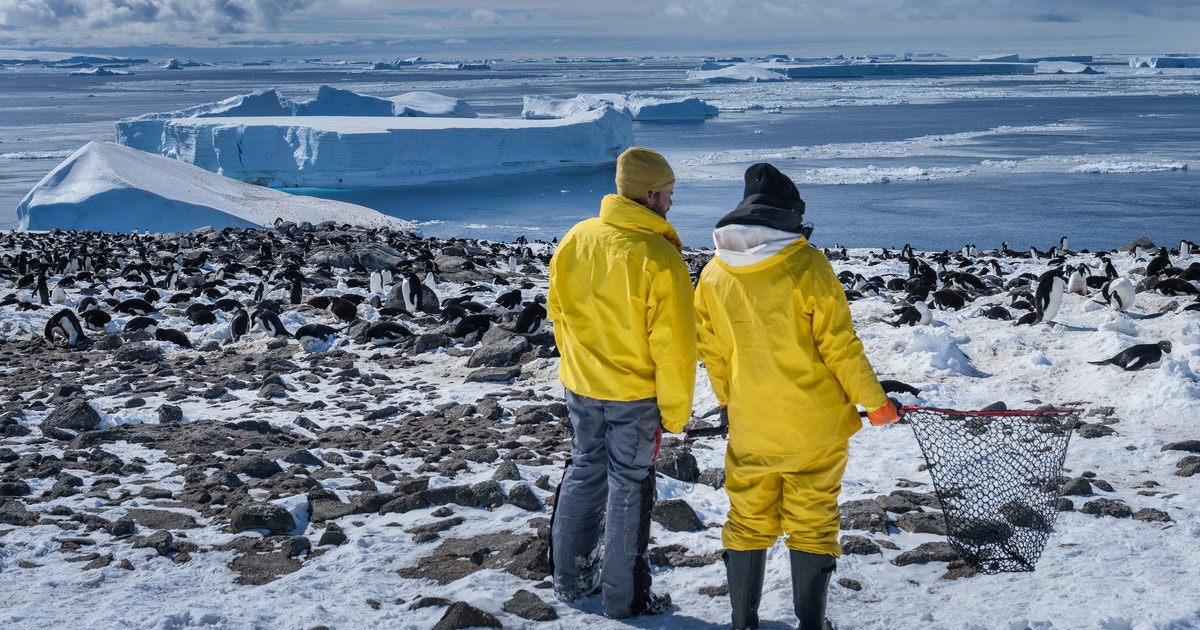
Every November, approximately one-fifth of the world’s Adélie Penguins gather to nest on seven craggy outcrops near the tip of the Antarctic Peninsula. The Danger Islands cover just 1.7 square miles but provide breeding grounds for the world’s largest known Adélie population—only discovered about a decade ago—plus at least nine other bird species, including Gentoo Penguins.
To protect them, Germany and the United States successfully campaigned in 2024 to designate the Danger Islands as an Antarctic Specially Protected Area. In late 2025, as part of Germany’s new responsibility to manage the conservation zone, scientists there spearheaded a scientific expedition to the islands to study the penguins and emerging threats—and try to get ahead of them so that the birds continue to thrive.
Conditions for penguins are changing fast.
Conditions for penguins are changing fast: The Antarctic Peninsula is warming five times faster than the global average. As sea ice has dwindled, so have the shrimplike krill that anchor the Southern Ocean food chain, including for penguins. In turn, scientists have observed Adélie Penguins declining in parts of the peninsula. To better understand how penguins may be responding to these changes, the expedition set out to gain a more precise count of Adélies breeding on the Danger Islands.
The team also assessed the threat from avian flu, which reached Antarctic wildlife as early as 2023. Although the disease hasn’t yet been detected in penguins, including on the latest mission, researchers are watching closely. “Millions of penguins that are so close together could really be heaven for a virus,” says Simeon Lisovski, a biologist at the Alfred Wegener Institute.
For a clearer picture of how threats to their food source might affect penguins, the team was also eager to investigate where the birds forage while rearing chicks. Lisovski and biologist Noell Heid glued satellite GPS tracking devices to 22 Adélie Penguins. The devices will transmit the penguins’ positions every 10 minutes until they fall off—hopefully not until March, after the breeding season—allowing the team to track the birds remotely from Germany.
Already some findings are raising eyebrows. In their pursuit of krill, some birds make weeklong journeys up to 124 miles northward. This is a surprisingly long distance for penguin parents to travel, since their chicks need constant feeding, says German Environment Agency ecologist Fritz Hertel, who initiated the expedition.
Worryingly, it suggests that there is not enough food available near the colony. For now, only the Danger Islands themselves are protected, not the surrounding marine environment, which could leave penguin foraging areas at risk from overfishing. The team plans to revisit the archipelago every other year, and by 2029 Hertel and his colleagues hope to have gathered enough data to make a convincing case for expanded protections.
The Danger Islands earned their name for being hidden under thick pack ice, potentially running ships aground. As sea ice has receded, the islands have become more accessible—but only just. The waters surrounding them are shallow and not well mapped. Most large icebreakers cannot safely get close, so the team opted instead for a nimbler sailboat, the Malizia Explorer. This gave them more flexibility but made the wind and ice greater hazards, forcing first mate Marin-Louis Moreau to sometimes spend hours on the mast searching for a safe pathway.
The scientists hunkered down inside, planning and waiting for their opportunity to climb ashore: In the end, the conditions allowed them only 12 hours on land at the Danger Islands. But during their brief stay, they gathered vital data and were treated to “beautiful weather and the most stunning scenery and light,” says photographer Esther Horvath, who specializes in polar exploration. “It was truly an adventurous scientific expedition.”
This story originally ran in the Spring 2026 issue as “Navigating Danger.” To receive our print magazine, become a member by making a donation today.
