

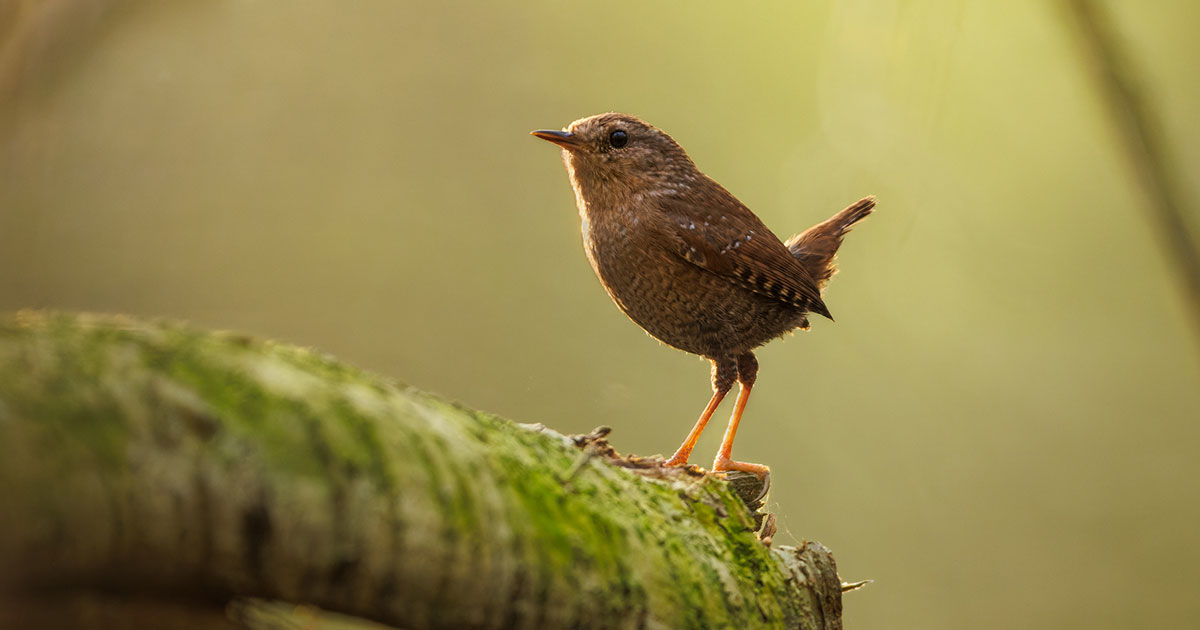
Winter is here, and for those of us in northern New England, so are all of its friends: frigid temperatures, snow, and, of course, cute little Winter Wrens bopping around the forest.
Oh right, that’s not the case at all!
Yes, sadly and somewhat perplexingly, the Winter Wren is not actually a winter resident across some of our coldest and snowiest eastern states. Instead, we just get sky-high electric bills while birders to the south—essentially anywhere between Massachusetts and Georgia and as far West as Texas—enjoy a bounty of the tiny brown songsters. But all is not lost: The birds do breed in mature forests across the northeast, Great Lakes states, and Canada. So for Mainers like me, Summer Wren would be a better name for this bird.
It’s Alexander Wilson’s fault, really. Writing from the Philadelphia area, the pioneering ornithologist was the first to describe this species for Western science in his 1808 American Ornithology, noting that “[this] little stranger visits us from the north in the month of October …” So for him, the bird was indeed just a winter wren. Thus, I guess it needs to be Winter Wren for everyone.
If I sound slightly salty, I am, and it’s because I love Winter Wrens and the idea of having them around during these chillier, slower birding months. There’s just so much going on in such a tiny body. For those of you that are lucky enough to live within the Winter Wren’s winter range, here’s what you need to know about these excellent birds and how to find them.
Despite their less-than-perfect name, Winter Wrens have a lot going for them. For starters, they might have my favorite song of any bird in America. Kenn Kaufman in Audubon’s online bird guide calls it “[a] high-pitched, varied, and rapid series of musical trills and chatters,” and David Allen Sibley says it’s “a remarkably long series of very high tinkling trills and warbles.” Some authors seem overwhelmed at having to describe the song and just resort to listing adjectives. “The rich, wild, sweet, babbling, indescribable song is characteristic and unmistakable,” wrote Ora Willis Knight in 1908, while A.C. Bent called it wonderful, charming, marvelous, startling, entrancing, copious, rapid, prolonged, and penetrating in 1948. I tell people that it sounds like “a mouse on amphetamines playing the violin.”
A Winter Wren’s song isn’t just complex—it’s loud. Most North American wrens are known for being loud (folks with Carolina Wrens in their backyards know what I’m talking about), but Winter Wrens are especially powerful. Studies have shown that, for their size, Winter Wrens have 10 times the sound power as a crowing rooster. That’s a lot!
And it’s all the more incredible that the sound is produced by such a small bird. The Winter Wren is a teeny brown ping-pong ball, more like a mouse in appearance and habits than a bird. They’re tiny even by tiny-bird standards—at about 4 inches long, they’re smaller than a chickadee and just barely bigger than a Ruby-throated Hummingbird.
A Winter Wren’s diminutive stature, lack of bright colors, and terrestrial habits can make it tough to track down for us birders. Their voice gives them away, though, no matter the season. Their song rings through the forest in the summer (though I hear them far more often than I see them). And while Winter Wrens don’t sing in the winter, they are, like many of our wrens, chatterboxes. Frequent stuttering chirps and short trills can all betray a Winter Wren’s location outside of the breeding season.
In almost all cases, however, you need to look on the ground if you actually want to see one. Winter Wrens can be found in a wide variety of habitats, and they forage for food by exploring exposed roots, brush piles, fallen logs, and crevices in search of invertebrate prey. (The genus name Troglodytes, it should be said, comes from the Ancient Greek word for “cave dwellers,” and references the birds’ habit of nesting and roosting in forest nooks and crannies.)
Their voice gives them away, though, no matter the season.
It’s a style of living that’s worked quite well for the Winter Wren, which was, until recently, the most widely distributed of all the Troglodytes wrens. For decades, birders knew the Winter Wren to be a single species living across North America, Europe, and Asia (where it was known simply as “Wren”). In 2010, however, taxonomists split Troglodytes troglodytes into three distinct species: the Eurasian Wren (Troglodytes troglodytes) in the Old World, the Winter Wren (Troglodytes hiemalis) in eastern North America, and (Troglodytes pacificus) along the West Coast from California to Alaska. Though there are slight differences between the three species in song style and coloration, they are still very closely related.
Writing from up here in northern New England, I am envious of those down south that get to enjoy winter Winter Wrens. I am also envious, come to think of it, because southerners also get summer Summer Tanagers, while that species doesn’t live here at all. I’m also envious that southern birders don’t have to scrape the ice off their windshields tomorrow morning before work and spread salt on the steps so that they don’t slip on the ice! I need to calm down, grab another cup of hot chocolate, and remember that in just a few months our summer Winter Wrens will be here again.
