


Last year, the Audubon Photography Awards expanded to include the South American countries of Colombia and Chile. The additions proved an immediate boon for everyone: Not only were the awards suddenly open to a whole new segment of talented bird photographers and videographers, but images featuring the two countries’ jaw-dropping diversity of species poured in. The entries dazzled our judges while giving new dimension to our winners, honorable mentions, and annual Top 100.
Our bonus galleries also reaped the benefits, including our favorite bird behaviors and our favorite chick pics from the 2025 awards. The video gallery here features a 50-50 split between clips from North and South America. Mixed in with footage of a bathing Snowy Owl and loving Common Loon you will now find daring Torrent Ducks and Golden-headed Manakins with moves. So check out the videos below, learn the story behind each shot, and if you’re curious to learn more about Audubon’s work in Latin America, visit here.
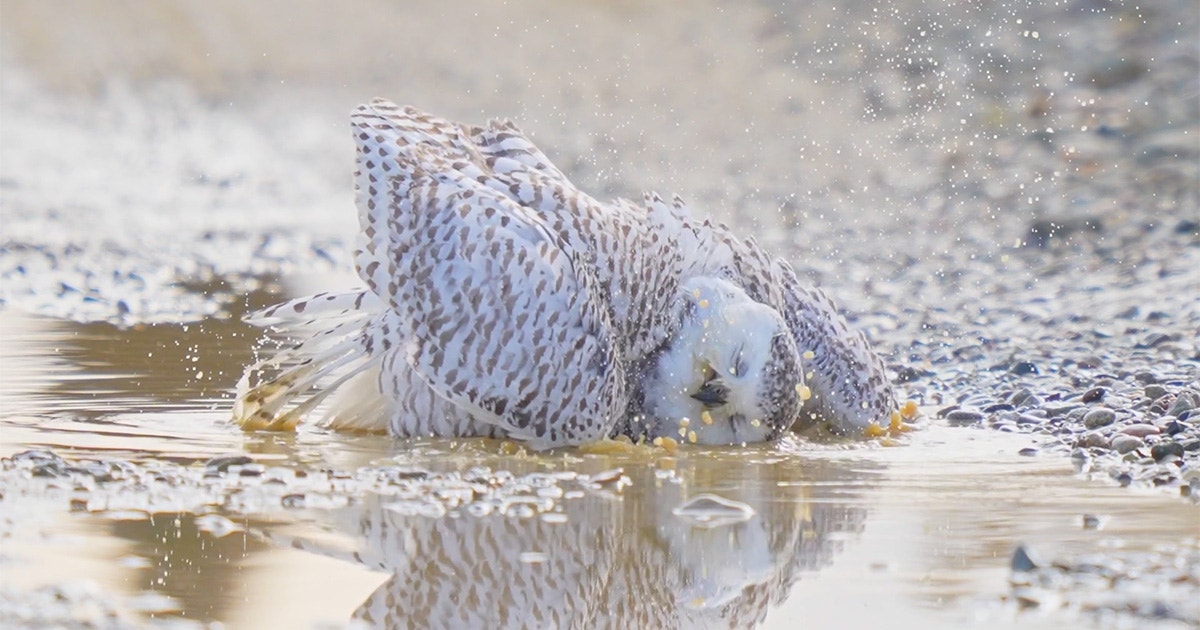
Snowy Owl by Danny Oh (above)
Location: Duxbury Beach, Massachusetts
Technical Details: Sony A1 with a 200-600mm lens at 600mm; 1/240 sec at f/6.3 ; auto ISO
Behind the Shot: I took this video as we were leaving the beach after photographing a few Snowy Owls one morning. To our surprise, this bird was on the main dirt road bathing in a melted snow puddle. Not wanting to miss the opportunity, I got out of my car, knelt down in the mud, and started to record without the use of a tripod. We tried to stay where we were, rather than moving around to get closer and causing the owl stress. The Snowy seemed relaxed, as it bathed for a long while. This video was taken around noon in early December when the owls had not yet established their territories on the beach, and thus were still very active. I had never seen a Snowy Owl bathing and was elated. It was definitely a once-in-a-lifetime experience.
Allen’s Hummingbird by Sukhjot Singh
Location: Irvine, California
Technical Details: Sony A7 Mark III with a Sony 200-600mm G Lens at 600mm in Super-35 Mode; 1/250 sec at f/6.3; ISO 1600
Behind the Shot: Winter might seem like an unusual time for nesting, but here in Southern California, Allen’s Hummingbirds get an early start. Beginning in October, this female Allen’s carefully scouted for a nesting site. She then tirelessly collected fur, small leaves, and twigs, skillfully bonding them together with spider webs to make a nest. While incubating the eggs, she braved several downpours and cold, windy nights with 40 mph gusts. Eventually, the tiniest of beaks popped out and started begging mom for food. She was punctual in feeding, and soon enough the chicks began flapping their wings. It was a bittersweet moment when they took their first flight. I knew how tough their journey was and how hard their mom had worked to protect and provide for them. This sweet memory of her feeding a chick after its first flight will stay with me forever.
Blue-gray Gnatcatcher by Sukhjot Singh
Location: San Joaquin Marsh, Irvine, California,
Camera specifications: Sony A1 with Sony 70-200mm F2.8 GM lens at 280mm and a Sony 1.4x teleconverter; 1/1000 sec at f/5.6 with 45° shutter angle; ISO 100
Behind the Shot: Blue-gray Gnatcatchers are one of our cutest songbirds, and it was my goal to show why they’re called gnatcatchers with a video. Documenting these tiny birds is challenging, as they are often on the move and very swift and agile in flight. During a visit to Sea and Sage Audubon in Southern California, I observed a small swarm of gnats hovering near a tree. I quickly positioned myself and waited with patience. My efforts were rewarded when this Blue-gray Gnatcatcher made a swift approach and relished a late afternoon buffet. By slowing the footage from 120 frames per second to 24 frames per second, we can appreciate the gnatcatcher’s agile flying, particularly the brief moment when it pauses its wingbeats to descend gracefully. This moment lasted only a few seconds, and I am thankful to have experienced it alongside this tiny but remarkable bird.
Golden-headed Manakin by Rubén Torres Restrepo
Location: Vereda San Mauricio, Yalí, Antioquia, Colombia
Technical Details: Nikon d7500 with a Tamron 150-600 mm; 4K 24 fps (1/50 sec) at f/6
Behind the Shot: Almost four years ago I discovered that, in the middle of a forest that I often traversed during my monitoring outings, Golden-headed Manakins gather in exactly the same spot to lek, carrying out their courtship displays and mating practices. These leks are small areas that can be used for up to a decade and always have a constant, nearby source of food—mostly small fruits—which allows them to maintain their energy during their almost all-day displays. Adult males perform to attract females, while juvenile males practice their “dance moves.” At this particular site, I have recorded up to eight males at the same time.
Torrent Duck by León Felipe Jiménez
Location: Gachetá, Cundinamarca, Colombia
Technical Details: Sony 200–600mm G at 600mm; 4K, 120 FPS, 1/250 sec at f/8; ISO 800
Behind the Shot: The Torrent Duck is a shy and elusive species that requires patience, knowledge of its behavior, and a stealthy approach to photograph. Getting close to these ducks has been quite a challenge, as a single misstep will cause them to swiftly flee downstream. For this reason, I approach from downstream, letting the current flow toward me. I move quietly, reading their behavior and keeping my distance to not cause stress. They always see me first, no matter how much camouflage or many hides I use. I have spent several years documenting the species’ natural history as part of a short film about Torrent Ducks in the Andean rivers of Colombia. This particular scene shows a chick and its father in the middle of a rushing river. For me, the scene captures the essence of this extraordinary duck: extreme adaptation, parental care, and resilience in the face of a dynamic environment.
Common Loon by Danny Oh
Location: Long Lake, Bridgton, Maine
Technical Details: Sony A1 with a 200-600mm lens at 600mm, 1/240 sec at f/6.3; auto ISO
Behind the Shot: I have been following this Common Loon family in Maine for many years. This particular year, the pair had one baby. I believe this scene was from the first week after the loonlet had hatched. The baby was riding on its mother’s back in the afternoon after being fed the whole day, thus the baby was full and getting tired. It soon after yawned and fell asleep. The chicks was so precious and cute. To not disturb the family, I hid behind a bush and recorded using a tripod.
Cedar Waxwing by Andy Raupp
Location: Montello, Wisconsin
Technical Details: Sony a1 with Sony 200-600mm lens
Behind the Shot: This video of two Cedar Waxwings splashing around in a shallow pool was taken in our yard. My dad and I built this water feature to attract birds, and during the warmer parts of the year, it always draws in lots of different species as they come for a drink or to splash around and cool off. One hot spring day, while I was set up with my camera near the water feature, a small flock of Cedar Waxwings flew in. I was thrilled to capture this slow-motion video of two of the waxwings splashing around.
Rainbow-bearded Thornbill by Juan Jacobo Castillo
Location: Armenia, Quindío, Colombia
Technical Details: Canon R7 with Rf 100-500mm lens; 120 fps at F5.6; ISO 800
Behind the Shot: This video was captured in the Colombian Andes, at two miles above sea level, in a patch of Andean forest where this hummingbird makes its home. The footage was the result of waiting for six hours in the cold, rain, and fog. After many cups of hot coffee, and as the fog slowly lifted, I saw the hummingbird as the sun began to break through. I watched it feed on different flowers, dozing off at times, preening, and stretching its feathers in different moments. It is well-known that these birds are highly territorial, often returning to their favorite perches. So I focused on the branch where I knew it would land, prepared the camera, and captured this magical moment as the bird preened and stretched its feathers.
Black-necked Swan by Sebastian Jesus Varela Monsalve
Location: La Albarrada, Arauco, Chile
Technical Details: Sony a7r4 with Sony 200-600; 1/800 sec at f/6; ISO 200
Behind the Shot: I was out looking for birds with my partner, and thanks to a tip from a friend, we went to La Albarrada, located in our home city of Arauco. To reach this wetland, you have to drive down to the base of a hill. When we arrived, we saw a pair of Black-necked Swans with their chicks. They were very calm beside the road, so we simply got out of the car and took out our equipment to capture photos and videos. We spent a long time there, enjoying that special moment.
White-vented Plumeleteer by Juan Antonio Alonso de Juan
Location:: Pacho, Cundinamarca, Colombia
Technical Details: Nikon D850 with Sigma contemporary 150-600mm lens at 600mm; 1/640 sec at f/6,3; ISO 250
Behind the Shot: Over the years, during my walks with my dogs, I have been collecting small native plants that grow along the edges of paths that are usually destined to be cut during routine clearing. I give them a chance to grow in my garden, and I especially like to collect flowering plants that attract hummingbirds. This provides these birds with a permanent, natural feeding place, as different trees and shrubs produce flowers at different times of the year. In this particular video, the flower of the nacedero tree can be seen, whose blossoms feed at least seven different species of hummingbirds that I have observed in my garden.

