

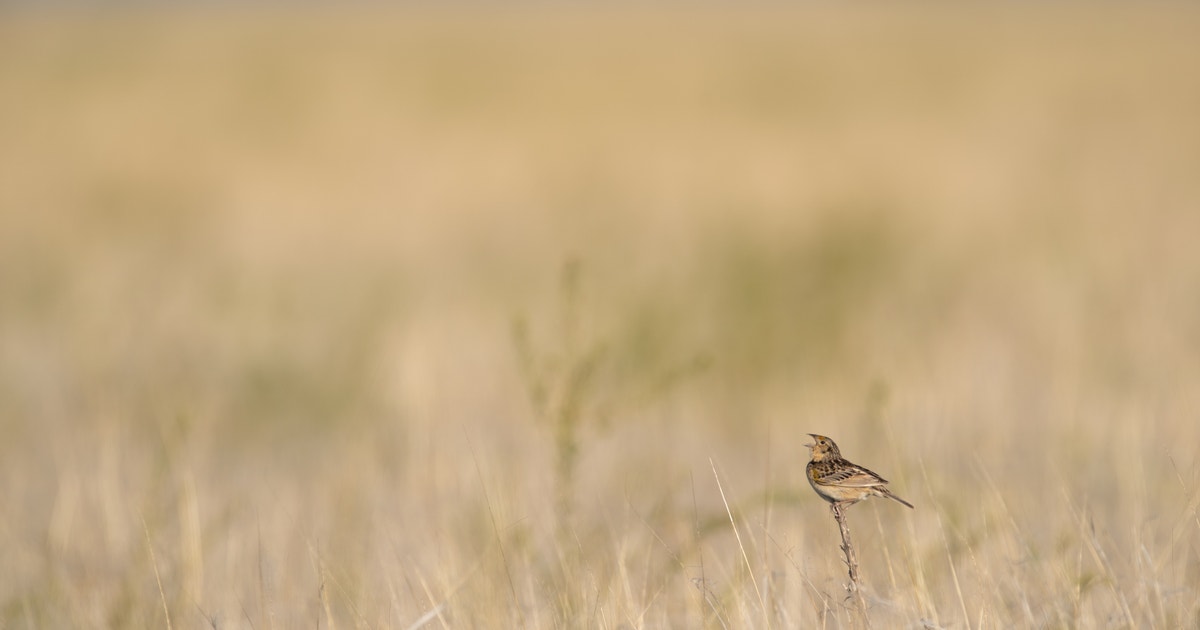
Native grasslands are among the most imperiled ecosystems in the world — and one of the least protected. Throughout the U.S., Mexico, and Canada, these critical ecosystems are dwindling at an alarming rate, as tracts are fragmented and degraded through unsustainable agricultural uses, proliferation of invasive plants, encroaching human development, and poor grazing practices. As a result, many birds and other wildlife are edging closer to severe population decline and even extinction.
Audubon aims to address these challenges through the conservation of focal bird species and the habitat they depend upon. We help the environment by helping birds. Since the vast majority of remaining grasslands are privately owned, we work with the farmers and ranchers that live and work on these lands. The Audubon Conservation Ranching Initiative is an innovative, market-based approach that connects conservation-conscious consumers to farmers and ranchers that employ bird-friendly management practices in raising their livestock.
In 2025, Audubon counts 15 participating ranches in Texas, spanning 178,000 acres of grasslands across the state. Fully certified ranches include: the Dixon Water Foundation’s Mimms Unit Ranch in Marfa, Bandera Grasslands in Hondo, C7 Ranch/Burgundy Beef in Grandview, the North Mason Unit in Mason, and ROAM Ranch in Fredericksburg.
Today we are speaking with three of our ACR producers, Jon Taggart of Burgundy Pasture Beef and Taylor Collins and Katie Forrest of ROAM Ranch. We’ll feature additional ACR producers in future conversations, such as Debbie and Don Davis of Bandera Grasslands and Chad Lemke of the North Mason Unit.
Audubon Texas spoke with three ACR producers: Jon Taggart of Burgundy Pasture Beef, and Taylor Collins and Katie Forrest of ROAM Ranch. We will feature additional ACR producers in future conversations, including Debbie and Don Davis of Bandera Grasslands and Chad Lemke of the North Mason Unit.
Editor’s Note: This interview has been edited for length and clarity.
Background and how you began conservation ranching?
Jon Taggart: We started our grass-fed beef operation around 1999. My family and I moved onto this ranch in 1995; at the time, 900 of the 1,400 acres had been plowed and were actively farmed. Beginning almost immediately, we worked to convert the farmland back to native grass. That conversion took about ten years.
We sold our first beef in 1999 and built a processing plant in 2004. For many years we distributed our meat by home delivery throughout the Dallas/Fort Worth metroplex, we home delivered for 17 years. We opened our first retail store in Fort Worth in 2014 and followed with a Dallas store in 2015. We started online sales early on alongside our home delivery service. Today our business looks quite different than it did eight weeks ago.
Taylor Collins: Katie and I are first-generation ranchers; we didn’t inherit agricultural land or even recreational property. We grew up in the city. Our move into ranching was driven by an interest in nutrition, health, and wellness, and by wanting to make a deep connection between soil health, land health, and the food we eat.
We discovered regenerative agriculture and soil-health principles early on. The work of Allan Savory influenced our approach and introduced us to holistically managed grazing and regeneration practices. Spending time on ranches that had long practiced these methods was life changing; it showed us how people can spend their lives restoring the land and serving their communities.
What does conservation ranching look like in your operation?
Taggart: For us, the biggest change was converting farmland back to native grass. Farming was not particularly profitable here, and as we restored grassland, we learned crucial lessons about biodiversity. Our inputs are minimal because native grasses largely sustain themselves: we don’t need fertilizers or herbicide sprays. We use high-intensity, short-duration grazing and maintain appropriate stocking rates and stock density to increase biodiversity. Over time, native grass and pollinators have flourished. When we arrived, there were virtually no deer or turkey; now wildlife is abundant.
Collins: We operate in a fairly brittle environment, so we must be intentional about capturing moisture and using rainfall effectively. Located in the middle of wine country surrounded by vineyards and orchards, many of which are monocultures, we want instead to restore the region’s former biodiversity. Our goal is to create an ecosystem that works with natural principles, mirroring nature rather than constantly opposing or trying to control it.
Benefits to the rancher and the animals?
Taggart: Because we manage cattle with low stress and through careful handling across the operation, animal health issues are minimal. Our protocol calls for no antibiotics and no added hormones; we haven’t administered antibiotics in years. If I had to give one, I wouldn’t even know where to find a syringe.
Collins: Being able to eat from the land we steward is important. Producing nutrient-dense food for ourselves and our community is deeply rewarding. More than anything, watching the land heal is the real return. In terms of production, we run higher stocking densities in pounds per acre than anyone else in our community. The more grass we grow, the more animals we can raise, which directly affects profitability.
Specifically, our bison herd: the first year three animals were born on the property; the next year 18 survived; and this year we expect more than 60 new calves. That growth reflects improved land health and the ability to nourish young animals.
Changes in wildlife populations and ecosystem function?
Taggart: Restoring grassland has substantially reduced soil erosion from previously plowed fields and improved water retention. During the drought from 2011 to early 2015, we did not need to reduce stocking rates or provide supplemental feed. Those outcomes reflect increased soil organic matter and the resilience of deep-rooted native plants, which are adapted to droughts, floods, freezes, and insect pressures.
We now have a mix of cool-season grasses and legumes paired with warm-season plants, allowing us to provide nutritious forage year-round with minimal inputs.
Collins: Katie and I grew up in Central Texas, and we are constantly identifying birds we have never seen before. Each year we see more wildlife and greater diversity. Mountain lions have returned to the property, which is encouraging given the important role predators play in ecosystem balance.
We’re also seeing diversity in plant biology: deep-rooted perennial grasses are re-emerging from seeds that had been dormant in the seedbed for decades despite prior plowing and spraying. Grassland birds are returning too, which has been rewarding to witness.
Forrest: There is also much greater diversity in insect species, which supports bird populations by providing abundant food.
Collins: A diverse insect community brings predator insects that help regulate pest species. Birds then help break parasitic life cycles in manure and act as natural debuggers for bison, contributing to overall herd health.
Favorite birds
Taggart: I miss the quail that were here when we arrived. I’d love to see them return. Quail require large areas of quality habitat, and we are surrounded by farmland, so their return might be a long shot — but they were present 25 years ago.
Collins: My top two are the Scissor-tailed Flycatcher and the Mockingbird. Mockingbirds are especially charismatic: they are territorial and fiercely protective of their nests, even chasing off larger birds of prey.
Forrest: I also admire the Scissor-tail, but lately I’ve been particularly interested in Black Vultures. They play an important but often underappreciated role in the ecosystem.
Why work with Audubon and the Conservation Ranching Initiative?
Taggart: Our partnership with Audubon gives us another avenue to tell the story of what limited-input, native-grass management can achieve. Looking at the Great Plains and how the land functioned historically provides a model to emulate. Biodiversity; insects, animals, and plants working together makes the land more productive. This partnership helps convey that conservation can coexist with, and even enhance, agricultural production.
Collins: We work with Audubon because it’s the right thing to do. As land stewards, our aim is to improve the property every day by emulating natural systems. Grassland bird species are underrecognized yet essential to ecosystem function. For a ranch to lack a habitat-management plan for these birds would be hard to imagine.
Forrest: Audubon is a reputable organization whose philosophy and knowledge base align with ours. Their expertise has provided guidance we could not have developed on our own.
These grassland bird species are some of the most under recognized, underappreciated, but also most critical parts of a healthy functioning ecosystem. And the list of ecosystem services they provide goes on and on. So to have a ranch or a farm that doesn’t have a habitat management plan for that animal that is so essential for land health, that was beyond fathomable for us.
Forrest: Audubon is the most reputable resource that also has a philosophical alignment with us, and a knowledge base that we couldn’t have obtained on our own.
