

By Wilmar Suárez
It is not enough to expand clean electricity generation if the rest of the system remains dependent on fossil fuels, writes Wilmar Suárez.
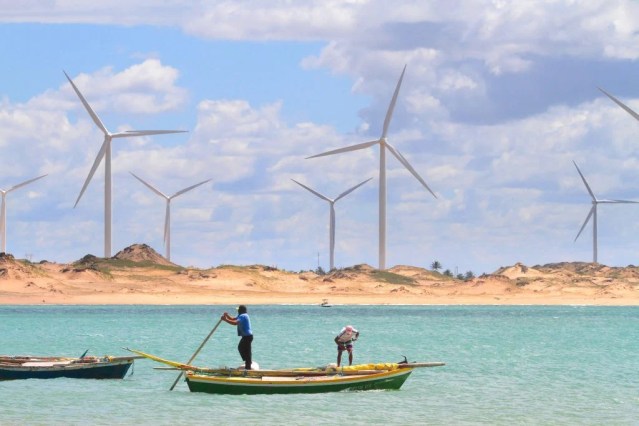
South America is emerging as a leader in the energy transition. Our flagship report at Ember, the Global Electricity Review 2025, found that 65% of electricity generated in South America and the Caribbean in 2024 came from clean sources – much higher than the global average, 41%.
For long-time observers, this will be no surprise. Many of the electrical systems in our region were developed over decades around hydroelectricity. Throughout the 20th century, large dams made it possible to meet a large part of the electricity demand. Now, solar and wind are coming to the centre stage amid the combined pressures of growing consumption, climatic phenomena such as El Niño, and reduced water availability.
However, despite these successes, there is still work to be done. It is not enough to expand clean electricity generation if the rest of the system remains dependent on fossil fuels, most of which are imported.
The region has an historic opportunity. But it needs to think beyond renewables and transform the wider energy system. Leveraging renewable generation to decarbonise other sectors of the economy can strengthen the energy independence of countries in the region, and reduce reliance on fossil fuels. This could save billions for Latin American economies, while providing cheaper and more secure energy for the public.
A Latin American success story
Countries such as Uruguay, Brazil and Chile have made particularly notable progress in terms of renewable generation.
Uruguay’s electricity generation is 95% renewable, mainly a combination of hydroelectric and wind power.
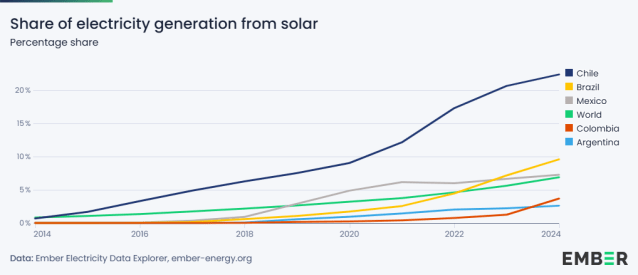
Brazil, the region’s largest economy, has increased its wind power generation fivefold in the past 10 years and its solar power almost sevenfold in the past five. Last August, wind and solar accounted for a third of the country’s monthly electricity generation for the first time. Chile, for its part, achieved a combined share of solar and wind generation of 34% and became the regional leader in battery energy storage with 1.8 gigawatts of capacity, driven by stable policies and a sharp drop in technology costs.
Chile and Brazil lead solar energy expansion in Latin America
Share of electricity generation from solar power
Untapped potential
Other major economies in the region, such as Argentina and Mexico, have also incorporated renewables over the past decade. But they have done so at a slower pace, reaching a share of around 13% for solar and wind power generation. Peru stands at 8% and Colombia at less than 4%.
In these economies, the story is one of untapped potential.
In 2024, more than half of Mexico’s electricity was generated with gas imported from the US. If it were to triple its renewable generation, it could reduce its need to import gas by around 20% and avoid spending some USD 1.6 billion annually on fuel import costs. Investment in renewable projects could also create more than 400,000 direct and indirect jobs, boosting local economies and providing development opportunities for communities that have often been marginalised by such schemes. This is a great opportunity for a country with one of the best solar resources in the world and the technical potential to supply 90% of its total electricity generation with solar energy and batteries.
However, as solar and wind generation reach higher levels of penetration, it is essential that the region’s electricity systems are prepared to take full advantage. This is where a political and regulatory environment must be created to bring “clean flexibility” into play: solutions such as battery storage, smarter electricity grids and better regional integration can ensure the renewable generation systems being installed can operate without technical restrictions.
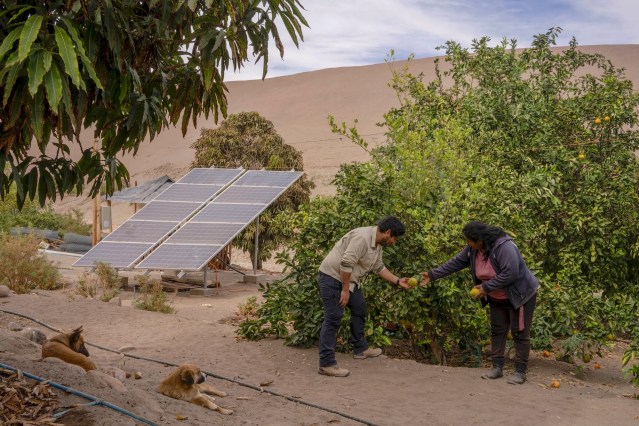
In Chile, where solar energy has the largest share of electricity generation – 22% in 2024, one of the highest rates in the world – significant efforts are being made to increase renewable generation alongside improvements in transmission and storage capacity. Currently, Chile finds itself in a situation where some of the solar power it is generating simply cannot be distributed or stored. According to data from Ember, for every percentage point that Chile manages to reduce its renewable energy curtailment – the practice of intentionally reducing energy generation when it exceeds demand – it could inject enough energy into the grid to meet the electricity demand of 120,000 households.
Renewables alone are not enough
Latin America and the Caribbean can go beyond renewables and reform the energy system as a whole. There are economic incentives to do so.
In Colombia, increasing energy efficiency in industry by 14%, electrifying 30% of water heaters and 10% of gas-powered household stoves could reduce gas imports by around USD 2 billion over 10 years. This shows the region can modernise and transform its energy systems, while generating significant savings and strengthening energy security.
The region can convert its clean energy leadership into direct benefits for its inhabitants, such as job creation, affordable electricity rates, increased levels of energy access and the development of local industries.
To do this, countries must put their people at the centre. For example, including local participation in renewable projects, ensuring quality working conditions and promoting regional development. By doing so, clean energy and electrification become the levers for reducing inequalities and driving transformative social and economic development.
Wilmar Suárez is the Latin America energy analyst at Ember, an energy thinktank.
First published in Dialogue Earth.
Discover more from A greener life, a greener world
Subscribe to get the latest posts sent to your email.
