

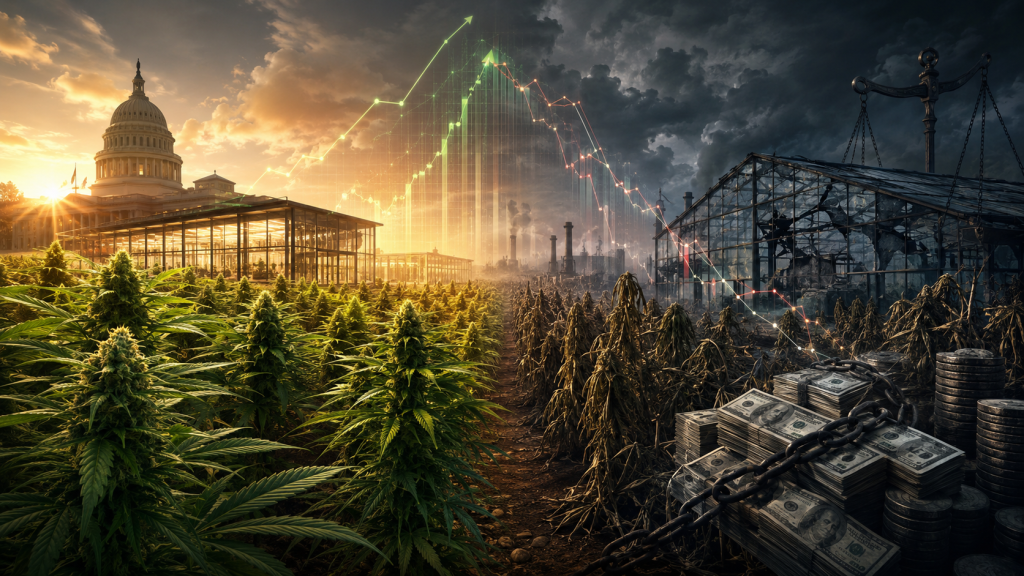

In November 2016, four states legalized adult-use cannabis on a single night, including California. The industry believed federal reform was two or three years out.
Ten years later, federal reform has arrived — partially, through an administrative order rather than legislation, covering medical cannabis but not adult-use. The banking bill written in 2019 is still in committee. And the industry that spent a decade waiting for Washington discovered that its real problem was arithmetic: too much supply, not enough legal demand.
This is what actually happened, and what comes next.
2016–2019: The Green Rush
The 2016 election was the industry’s high-water mark for momentum. California’s Proposition 64 passed alongside adult-use measures in Massachusetts, Maine, and Nevada, and medical measures in Florida, Arkansas, and North Dakota. Florida became the first Southern state with a full-scale medical program. North American legal cannabis sales hit roughly $6.7 billion in 2016, up 34% year over year, and reached about $9.2 billion in 2017.
Two federal developments defined this stretch, pulling in opposite directions.
In January 2018, Attorney General Jeff Sessions rescinded the Cole Memo, the Obama-era guidance that had told federal prosecutors to deprioritize state-legal cannabis. Nothing much happened enforcement-wise, but it reminded everyone that state legality was a policy choice, not a legal right.
Then in December 2018, the Farm Bill legalized hemp — defined as cannabis with no more than 0.3% delta-9 THC by dry weight. That definition, drafted narrowly, accidentally opened the door to an entire universe of other cannabinoids: delta-8, delta-10, THCA, HHC. Nobody understood the implications at the time. They would matter enormously.
Capital poured in. So did legislation that went nowhere. The SAFE Banking Act was introduced in March 2019, cleared the House Financial Services Committee 45-15, and passed the full House in September 2019 — the first of what would become seven House passages, none of which ever received a Senate floor vote.
2020–2021: COVID Was the Accelerant
The pandemic did more for cannabis normalization in eight weeks than the previous eight years of advocacy.
When stay-at-home orders arrived in March 2020, every state with a regulated cannabis system allowed sales to continue in some form, deeming cannabis businesses essential alongside groceries and pharmacies. California’s order explicitly covered medicinal dispensaries. It was, as coverage at the time noted, official recognition that for a meaningful number of Americans, cannabis sits in the same category as milk and bread.
The sales response was immediate. Headset data showed California legal cannabis sales up 159% on a single day in March 2020 compared to the same day in 2019. Washington state sales jumped 33% in a day. Colorado, Oregon, Alaska, and Nevada all spiked. Later peer-reviewed analysis confirmed that mean monthly sales in Washington, Oregon, Alaska, and Colorado ran higher throughout the 2020 pandemic period than in 2019.
The numbers for the full period tell the story: U.S. legal cannabis sales reached roughly $17.5 billion in 2020 and about $25 billion in 2021. Employment went from 211,000 jobs in 2019 to 243,700 in 2020, then added another 77,300 in 2021 and 107,059 in 2022, peaking around 428,000.
Legalization accelerated too. Arizona, Montana, New Jersey, and South Dakota passed adult-use measures in November 2020. New York, Virginia, New Mexico, and Connecticut followed by legislature in 2021.
Two things are worth naming honestly about this period. First, the essential-business designation was a genuine political turning point — it is very hard to argue a product is uniquely dangerous after your state has classified its retailers as critical infrastructure. Second, the sales surge was partly a stimulus-and-lockdown artifact, and the industry built capacity as though it were a permanent demand curve. That misread is the root of most of what followed.
2022–2024: Federal Momentum, Federal Stalemate
The Biden administration’s cannabis record is genuinely contested, and it’s worth laying out the sequence rather than the spin.
October 6, 2022: President Biden pardoned federal simple-possession convictions and directed the Secretary of Health and Human Services and the Attorney General to review how marijuana is scheduled under federal law. This was the first presidential directive of its kind.
August 29, 2023: HHS completed its review and recommended moving marijuana to Schedule III, finding a currently accepted medical use and lower abuse potential than Schedule I or II substances.
April 2024: The DOJ Office of Legal Counsel advised that HHS’s scientific and medical findings were binding on the DEA prior to rulemaking.
May 21, 2024: DOJ published a Notice of Proposed Rulemaking to move marijuana to Schedule III — while noting the DEA had not reached its own determination.
Then it stopped. An administrative hearing was scheduled, a request for interlocutory appeal was granted, and the matter was stayed pending review by the DEA Administrator. Procedural litigation consumed most of 2025. The NPRM was never finalized.
Supporters describe this as historic: the first serious federal reassessment of cannabis scheduling in fifty years, and it produced a formal scientific finding that cannabis has medical value. Critics point out that four years of process ended with marijuana still in Schedule I, no banking legislation, and a rulemaking stalled in its own agency’s hearing apparatus. Both descriptions are factually accurate. Which one matters more depends largely on whether you were running a business during it.
Congress didn’t fill the gap. The retooled SAFER Banking Act cleared the Senate Banking Committee 14-9 in September 2023 — further than any Senate version had ever gone — and then died without a floor vote.
Meanwhile, the economics turned. Oversupply and price compression took hold across mature markets. In November 2024, Florida’s Amendment 3 drew 57% support and failed anyway, short of the state’s 60% threshold, ending the industry’s best shot at a major Southern adult-use market. Hiring fell 21.9% in 2024 compared to the prior year. Active U.S. cannabis business licenses contracted more than 10% over two years.
2025–2026: Executive Action, and a Hemp Reversal
The last eighteen months produced more federal movement than the previous nine years — some of it in directions nobody in the industry wanted.
November 12, 2025: The appropriations act that ended a 43-day government shutdown included Section 781 (P.L. 119-37), which redefines hemp using a total-THC standard capped at 0.3% by dry weight, caps finished consumable products at 0.4 mg total THC per container, and excludes synthesized cannabinoids. The 2018 Farm Bill loophole closed. Effective date: November 12, 2026.
The U.S. Hemp Roundtable estimates this would eliminate roughly 95% of existing hemp cannabinoid products — an industry worth about $28 billion supporting roughly 300,000 jobs. Industrial hemp for fiber, grain, and building materials is untouched.
December 18, 2025: President Trump issued an executive order directing the Attorney General to expedite rescheduling and expand lawful access to hemp-derived CBD.
April 23, 2026: Acting Attorney General Todd Blanche signed a final order — effective April 28 — moving marijuana in FDA-approved drug products and marijuana under a state medical marijuana license from Schedule I to Schedule III. Section 280E no longer applies to state-licensed medical operators. Adult-use cannabis stayed in Schedule I.
June 24–25, 2026: The SAFE Banking Act was refiled in both chambers — S. 4942 (Merkley) and H.R. 9471 (Joyce) — and referred to committee.
June 29–July 15, 2026: A formal DEA hearing before Chief ALJ Derek Julius took 17 days of testimony on whether marijuana more broadly should move to Schedule III. In an unusual posture, the DEA argued for rescheduling while all seven outside designated participants opposed or doubted it.
Where the Industry Actually Stands
Legal cannabis sales ran roughly $14 billion in the first half of 2026, on pace for close to $30 billion for the year. Estimates vary by methodology — some analysts put 2025 at $31.3 billion and others at $33.8 billion — but the trend is consistent: modest growth, unevenly distributed.
Underneath that, the correction is real. Whitney Economics estimates U.S. legal production capacity could satisfy roughly 600% of legal demand, and that only about 27% of operators turned a profit in 2024. The U.S. Cannabis Spot Index sat near $1,015 per pound in April 2026, down 6.8% year-to-date, after bottoming at $888 in January 2025. Wholesale prices are down roughly 32% since 2021. Retail gross margins compressed from 52.6% in 2021 to 42.7% in 2025. More than $3.8 billion in overdue payments are circulating through the supply chain. In 2025, the industry shed jobs for the first time.
Growth is bifurcated. New York, Ohio, Maryland, New Jersey, Minnesota, and Delaware are posting strong gains. California, Colorado, Washington, and Oregon are contracting 4–9%. Oregon has an estimated three million pounds of unsold flower in storage.
And banking, the thing everyone waited a decade for, remains partial. Roughly 800 to 850 depository institutions file cannabis-related SARs, up from about 633 in 2019 — but the 2014 FinCEN guidance still governs, Bank Secrecy Act obligations still apply, and as of July 1, 2026 no federal banking agency had issued cannabis-specific guidance revised for the post-Schedule III world.
Looking Forward
Near-term, watch four dates and one docket.
August 17, 2026 — post-hearing briefs are due in the DEA rescheduling proceeding. After that, Judge Julius issues a recommendation and the DEA Administrator decides. There is no statutory deadline for either step, and a consolidated challenge to the April order is pending in the D.C. Circuit. If adult-use cannabis reaches Schedule III, 280E relief extends to the whole industry, and the split-schedule problem facing dual-license operators disappears.
November 12, 2026 — the new hemp definition takes effect absent congressional action. Delay bills exist (H.R. 7024 and S. 3686 would push it to 2028) but neither has cleared its chamber. This is the single largest near-term cliff in either industry.
November 2026 midterms — a Massachusetts ballot campaign would repeal that state’s adult-use legalization, the first serious rollback attempt anywhere. Pennsylvania remains the most likely next adult-use state. A group of House Republicans is reportedly preparing a descheduling bill ahead of the elections.
Committee calendars — SAFE Banking sits in three House committees. Historically, that is where it stops. The Cannabis Administration and Opportunity Act was refiled July 16, 2026 with 17 sponsors; the MORE Act has reached 75, all Democrats; the bipartisan STATES 2.0 Act would exempt state-legal activity from most federal enforcement without full descheduling. None has been enacted.
Longer-term, the honest read is this. The federal barrier that dominated a decade of industry strategy is coming down slowly and partially. But the binding constraint has changed. Descheduling tomorrow would not fix oversupply, would not restore wholesale prices, and would not save operators who built cultivation capacity for a demand curve that never materialized. It would help — meaningfully, especially on taxes and capital access — but it would help a smaller, more consolidated industry than the one that spent 2019 lobbying for it.
What the Decade Taught
Three things, mostly the hard way.
Crisis moves policy faster than advocacy. A pandemic did more for cannabis legitimacy in two months than a decade of lobbying, because essential-business designations forced a category decision that no legislature wanted to make.
Executive action is faster than legislation, and less durable. The single biggest federal change of the decade came by administrative order in April 2026, not by any of the bills written for the purpose. It is also the change most exposed to reversal — which is exactly what the D.C. Circuit litigation is about.
Legal status was never the whole business model. The industry treated federal prohibition as the thing standing between it and profitability. It turned out that license caps, tax structures, cultivation capacity, and consumer price sensitivity mattered at least as much. The states that legalized without limiting supply produced the worst economics, regardless of what Washington did.
Ten years in, cannabis is a real industry with real revenue, real employment, and real distress — no longer a policy question waiting on a vote. That is progress. It is just not the progress anyone was predicting in November 2016.
Sources
- Congress.gov — Department of Justice Eases Control of Medical Marijuana (CRS)
- Congress.gov — Change to Federal Definition of Hemp (CRS)
- Congress.gov — Marijuana Banking: Legal Issues and the SAFE(R) Banking Acts (CRS)
- DEA — Marijuana Rescheduling Regulatory Actions
- DEA/HHS — Basis for the Recommendation to Reschedule Marijuana
- Moritz College of Law — Federal Marijuana Rescheduling timeline
- ABC News — Cannabis shops as essential businesses during the pandemic
- University of Washington ADAI — Cannabis sales increases during COVID-19
- Ballotpedia — Florida Amendment 3 (2024)
- MJBizDaily — Legal cannabis industry sheds jobs for first time
- MJBizDaily — Oversupply and price compression worldwide
- The Marijuana Herald — U.S. cannabis sales, first half of 2026
- Vicente LLP — Cannabis Rescheduling Explained
- ArentFox Schiff — Executive action revives federal rescheduling efforts
VIEW LISTING: The Decade That Legalized Cannabis and Nearly Broke It: 2016 to 2026.
