

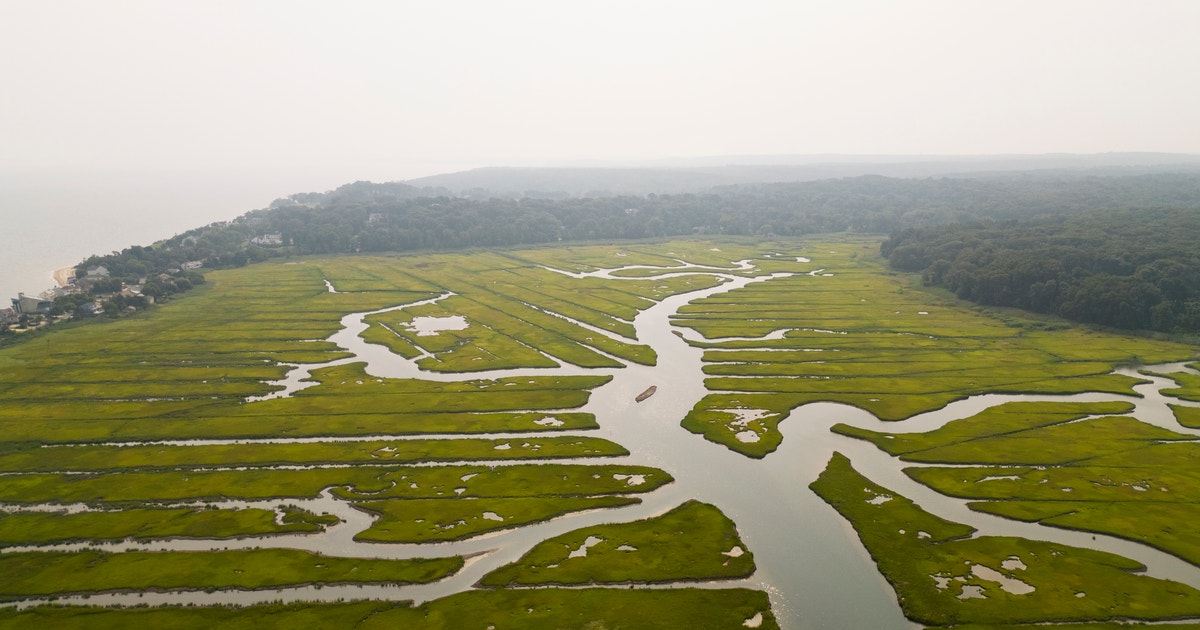
What happens when humans accidentally create a superhighway for crabs in a salt marsh? Audubon staff joined researchers from Stony Brook University at Crab Meadow marsh (Town of Huntington, Long Island) to find out.
The story starts in the early 1900s, when “mosquito ditches” were popularized up and down the Atlantic Coast. Mosquito ditches are long trenches that crisscross a salt marsh. They were meant to drain the marsh of water and control mosquitos, but the practice was eventually abandoned.
What lasted was their impact – mosquito ditches alter the natural movement of water in and out of a salt marsh, impacting the health of the habitat. At Crab Meadow, the mosquito ditches act like superhighways for crabs, giving them easy access to the marsh interior where they dig burrows and disturb plant roots along the ditch edges, further destabilizing the marsh.
Along these mosquito ditches, the Stony Brook University research team is studying how crab burrowing impacts the flow of nutrients through the marsh.
Nutrients like nitrogen enter the marsh from surface run-off, groundwater seepage from septic systems, and from the atmosphere. Excess nutrients can limit root growth of marsh plants, and we need healthy marsh plants to keep Crab Meadow stable – think of the plants’ root systems as a tapestry that holds the soil together.
The research team is measuring nutrient concentrations, greenhouse gas fluxes, sulfide levels (a byproduct of anaerobic respiration that can stress plants), and crab burrow density. Their measurements will shed light on why the ditches at Crab Meadow have been drastically widening over time and how crab burrows might be contributing to this issue.
But ditches and nutrient pollution are only part of the problem. Together, they limit the ability of marshes to withstand sea level rise. Increased flooding on the marsh surface causes the plants to become stressed. Over time, the plants die and pools of open water form between the linear mosquito ditches. This pooling can be observed throughout the eastern portion of Crab Meadow marsh, and it is expected to worsen due to increasing rates of sea level rise.
Audubon and our partners at the Town of Huntington and USFWS Coastal Program are gearing up for an exciting refresh at Crab Meadow marsh, and the information collected at the site will help inform our design plan for restoration.
The primary goals for restoration are to make the marsh more resilient to sea level rise and to improve habitat for birds like the Saltmarsh Sparrow. This intriguing species nests only in the higher portions of the marsh that are infrequently flooded. Their nesting is timed with the tidal cycle, so that chicks fledge before the highest spring tides every month. Habitat loss due to sea level rise, development, and invasive species has critically imperiled this species, with some researchers predicting extinction by 2050. Restoration projects like this will hopefully reverse this decline and have benefits for Seaside Sparrows, Clapper Rails, Willets, Ospreys, and other bird species as well!
