

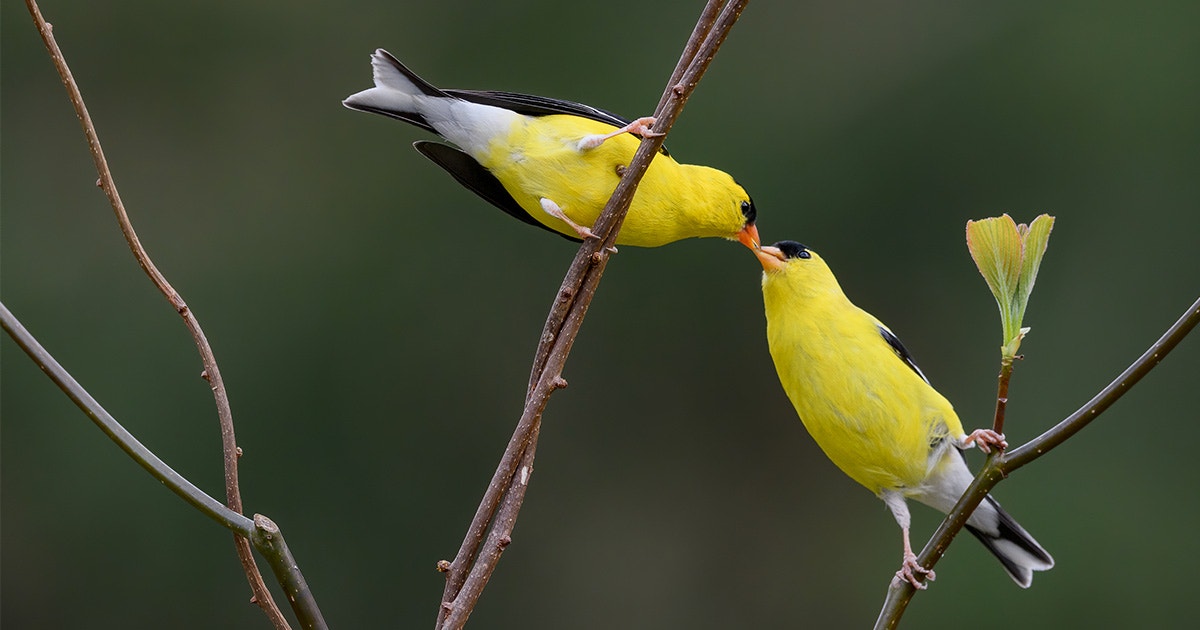
The male American Goldfinch, dressed in sunny yellow, brightens every feeder he visits during the spring and summer months. And he visits many, seeing as the American Goldfinch is the most common species of goldfinch in the United States (there are three), with a range covering much of the United States year-round. Plus, because they’re a sucker for seeds, it’s easy to attract these birds with the right spread.
American Goldfinches might be known for their golden plumage, but they’re much less recognizable in their winter wardrobe. The difference between their two looks is so stark that you might not even realize you’re feeding the same individuals throughout the year. So read on to learn more fun facts about these cheery chirpers, including how to identify them at their least flashy.
1. Hold the bugs—American Goldfinches are almost entirely vegetarian. This is rare in the songbird world, where even species with seed-based diets rely on insects to get their protein when they’re young. Goldfinch nestlings, however, can survive on mostly seeds, with the occasional insect mixed in.
2. This reliance on seeds protects finch chicks from the trickery of Brown-headed Cowbirds, who lay their eggs in other species’ nests. After hatching, young cowbirds often out outcompete their nestmates for food brought by the adults, thanks in part to extra strong neck muscles. But because cowbirds can’t survive on seeds alone, they tend to die in American Goldfinch nests.
3. American Goldfinches can reliably be found around thistle plants, which provide their absolute favorite seed, but you can attract them to your feeder with a similarly-shaped seed called Nyjer. Most tube feeders designed for Nyjer have perches above and below the eating holes to allow the birds to eat upright or inverted, which they often do when foraging for thistle seeds.
4. Nesting happens during the dog days of July and August, one of the latest starts to the nesting season of any North American songbird. This timing likely allows them to take advantage of thistle seeds that are most abundant during peak summer. In addition to eating the seeds, goldfinches use thistle down to build their nests. They weave it together with spider silk to create such tightly-knit structures that they’ve been known to hold water.
In addition to eating the seeds, goldfinches use thistle down to build their nests
5. American Goldfinches are very vocal, frequently calling out while in flight. Keep an ear out for their four-syllable call with an even cadence that sounds like po-ta-to-chip or per-chick-or-y. They time their chirps with their flight pattern, which can be easily identified by its bouncy shape: a dip down, a zip back up. They vocalize on the “up” bits.
6. All that potato-chipping may sound the same to us, but goldfinches, along with several other types of finches, seem to be able to recognize differences in individuals’ flight calls. Once mates pair up, they begin to make nearly identical calls. Goldfinches tend to travel in flocks, so researchers believe the couple’s shared tune may allow them to find each other or be recognized as a unit by their peers.
7. American Goldfinches molt their body feathers twice a year. In late winter they put on their yellow gear, which brightens throughout the spring and heralds in the season alongside the daffodils. Then, in the fall, they turn a smudgy brown, as do females (they’re a less vibrant yellowish-green during breeding season). To identify them during their non-breeding periods, look for their mostly black wings with thick white or cream wing bars.
8. Their dramatic seasonal shift goes beyond plumage: Both male and female American Goldfinches take on a cheerful orange beak during breeding season. Research suggests that a brighter bill makes a female more respected within a flock. When it’s off-season, male and female bills fade to a dark gray color.
9. What do New Jersey, Iowa, and Washington have in common? All of them celebrate the American Goldfinch as their state bird—but none of them use that name. New Jersey and Iowa call their state bird the Eastern Goldfinch; Washington claims the Willow Goldfinch. They’re all the American, though. The names refer to subspecies on the Pacific and Eastern coasts.
10. American Goldfinches are partially migratory—many stay in roughly the same area, moving around a general region. But those populations in Canada and northern states that do move farther south avoid regions where the average minimum January temperature is 0 degrees Fahrenheit, according to a 1988 study. Which, honestly, fair enough.
