

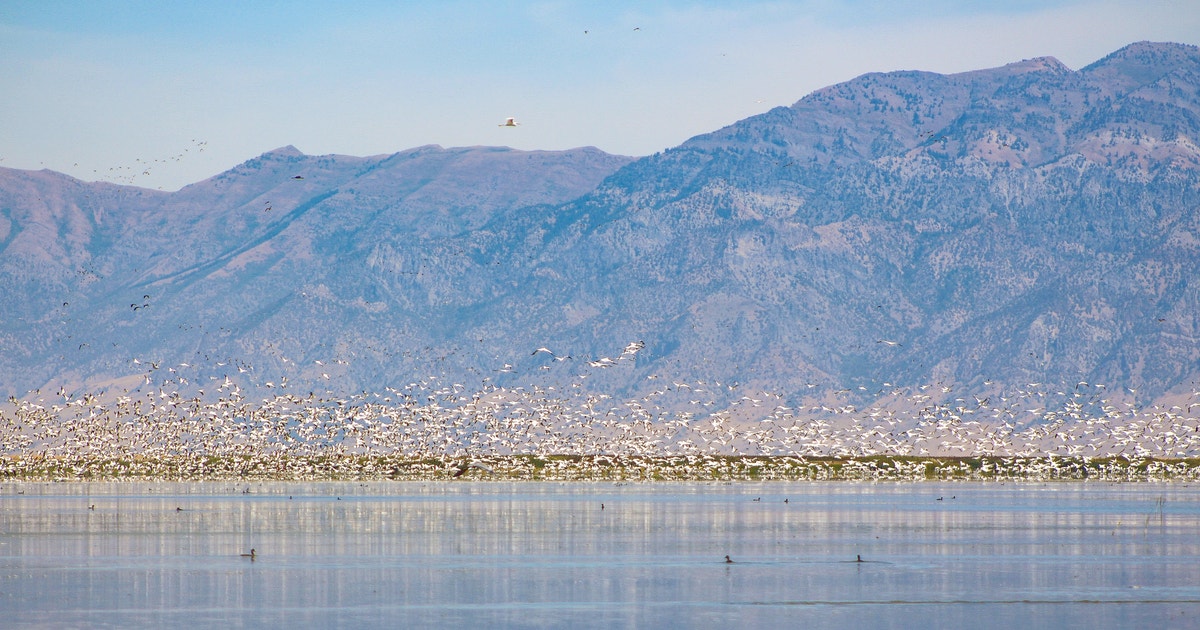
Below-average runoff and persistent drought are driving water levels close to record lows once again at Great Salt Lake. These conditions serve as a stark reminder that preserving the lake and its wetlands is a continuous endeavor—one that will take collective action and partnership every year. Great Salt Lake provides irreplaceable habitat and is a key nesting, breeding, and stopover point for some 12 million migratory birds annually, representing 339 species. Audubon continues to champion solutions for the lake and to work with decision-makers to support management tools and options that employ flexibility and adaptability to changing conditions, in addition to much-needed investments in the lake’s health.
Recognizing the need for continued action, several new tools and policy levers are now being implemented. These recent policies and commitments build on the solution-oriented programs that Audubon continues to prioritize and are important steps forward as we continue to face drought and greater pressure on Utah’s water systems. Partnership, innovation, and funding will continue to be the most important tools we have as we work together to get Great Salt Lake back to healthy levels.
Other statewide highlights include:
Great Salt Lake Distribution Management Plan
Following legislation passed in 2024, the state implemented a plan to manage lake mineral extraction that evaporates water to produce mineral salts. This program has multiple components, including voluntary agreements with many mineral producers to reduce their water consumption in relation to lake levels. As a part of that same legislation, the Utah Division of Water Rights adopted the Great Salt Lake Distribution Management Plan (Plan) to manage and account for the lake’s water.
Incorporating aspects of Utah’s water rights system and the mandate for sovereign lands management authority, the Plan relies on “principles of prior appropriation and multiple use sustained yield in relation to the reasonable preservation or enhancement of the Great Salt Lake’s natural aquatic environment.”
The framework of the Plan regulates how water is measured, allocated, and distributed among water rights at the lake. This includes Great Salt Lake water rights held by companies for mineral production from the lake, as well as ”dedicated water,” which are water rights put to beneficial use at Great Salt Lake relying on the instream flow policy changes made in 2022. Mineral extraction water rights will be managed by priority, the terms of voluntary agreements, and in relation to lake levels. Importantly, dedicated water, including water transacted by the Great Salt Lake Watershed Enhancement Trust, which is co-managed by Audubon and The Nature Conservancy, and its partners is protected from mineral extraction and will remain in the lake year after year, subject to reductions for some evaporation. The Plan also introduces the “Great Salt Lake Distribution Accounting Tool” that tracks lake elevation, salinity, water rights, dedicated water delivered to or held in the lake, and other related metrics.
By limiting withdrawals for mineral extraction as lake levels decline, and by protecting water dedicated for use in the lake, the Plan is designed to help protect ecological health by preserving salinity balance, wetlands, habitats, bird populations, and reducing exposed lakebed that contributes to dust pollution. It also provides a new level of clarity and transparency for mineral companies so they can plan their business operations in the face of fluctuating lake levels.
2025 – 2035 Utah Wildlife Action Plan Prioritizes and Protects Great Salt Lake
Utah’s recently adopted 2025-2035 State Wildlife Action Plan—the state’s official guide to protecting and conserving wildlife and their habitats—incorporates a wide range of updates, including a new focus on saline lakes and species that depend on them.
The new elements that directly connect statewide conservation priorities to the health of Great Salt Lake include:
- Great Salt Lake is now recognized as a key aquatic habitat
- Brine flies, which are a key food source for many birds and species of migratory birds, such as American Avocet, Wilson’s Phalarope, Snowy Plover, and other species have been added as a species of greatest conservation need
- Microbialites—the foundation of microbial mats that support brine fly larvae—are now included as one of 14 terrestrial key habitats
With the 2025 update, the state of Utah is taking important steps forward, acknowledging the threats facing Great Salt Lake and the species that depend on it and focusing efforts on its conservation and protection.
Increased Flexibility for Berm Management
In October, the Utah legislature adopted policy changes to provide greater flexibility for state officials to protect the lake’s vital South Arm (Gilbert Bay) ecosystem, while still preserving Gunnison Bay—the North Arm of the lake. Now, Utah’s Division of Forestry, Fire and State Lands has greater flexibility to manage the causeway berm that separates the North and South Arms of Great Salt Lake, specifically to control how water and salt move between the lake’s North and South Arms.
Managing the flow between these arms is essential in keeping the lake’s ecosystems healthy. Adaptable berm management is especially important during dry years when water levels are low. Without the ability to adjust the berm, parts of the lake could become either too salty or, at times, not salty enough, causing ecological harm—such as declines in brine shrimp reproduction. Low water levels can expose and dry-out microbialites, which are rock-like formations that provide the structural foundation for microbe mats. These systems are prevalent along the lake’s shallow edges and are essential for brine fly reproduction. Many bird species that rely on the brine flies and brine shrimp or their cysts can become vulnerable with the loss of important food and energy sources during spring and fall migration periods. With this policy change, state managers can respond quickly and responsibly to changing lake conditions, helping to protect the lake’s delicate balance and avoid long-term environmental damage.
Great Salt Lake 2034 Charter and Funding
In the past few months, Utah state leaders, including Governor Cox, Senate President Adams, House Speaker Schultz, and Congressman Moore joined with business executives, philanthropists, conservation organizations—including National Audubon Society and The Nature Conservancy—and others to discuss the future of Great Salt Lake and its wetlands and pledge to restore and protect the lake for generations to come through the Great Salt Lake 2034 Charter.
The signing of the Great Salt Lake 2034 Charter marks a significant public commitment to protect the lake and its wetlands and calls for Utahns to join the rally to restore the lake’s health by 2034, protecting it for generations to come.
Funders pledged a $200 million commitment to support long-term, solution-driven efforts for Great Salt Lake.
Such commitments, combined with $53 million in open funding opportunities—$50 million from the Great Salt Lake Commissioner’s Water Delivery Program and the remaining $3 million from the Great Salt Lake Watershed Enhancement Trust and the Utah Division of Forestry, Fire and State Land’s Wetland Protection and Restoration Program—provide a needed boost for diverse projects and solutions in the Great Salt Lake basin.
The significant level of commitment from a range of partnerships serves as another step forward toward addressing the urgency of the challenges facing Great Salt Lake.
