

As a professional hawk counter, David Brown has seen a lot of raptors—and fantasized about even more. “You’re always dreaming about some of the rare stuff that might show up,” Brown says.
On the damp, gloomy morning of November 19, though, he would have happily taken a Red-tailed Hawk. There were hardly any birds migrating past Delaware’s Ashland Nature Center, where Brown spends the fall monitoring hawk movements to collect long-term population data; he tallied only eight individual raptors in more than four hours of observation.
That made it all the more surprising when he received a rare bird alert late that morning in a group chat. At an industrial park near the port in nearby Wilmington, Lauren Morgens, captain of the replica tall ship Kalmar Nyckel and an avid birder, had photographed a Yellow-headed Caracara, a gangly raptor native to open marshes and grasslands across much of South America. It was the first East Coast sighting of the species north of Florida and one of only a handful of records in the history of the United States.
“This bird flew by, and I knew immediately what it was in the first millisecond,” Morgens told the Birding Community E-Bulletin. “And the second millisecond, I thought ‘that’s absolutely impossible.’”
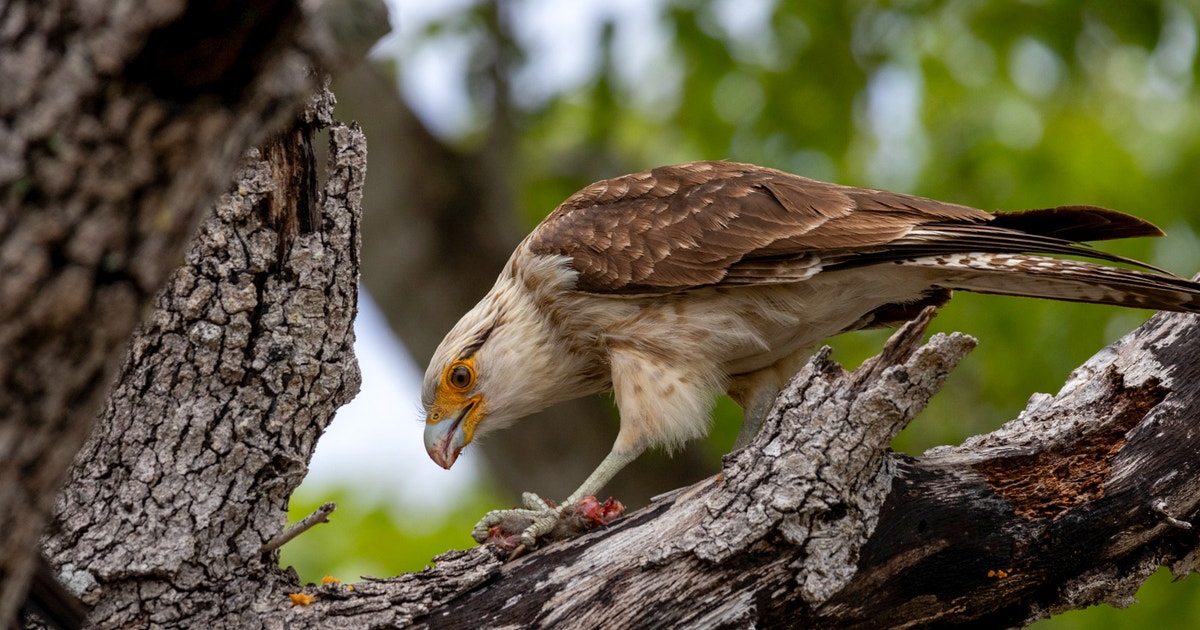
Brown says he quickly made the “executive decision” to shut down the hawk count for the day, and within an hour, he joined the crowd of giddy observers scattered across the shipping yard. At the center of the fray stood a medium-sized, cream-colored raptor with a dark mantle, a long black-and-white tail, and a pinkish face. Despite being thousands of miles north of its expected range, the caracara seemed right at home. It even appeared eager to explore the local cuisine, running across the roof of a Philly cheesesteak meat manufacturer on its strong gray legs.
Even Brown—ever the dreamer—was floored. “Yellow-headed Caracara never crossed my mind as something I might come across,” he says. “Before seeing this bird, I wouldn’t have known what the field marks were or what they looked like.”
Brown isn’t alone. Until very recently, the species was a seeming impossibility for North American birders. Closely related to the larger Crested Caracara of the southern United States and more distantly linked to falcons, the Yellow-headed Caracara is known as a more southerly species, a resident common from Panama to Uruguay. There is a good reason the omnivore is omitted from every North American field guide: Prior to 2022, it had never been confirmed north of Guatemala. (Earlier sightings occurred in California and North Carolina, but those birds were deemed escapees from captivity.)
In the past few years, however, the species seems to have been gripped by newfound wanderlust. The wave began when a single observer photographed a brown-spangled immature caracara near Miami in November 2022—an eye-opening record, but one largely dismissed as a one-off curiosity. But then came a sighting from California. And Texas. And several more from Florida. And now, Delaware. Today, it feels that the next caracara could appear at any place, at any time.
Today, it feels that the next caracara could appear at any place, at any time.
This influx may seem to have occurred practically overnight, but the spate of sightings continues a decades-long northward range expansion taking place well south of the Rio Grande, says Audubon field editor Kenn Kaufman. Since the 1970s, he notes, Yellow-headed Caracaras have slowly crept up across Central America from their historic range in Panama, expanding hundreds of miles north into Nicaragua and Honduras. More recent records in southern Mexico, Jamaica, and the Dominican Republic indicate that the birds continue to wander.
What is behind the expansion? Kaufman suspects a common cause: newfound access to suitable habitat. “Yellow-headed Caracara is an open-country species, and I’m sure the clearing of forests in Central America had something to do with its spread,” he says. Such habitat alteration has proved a boon to other species like the White-tailed Kite, which has flourished as woodlands have been converted into agricultural lands across the Americas.
Wherever caracaras roam, they shouldn’t have trouble finding plenty to eat. The species has a remarkably diverse diet. Smaller birds, fish, insects, road-killed crocodiles, horse dung, garbage—if it can fit in the bird’s bill, it’s probably dinner. Yellow-headed Caracaras are as comfortable snacking on fruit and corn—an unusual behavior among raptors—as they are perching on cattle and capybaras to feed on ticks, or even picking flesh from an open wound on a cow’s back. With such egalitarian tastes, caracaras are well-equipped to persist wherever they find themselves.
Should trends continue, it seems plausible that Yellow-headed Caracaras may one day become somewhat more regular visitors to the southern United States. In the near term, though, sighting of the species will likely remain rare. Fortunately for hopeful observers, several of the caracaras have proven quite comfortable in their new homes: Individuals in Texas and Florida have each stuck around for well over a year and continued to be sighted into late 2025.
The Delaware bird was less persistent, vanishing after only a few days. Still, the record is a reminder that the long-necked, broad-winged, wedge-tailed raptor could materialize anywhere. Hopeful birders may want to focus their efforts around shipping ports and coastal regions, which seem to be magnets for the wanderers—perhaps an indication that some may be hitching rides on northbound ships. But with the unpredictability of the push, any patch of open space or sky just might do.
Hawk counter Brown has learned that lesson. “I wouldn’t have high hopes to get one,” he says. “But it’s certainly on the list of possibilities.”
