

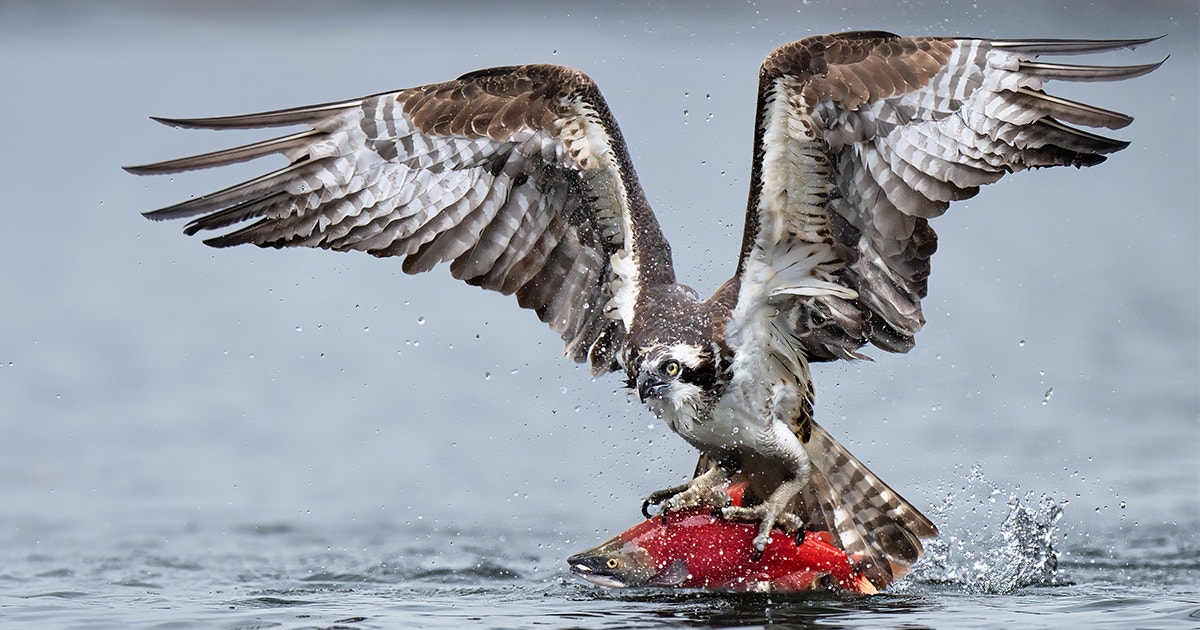
If you ever find yourself at a river’s bank, a lake’s edge, or an ocean’s coast, keep an eye out for one of nature’s most skilled fishers—the Osprey. Distinguished by its bright yellow eyes and M-shaped wingspan, this bird of prey can be found around the world just about anywhere fish live. In North America they breed from coast to coast and—aside from some year-round resident birds in South Florida—migrate to warmer regions in the non-breeding season, from the Gulf Coast to South America.
Human activity can help or harm all avian species, but few birds indicate our influence as clearly as Ospreys do. People have placed these beautiful birds in peril before, and our actions today still put them at risk. But if the past has anything to teach us, it’s that we have the power to protect Ospreys today and tomorrow. Read on to discover why these remarkable raptors deserve our devotion.
1. Ospreys occupy every continent but Antarctica. Scientists divide them into four subspecies, only two of which migrate. One generally breeds in Europe and Asia and spends the winters mainly in Africa and southern Asia, while the other breeds in North America and escapes the cold by migrating as far as South America. The other two subspecies favor a non-migratory lifestyle, one in the Caribbean and the other in and around Australia.
2. No matter where they live, all Ospreys share an obsession with seafood. Altogether, North American Ospreys eat around 80 fish species, which comprise some 99 percent of their diet. In the right weather conditions they can catch fish on three-fourths of their dives. Even William Shakespeare noted how adept the birds are at seizing their prey. Describing how the titular general of his play Coriolanus conquers his enemies, the Bard wrote: “I think he’ll be to Rome / As is the osprey to the fish, who takes it / By sovereignty of nature.”
3. Ospreys boast several adaptations that make them such fearsome hunters. Using their keen eyesight to spot their prey from above, they dive down and extend their long legs just before hitting the water, which allows them to grasp fish up to a meter deep. During a dive, they shut their nostrils to keep water out, and they use a third eyelid, called a nictitating membrane, like a built-in pair of swim goggles. Their especially well-developed preen gland waterproofs their feathers, preventing their plumage from getting waterlogged.
4. Ospreys won’t let a good meal get away. Barbed pads on their toes grip fish in place, and their reversible outer toes can point forward or backward for a stronger grasp. After emerging with their prized possession, they point it facing forward in an aerodynamic position, perfect for helping remove wind resistance as they fly back to a perch to snack on their catch—or back to a nest to feed their young.
5. Like surfers and skateboarders, Ospreys like to lead with one foot over the other. In a 2018 study, researchers analyzed photos of Ospreys catching fish and found that when the birds use both feet, they hold their prey with the left foot forward most of the time. Scientists believe this might have to do with keeping the fish balanced in the air while flying. In addition, it suggests that Ospreys use one side of their brain to help complete this complex task—something human brains do, too.
6. Owing to their diet, Ospreys are sometimes called “sea hawks.” But even though the Seattle Seahawks aspire to catch footballs as well as Ospreys catch their prey, the team does not claim the raptor as their mascot. Instead, the Seahawks rely on Taima—a trained Augur Hawk native to Africa—to rally the crowd during home games.
7. Luckily, Osprey lovers have another bird they can root for: Iris, an almost 30-year-old Osprey based in Montana’s Clark Fork River watershed. Tracked by scientists since 1999, Iris is the oldest known Osprey in the world, outliving the species’ average lifespan of 15 to 20 years and caring for more than 20 offspring. Much to the delight of her fans, Iris returned to her nest once again this spring, and her daily life remains on display for all to see, via a 24/7 live stream.
8. Osprey nests tend to become larger with each generation, growing up to 6 feet wide and 13 feet deep. That makes them a convenient place for other bird species to assemble their own avian accommodations. Bald Eagles, Canada Geese, or Great Horned Owls will take over a nest in early spring, before the original owners return for their breeding season. Other birds move in even when the Ospreys are home: House Sparrows, Common Grackles, and European Starlings are among the species that may tuck their nests into the side of an occupied Osprey nest.
9. When selecting a nest site, Ospreys mostly opt to build on structures made by people. These include platforms mounted on poles specifically for Ospreys to nest on, but sometimes the birds opt for more problematic sites such as utility poles, where electric fires are a hazard. (To protect the birds and prevent power outages, energy companies use drones and public monitoring programs to find nests at risky sites and build attractive platforms nearby.) Also worrisome, they often build their nests with a mix of natural and plastic materials, from sticks and seaweed to bags and Barbie dolls. When fishing lines, ribbons, or twines wrap around the feet of chicks, serious injury can be imminent.
10. Despite mounting a successful comeback once before, Ospreys are in trouble once again. The Atlantic menhaden, a fish species that’s among their primary food sources, is in decline. Likely culprits include overfishing and climate-change impacts on oceanic conditions. That means less food for hungry Osprey chicks—and lower reproductive success for East Coast populations. But history shows that, when humans lend a helping hand, the raptors can recover from such serious risks. Once the EPA recognized that DDT was thinning Osprey eggshells and banned the insecticide in 1972, Ospreys bounced back from the brink of extinction. Today people across the world use community science to study and conserve the species, generating broad support for actions to help Ospreys survive and thrive long into the future.
