

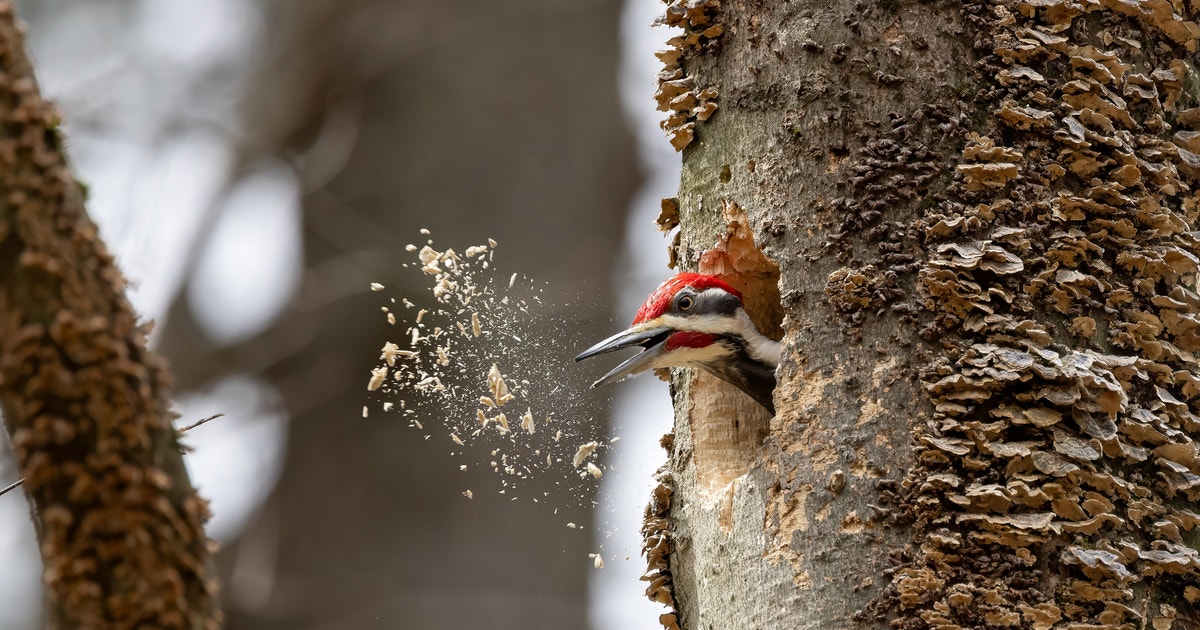
If you’ve ever witnessed a Pileated Woodpecker chiseling away at a tree trunk, you might have wondered if all that wood pecking was taking a toll on the tree. Pileated nest holes, after all, can measure up to a foot long and extend very deep. But fear not: For the most part, North America’s 22 woodpecker species don’t harm the trees they hammer on—much less kill them. In fact, the birds play an important role in keeping forests healthy.
Drumming versus Drilling
Woodpeckers generally engage in two distinct behaviors: drumming and drilling. When they drum, they loudly peck on tree limbs or dead trunks, taking advantage of resonant forest materials to communicate. Whether it be for mating or territorial purposes, a single woodpecker can drum more than 8,000 times in a single day. This behavior only scratches the surface of bark and does not damage trees.
Drilling, on the other hand, generates holes or gashes in a tree.
Drilling, on the other hand, generates holes or gashes in a tree. When woodpeckers drill, they’re usually searching for insects underneath bark, digging out cavity nests in tree trunks, or, in the case of the Acorn Woodpeckers, creating openings to set aside nuts for later, a storage system known as a granary.
While drilling can result in damage, it’s usually not enough to harm a healthy tree—though the holes can make a tree more susceptible to infestations and disease. Woodpeckers and their handiwork also aren’t typically detrimental to trees for another important reason: The birds tend to focus their efforts on dead or rotting trees, the kinds filled to the brim with bugs such as carpenter ants and beetle larvae. If the tree or limb isn’t already dead, it’s likely on its way thanks to an infestation or the presence of fungi or a tree-specific disease.
“Woodpeckers are rarely the cause of damage,” says Nicholas Antonson, a biologist at California Polytechnic State University who studies woodpeckers and other bird species. “They tend to find already damaged areas for their behaviors. And so, rather than seeing woodpeckers as the villain, you can almost see them as your first-line arborist.”
How Woodpeckers Can Help Trees
Indeed, woodpeckers and their powerful beaks can be a boon for trees by acting as an indicator of an infestation and even helping to mitigate the destruction. For instance, woodpeckers eat emerald ash borer beetles, an invasive species that kills ash trees by gnawing away at their tissue. But one long-running community science project found that Red-bellied Woodpeckers killed roughly 40 percent of the beetles in a given area when present, resulting in a population spike for the birds.
Suzanne Treyger, senior manager of the forest conservation program for Audubon New York and Connecticut, knows firsthand how the benefits of woodpeckers far outweigh any potential risks to trees. “I would say that pests and pathogens and different diseases are going to be more of a concern with harming trees than woodpeckers,” Treyger says.
Woodpeckers offer another essential ecosystem service in the nest cavities they create. The birds carve out openings in the softer wood of dead trees and let the wood chips fall where they may inside the holes to cushion their eggs. These carefully constructed hollows later become the homes for hundreds of other cavity-nesting bird species—from owls to bluebirds—around the globe. Not to mention the mammals that might also take up residence.
When Woodpeckers Do Harm Trees
There is one kind of woodpecker more likely to harm or kill trees than others: sapsuckers. The four species of sapsucker—Yellow-bellied, Red-naped, Red-breasted, and Williamson’s—tap sap-filled trees like maples and hemlocks on a continual basis. In the process, they bore rows or columns of holes—called wells—into trunks, revisiting them often to access as much sap (and as many sap-trapped insects) as they can.
They can sometimes take off a full ring of bark, girdling and fatally injuring the tree.
Usually, trees survive these tidy, grid-like arrangements, but if the birds return again and again, they can sometimes take off a full ring of bark, girdling and fatally injuring the tree. Although this is a rare occurrence, there are steps you can take to prevent sapsuckers from perforating a tree you care about to death. To keep the birds at bay, cover an area they’ve already started tapping with chicken wire, wired mesh, or burlap until they find a new tree to target.
However, if you’re not worried about damage and just want to watch nature play out, it can be fun to observe sapsuckers—and any woodpecker, for that matter—do their thing. “A lot of people can recognize the drumming, and they’re very flashy and colorful,” Treyger says. “They’re a charismatic species in our woods.”
