

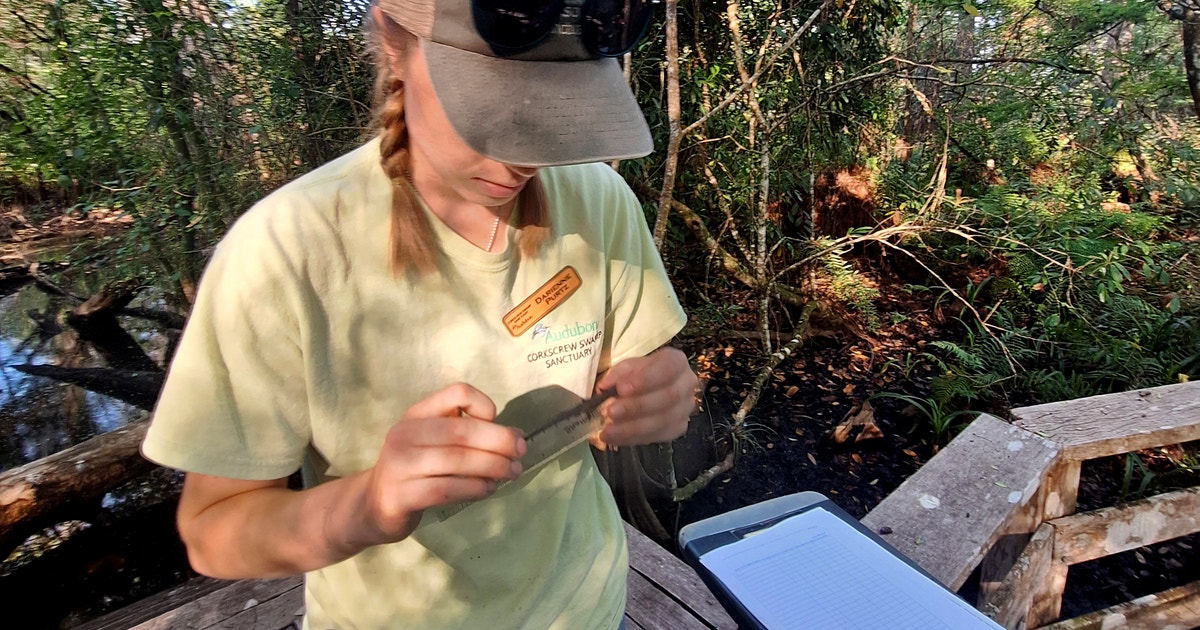
Darienne Purtz pulls a wheeled cart out of the storage shed, loads up her clipboard, boots, and other gear, and rolls it onto the boardwalk toward this week’s sample site. As a research associate for Audubon’s Corkscrew Swamp Sanctuary, Purtz typically conducts her work in the sanctuary backcountry, but today, she threads her way around curious visitors, her cart bumping over the boards. Purtz is happy for the opportunity to engage, and most visitors express appreciation for the work underway as part of the Sanctuary’s mission to collaboratively protect birds, other wildlife, and people from the unintended consequences of burgeoning development and associated human activity nearby.
Aquatic surveying program
Audubon staff monitor populations of small animals that live in the water, including fish, amphibians, and insects, because they serve as indicators of a healthy wetland and make up the prey base for birds and other animals.
“We have survey sites in five different areas of the Sanctuary, where we collect data three times a year,” adds Purtz. Four sites are associated with wetland restoration activities, and the fifth one is along the CLASS loop of the boardwalk, which is typically only accessed during education programs.
At each study site, Purtz deploys six wire mesh minnow traps at water depths of at least 20 inches. Roughly twenty-four hours later, she checks the traps and collects the captured animals to bring them back to the lab, where they are identified, sexed (for some species), and measured.
Animals that live in the water are monitored in the late-wet season (Oct-Nov), the early-dry season (Dec), and the mid-dry season (Jan-Feb). The swamp changes dramatically over the course of a year, and these three sampling events allow biologists to see how animals respond to those changes.
“Minnow trapping only works if there is enough water for fish and other species to move around, and if that water is warm enough that they are active,” says Purtz.
Commonly caught fish species include flagfish, golden topminnow, and Eastern mosquitofish, but the traps also capture crayfish, amphibians (adult and larval), and aquatic insects, such as predaceous diving beetles.
Today’s catch
Upon arriving at the CLASS loop site, Purtz pulls out her clipboard and pen to record the time the traps are pulled and the water depth. She opens the first trap and readies her ruler. Amidst the squirming fish, she is excited to spot a peninsula newt, Notophthalmus viridescens piaropicola. These amphibians rely on calm, fresh waters with plenty of vegetation where they hide from the time they hatch as larvae through their adult form. Interestingly, this species is unpalatable to many fish, but crayfish, turtles, and wading birds can eat them. Purtz also recorded a few slough crayfish in the traps where newts were caught.
Once all trap contents are removed and recorded, Purtz loads the empty traps on her cart and rolls everything back to the lab, where she will process the samples and begin entering the data.
Why this is important
Aquatic fauna sampling is only one of the many ways Audubon staff keep tabs on wildlife populations in the Sanctuary to support the conservation and restoration of natural ecosystems throughout the Western Everglades.
“The presence and absence of some species confirm adequate water levels and water quality conditions,” says Purtz, who explains that the species caught and the numbers of individuals vary depending on season.
Fish, insect, amphibian, and reptile data tell biologists how the ecosystem responds to wetland water levels and provide insight into the food available for predators, like wading birds, alligators, and otters. These prey species are key indicators, and data collected from a variety of surveys of animals in the water and on land, combined with vegetation surveys, enable the research team to connect the dots between the annual rise and fall of water levels and the health of the entire ecosystem.
