


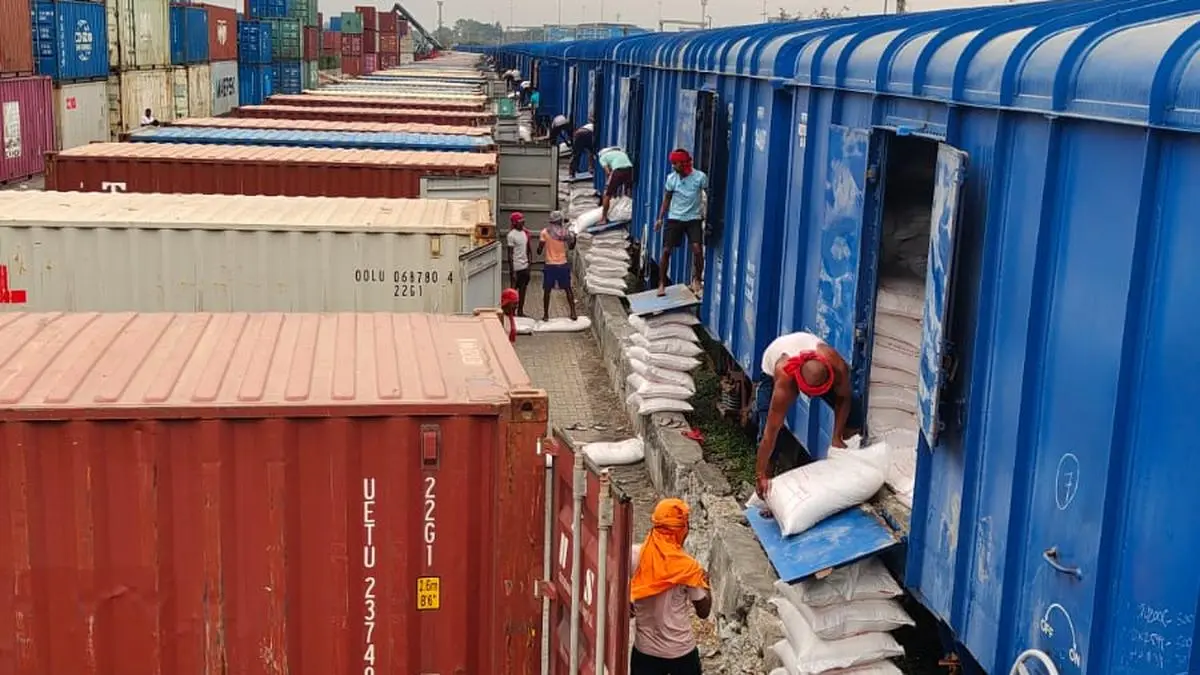


Rice bags shifted from rail wagons to sea containers at the Concor ICD in Tondiarpet
| Photo Credit:
Supplied
Nearly 2,700 tonnes of rice from Andhra Pradesh are on their way to China through a rail-road-sea logistics chain via Chennai Port, marking the revival of export cargo handling through BCN wagons at the Container Corporation of India’s (CONCOR) Inland Container Depot (ICD) at Tondiarpet after a gap of nearly five years.
The consignment, sourced from the Samalkot and Tanuku regions of Andhra Pradesh, was loaded in 42 BCN (Bogie Covered Wagon with Pneumatic Brakes) wagons and transported about 575 km by rail to ICD Tondiarpet in Chennai. There, the rice bags were directly stuffed into 105 twenty-foot equivalent unit (TEU) containers and will be transported about 5 km by road to Chennai Port for shipment to China.
CONCOR officials said the movement represents an important step towards promoting efficient, cost-effective and environmentally sustainable multimodal logistics solutions.
Traditionally, cargo arriving in BCN wagons is unloaded at railway goods sheds and transported by trucks to warehouses for containerisation, involving multiple handling stages and additional transportation costs. The process typically takes three to four days.
In contrast, the direct stuffing operation at ICD Tondiarpet enabled the cargo to be transferred straight from rail wagons into containers, completing the process within a day. This not only reduced handling costs and transit time but also minimised the risk of pilferage associated with multiple cargo movements.
Officials noted that rail-based movement offers both economic and environmental advantages through lower carbon emissions and reduced dependence on road transport. “For bulk export cargo, rail transportation provides a cost-effective and sustainable alternative to conventional road movement, delivering tangible savings in overall logistics costs,” officials said.
According to a rice exporter associated with the shipment, the rail-road-sea movement reduced transportation costs by nearly 40 per cent compared with the conventional road-sea route.
The revival comes amid a strong rebound in India’s rice exports. Rice export restrictions imposed during 2022-23 to contain domestic food inflation had reduced bulk cargo movements, making BCN wagon operations less viable. However, record harvests improved domestic stocks and the government gradually relaxed and eventually lifted export curbs by 2025, paving the way for a recovery in overseas shipments.
Officials said that while Visakhapatnam is geographically closer to Samalkot than Chennai, exporters opted for Chennai because of better container availability, more competitive ocean freight rates and superior vessel connectivity.
The operation also highlights Chennai’s continuing importance as a logistics gateway for southern India, with exporters increasingly leveraging its container infrastructure and shipping connectivity to access international markets.
Published on May 30, 2026

