

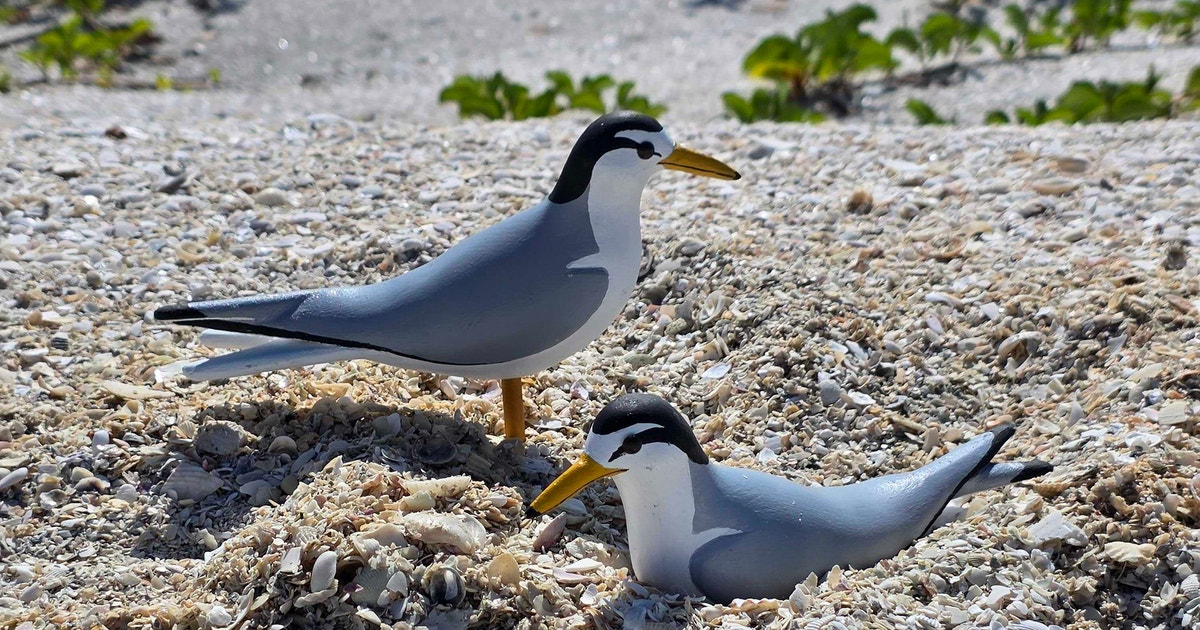
Least Terns are small seabirds that nest on the beach, typically in large colonies. These coastal birds depend on expanses of clean, healthy habitats to raise their families, and are increasingly having difficulty finding good nesting areas in the Sunshine State. To combat this, Audubon staff use decoys to lure birds to high-quality nesting habitats. But where to source these unique wooden decoys?
“We use Least Terns’ colonial-nesting behavior to our advantage by placing decoys that signal safe, suitable nesting areas as the birds arrive from their wintering areas and search for places to raise their young,” says Megan Hatten, project manager for Audubon’s Southwest Florida Shorebird Program.
Ed Brackett, a woodcarver in New Hampshire, learned about the use of decoys in bird conservation through a National Audubon Society article about the reestablishment of Tufted Puffins in Oregon. When his online search showed a similar effort underway in Florida for Least Terns, he reached out to offer his services.
“I’ve always been interested in art and crafts, especially woodcarving,” says Brackett. He took art lessons in high school, and, in the early 1980s, took a bird decoy-carving class with his father, a seasoned woodcarver. Brackett set his craft aside for several years while working in the engineering field with a medical device manufacturer, but picked it back up in 2010, when his father passed away.
“He wanted me to take his tools and resume carving,” Brackett says. That’s just what he did.
Brackett started by crafting a variety of folk-art objects and later replicated decoys he saw in his father’s old books. He decided to take another bird decoy carving class, this time with Bill Sarni of Hingham, Massachusetts. Sarni, a decoy collector whose work has often been published, takes pride in the accuracy of his work.
One of the first decoys Brackett made with Sarni was a copy of a Joe Lincoln Yellowlegs. Lincoln was credited with capturing the essence of wild birds in his carvings with a particular folksy style.
“I really enjoy doing it,” Brackett says. He makes birds and other items for himself and for his wife, who fell in love with the antique Common Loon he made for her. “I’ve also sold a few to friends.”
Previously, Brackett had produced three American Oystercatchers for the Oystercatcher Working Group’s banding program in Mexico and Piping Plovers for Mass Audubon. In 2026, he carved 15 Least Terns for Audubon. While he donates his time to projects like ours, some projects require material costs to be covered.
According to Hatten, the decoys Brackett sent are amazingly accurate and are working with limited success. In late May, Least Terns started nesting on Marco Island again, not too far from the decoys.
Brackett often uses discarded wood scraps he finds in the lumber yard, particularly American basswood or even torn-down fence posts, for the birds’ bodies. Then he gets tacks for eyes, dowels for legs, and special glue to hold the pieces together. Once the carving is complete, he paints it with acrylic, using the utmost care to be as accurate as possible.
Brackett, who retired in 2020, started spending more time in the wood shop in his yard (his sanctuary) in New Hampshire, and is now teaching wood projects at the Nantucket Historical Association. He hopes to receive a new request for decoys soon so he can enlist his students to assist with their production in his next class this August.
How long does it take to carve a bird decoy? Brackett says, with a chuckle, that he never keeps track. Each decoy is different, depending on size and detail. A larger decoy, such as a goose, can take a full week to make. Through his project for Nantucket Historical Association (a 16-hour class), the students finish decoys as they learn.
Interestingly, many of his students are retired, with some in their 80s. Brackett notes how difficult it is to get younger people into this hobby. A member of the New England Woodcarvers since 2010, Brackett saw its membership drop off considerably during the pandemic, and today is only a small portion of what it was in its heyday.
“I would encourage anyone interested in wood carving to join a group to get good instruction from fellow woodcarvers who can help you along,” Brackett adds.
Bird decoy carving classes not only keep a cherished tradition alive but also bring people together to appreciate and understand birds—an important first step toward inspiring actions to protect them. In this way, we can channel the charisma of our avian friends as we grow our network throughout the hemisphere, inspiring new constituencies—and future generations—to act on behalf of birds and people.
