

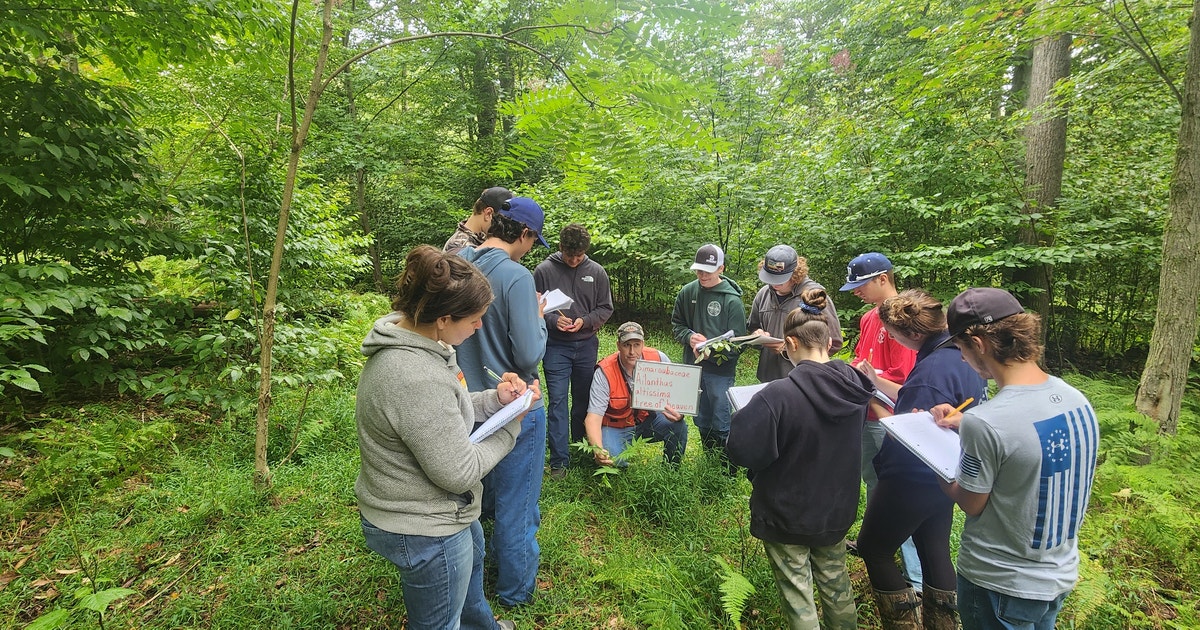
Mike Eckley’s connection to the natural world began knee-deep in Pennsylvania’s trout streams, where weekends spent fishing with his father sparked a lasting curiosity about the outdoors. Over time, that early interest shifted from water to woods, taking root in a career in forestry and land stewardship.
Now working with private forest landowners across central Pennsylvania, Mike helps clients navigate management decisions that balance ecological health, wildlife habitat, and long-term stewardship goals. He also lectures within the Penn State DuBois Wildlife Technology Program. Still a self-described “birder in training,” he has used Audubon Mid-Atlantic’s Forester Training and Endorsement Program to sharpen his skills, deepen his ecological insight, and build stronger, trust-based relationships with landowners, growing both his expertise and his business along the way.
Read on to discover how Mike initially became interested in forestry, how the endorsement and training impact his daily work, and how bird-friendly forestry is beneficial in our region.
What led you to become interested in forestry?
My interest and eventual passion for forestry evolved out of time spent fishing as a youth. My father devoted many weekends to taking me fishing on trout streams within the Big Woods of Central Pennsylvania. Slowly but surely, my interest in the water transitioned to the land and surrounding trees.
Where did your interest in bird-friendly forestry come from, and why is it important?
In 2008, I found my way back to my home state of Pennsylvania through employment with The Nature Conservancy. As the chapter’s first Outreach Forester, I soon realized I was surrounded by avid birders, from the staff to donors to volunteers. Over time I learned that bird-friendly forestry was my ticket to engaging with many different people and speaking their preferred ‘love’ language.
How did you benefit from the endorsement process?
In private practice, I now work with a diverse cross-section of forest landowner types, and the endorsement process has helped improve my visibility and credibility with certain audiences, especially those who are passionate about birds.
Any key takeaways about wildlife management?
The program has helped me to ‘connect-the-dots’ by strengthening my understanding of certain bird species’ habitat requirements and has provided me with a playbook of best management practices that I can embrace to help species in decline. When I meet with landowners who have an interest in managing their forest to help birds, I now have a complete toolkit of practices to introduce them to.
For example, if a client has overgrown fields adjacent to a forest, I’m able to talk with them about how, with a little cutting and clearing, they can maintain scrubby habitat to benefit specific species like Prairie Warbler or Golden-winged Warbler.
What makes bird-friendly forestry different from other approaches to forestry?
Bird-friendly forestry has deepened my focus on how forests are managed, especially in terms of maintaining structural complexity with greater intention. By applying targeted “finesse factors,” we can retain and support species that provide essential food and shelter for birds.
For example, we identify and prioritize vigorously growing oak trees that develop broad crowns and produce abundant acorns. Supporting these “champion trees” may involve selectively thinning mid-story vegetation to allow more sunlight to reach the forest floor. This not only strengthens the growth of these key trees but also enhances their ability to support caterpillars and other food sources vital to bird populations.
How do you explain bird-friendly forestry to new landowners you’re working with?
Much of my career is centered on engaging people in dialogue on managing forests. For many landowners, wildlife has and continues to serve as the primary vehicle that drives management decisions. Bird-friendly forestry has served as a new ‘engine additive’ for me to further captivate and build important, trust-worthy relationships with my clients.
How did the training influence your work?
I find it exciting and rewarding to know that I am working within a landscape—the PA Wilds region—identified through science as a priority area for so many important values, including conservation of birds to which a growing number of people enjoy and care deeply about. Here, efforts are channeled to focal areas that have been identified as critical migratory pathways. Pennsylvania is a high-responsibility state for the viability of both game and non-game species.
Do you have a bird story or personal connection to birds?
Most recently, birds have been a way to connect with my teenage son. He is going through a stage where he is losing his luster for spending time with his dad. During a recent outing in the woods, I stopped abruptly and said, do you hear that bird? He scoffed, rolled his eyes, kicked the leaves and said out loud, ‘No’, dismissing my interest in the obscure sounds of its tweets. I pulled out my iPhone, activated the Merlin app, and captured audio of the bird. It portrayed the image of the Rose-breasted Grosbeak, which soon revealed its location to both of us – perched on a nearby sapling. My son’s facial expression transitioned from a sign of annoyance to showing curiosity.
What’s your favorite bird? Favorite tree? Why?
I admit, I am a birder in training. Although my skills need honing, I had a very memorable encounter with a couple of Pine Warblers that really left an impression on me. My favorite tree species is white oak because I own quite a few on my personal property. I am drawn to the white oak’s aesthetic beauty, characterized by their large, sweeping, quarter-acre sized crowns and ashy gray, flaky bark. It helps knowing that the white oak is an important species ecologically for warblers.
Mike’s journey shows that ecologically-responsible forestry practices are as much about listening as they are managing – listening to the land, wildlife, and the people who care about them both. Programs like Audubon’s Forester Training and Endorsement are helping professionals translate that information into action – where thriving bird populations and healthy forests go hand in hand. Please visit our website to view more information about Audubon’s Forester Training and Endorsement Program.
