

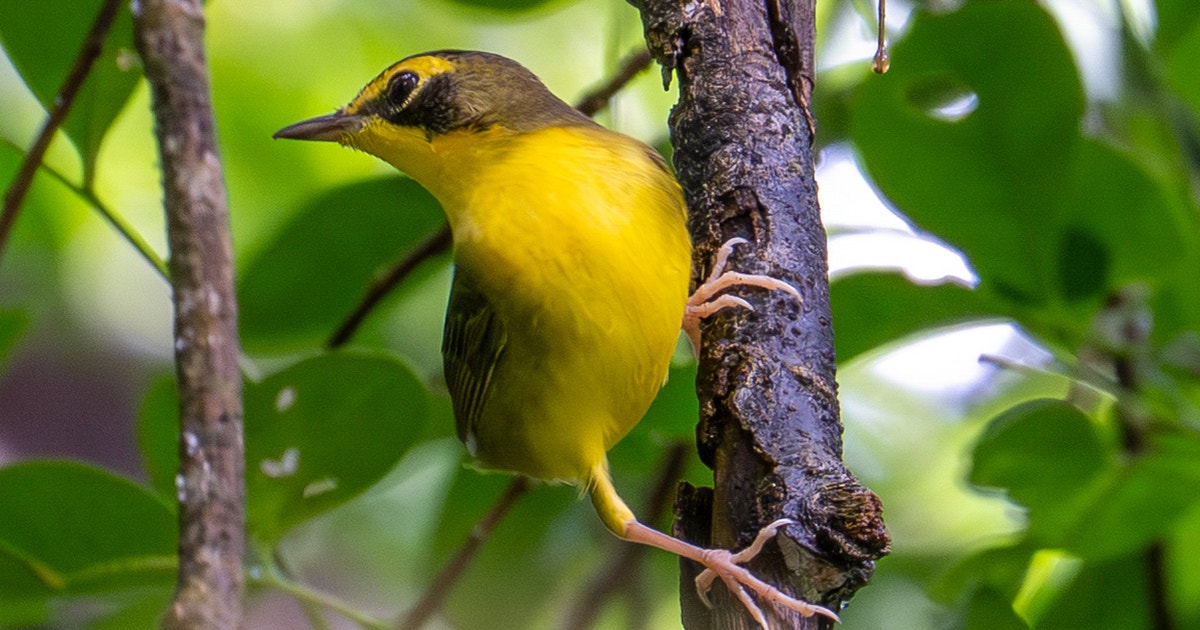
Ricardo Berrios Perez leads bilingual birdwatching tours in New York City’s Central Park as a volunteer for the nonprofit Latino Outdoors. He knows when migratory warblers have returned to their breeding grounds in North America just by their distinct chirps. But when the colder months roll around, he’s more likely to be found waiting out the freezing temperatures indoors: Much like his favorite travelers, Perez is “not a big fan of winter,” he says.
As the blistering winter blankets much of North America, migratory birds like Wood Thrushes, Kentucky Warblers, and Magnolia Warblers (one of Perez’s favorites) seek refuge in Central and South America, enjoying the warmer weather and richer foraging. Now, research is revealing a clearer picture of where these species spend time during the months they are absent from North America.
“I did know the birds tend to traverse long distances to avoid winter,” says Perez, “but I never really stopped to think about where specifically they were going.”
Scientists have long known that many familiar migrants spend their non-breeding months in major forests in Central America, but they lacked the data to measure the critical role certain places play for different species throughout the year. In a new study, researchers drew on data from eBird—a global database of more than 2 billion bird sightings submitted by birdwatchers—to gauge how important key forests are to migratory birds. The team analyzed week-by-week maps for 314 bird species, using eBird data combined with remote sensing and machine learning models, to track where bird populations concentrate throughout the year. They found that one-tenth to nearly half of the global populations of 40 migratory bird species spend time in five key forests.
As five billion migratory birds funnel through the narrow corridor of Central America during migration, many stop by or overwinter in the rainforests, mangroves and wetlands of the region’s “Five Great Forests,” whose core areas add up to 25 million acres, about the size of Virginia: Selva Maya in Mexico, Belize and Guatemala; Moskitia in Honduras and Nicaragua; Indio Maíz-Tortuguero in Nicaragua and Costa Rica; La Amistad in Costa Rica and Panama; and the Darién in Panama and northern Colombia.
Over 40 percent of the planet’s Cerulean Warbler population passes through these forests during spring migration.
More than a third of the world’s Kentucky Warblers and nearly a quarter of all Wood Thrushes and Golden-winged Warblers overwinter in these forests, according to the study by researchers from the Wildlife Conservation Society and the Cornell Lab of Ornithology. Additionally, over 40 percent of the planet’s Cerulean Warbler population, which has declined by more than 70 percent since 1970, passes through these forests during spring migration.
But these forests are disappearing at an alarming rate, which researchers found is leaving vast bird populations in peril. Deforestation, largely fueled by illegal cattle ranching, has already wiped out millions of acres of forested land. The Selva Maya and the Moskitia are the most significant forests for these birds, yet are also the most threatened, shrinking by 25 percent in only 15 years.
As the healthy habitat around them dwindles from mounting threats of deforestation, pollution, and climate change-fueled wildfires, the birds—exhausted after a long journey—may end up competing for high-quality spaces and resources to refuel and recover, says lead author Anna Lello-Smith, a conservation scientist at the New York City-based Wildlife Conservation Society.
The study also points out that these Mesoamerican forests serve as “sister landscapes” to forested areas in the U.S. and Canada, with strong connections to Appalachia, the Mississippi Delta, the Great Lakes, New England, and even New York City’s Central Park. These ecological counterpoints share the same migratory bird populations that breed in North America and overwinter in the five forests—and threats to one landscape echo across the other.
“If we lose those forests, we will lose these birds that we love to watch come back every spring,” says Lello-Smith.
“If we lose those forests, we will lose these birds that we love to watch come back every spring.”
But conservation efforts are far from a standstill. In fact, Indigenous and local communities are leading efforts to restore land and bring back bird-friendly livelihoods such as sustainable cacao and allspice production. A joint regional initiative aims to protect nearly 25 million acres of the Five Great Forests and restore more than 1.2 million acres of land that has been illegally cleared. In the Selva Maya in Guatemala, for example, researchers are working with communities that run native tree nurseries, growing tens of thousands of native tree seedlings which are then planted on former cattle pastures, bringing back forest and bird habitats.
In 2019, reforestation in the Selva Maya in Guatemala far outpaced deforestation for the first time, Lello-Smith says, highlighting that her previous research documented more than 200 bird species returning to these restored pastures.
Jorge Velásquez, science director for Audubon’s Latin America and Caribbean region, says while the importance of these forests are already “well-established,” this new research adds “a stronger, data-driven case for sustained support to manage” them along with Indigenous lands. By mapping “stewardship connections,” the study highlights the critical links that migratory species create between distant geographies.
“The stewardship connection maps presented in the paper clearly illustrate cross-border dependencies and help justify conservation investments by U.S. states and Canadian provinces beyond their borders,” says Velásquez, who is not involved with the study.
In fact, part of the reason researchers wanted to showcase these sister landscapes is to use them as communication tools to connect people in North America with communities doing the work. “They can’t really do it alone,” Lello-Smith says. “A lot of them are literally putting their lives and safety on the line to do this protection work.”
Central America has one of the highest rates of murder of environmental defenders. They patrol their lands to detect and halt illegal activities, including land grabbing for cattle ranching and exploitation of Indigenous people and natural resources.
It’s important to realize “how much these local communities are doing and achieving with such little resources,” Lello-Smith says. “But their efforts are already paying off.”
