

Owls are awesome. They capture our imagination like no other bird family, and it’s easy to see why. Luckily, we have 19 different owl species that live in North America to admire. Many are common and can be found across broad swaths of the United States, while others, like the Northern Hawk Owl, are only occasional visitors south.
Although owls are often associated with woodlands and the night, not all species are nocturnal or reside exclusively in forests. Burrowing Owls, for example, can be found in deserts and other open spaces, where they live in communities and are most active during the day. Meanwhile, Short-eared Owls prefer dusk and can readily be found hunting above marshes and grasslands. Point is, owls are everywhere, and there are more opportunities to see them than you might realize. So get to know the owls below, and if you’re feeling inspired, go try to find one.
Barred Owl
Key field marks: Large and round, Barred Owls are named for the brown horizontal striping on their white throats and upper breast.
Fun fact: Barred Owls mate for life, and a calling pair can easily be recognized by their trademark call carrying through the eastern woods: who cooks for you, who cooks for you, all?
Great Horned Owl
Key field marks: One of our largest North American owls, the multi-colored Great Horned might also be our most recognizable thanks to its two giant ear tufts, or “horns,” atop its head.
Fun fact: Great Horned Owls are one of our earliest nesters, mating and laying eggs in the middle of winter. This allow adults more time for chick rearing and to teach young owls how to hunt.
American Barn Owl
Key field marks: This sleek, medium-sized bird’s speckled white belly, brown back, and heart-shaped facial disc give it an appearance unlike any other owl in North America.
Fun fact: The element of surprise is important when hunting, and American Barn Owls are virtually silent in flight thanks to the shape and texture of their feathers.
Eastern Screech-Owl
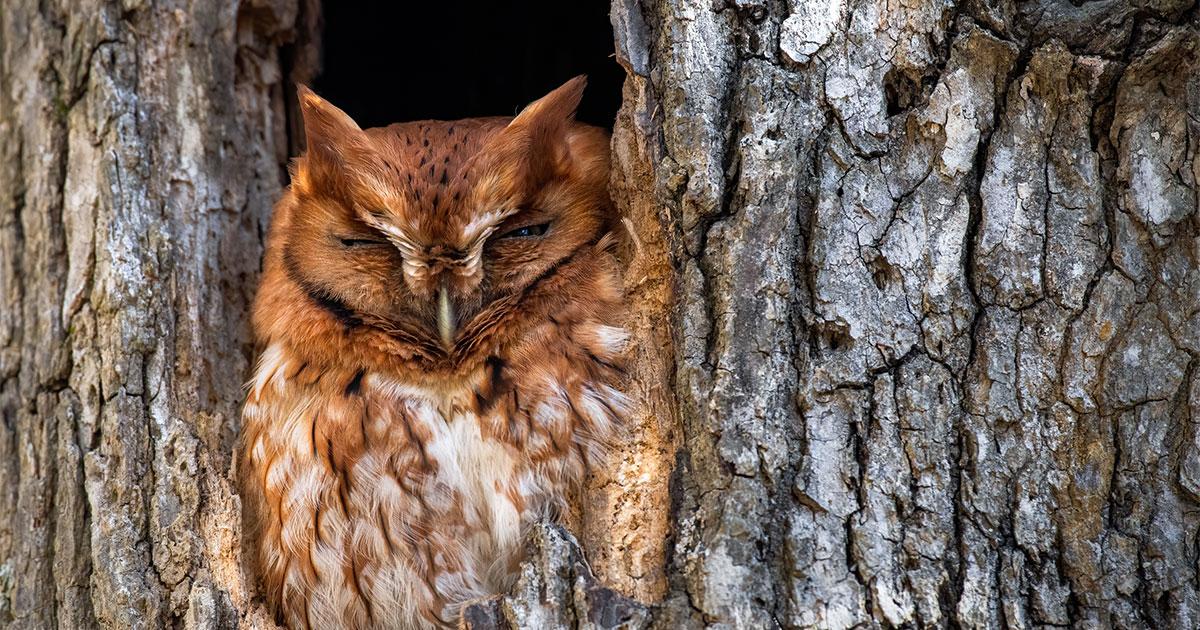
Key field marks: The Eastern Screech-Owl is a smaller owl with two tiny ear tufts and a mottled, bark-like plumage pattern that comes in three morphs, or colors: brown, gray, and red (rufous).
Fun fact: Despite their name, screech-owls don’t screech at all. They also don’t really hoot. Instead, these compact owls vocalize with soft trills and horse-like whinnies.
Western Screech-Owl
Key field marks: Strikingly similar to its eastern counterpart, the Western Screech-Owl features a much darker beak compared with the lighter, yellow-ish beak of the Eastern.
Fun fact: Screech-owls catch blind snakes, a type of worm-like reptile, to feed their chicks. But instead of killing them right away, as is typical, they bring the snakes back alive alive. Any that escape being eaten live in the nest and feed on potentially harmful insect larvae.
Whiskered Screech-Owl
Key field marks: Though tough to spot, whiskery feathers, called rictal bristles, around the beak help distinguish this southwest specialty from the Western Screech-Owl, which can be found in much of the same range.
Fun fact: Continuing with surprising screech-owl sounds, the Whiskered forgoes trills and whinnies for a rapid-fire series of toots that is often compared to more Morse code.
Burrowing Owl
Key field marks: Most active during the day, these small brown-and-white sentinels with round heads stand atop spindly legs as they watch over their burrows with golden eyes.
Fun fact: Along with a cute little double hoot and various other noises, Burrowing Owls make a hissing sound that is believed to mimic the sound of a rattlesnake to ward off potential predators.
Snowy Owl
Key field marks: With fluffy white feathers all the way down to their feet, Snowy Owls are large, yellow-eyed denizen of the arctic tundra during summer months and found throughout Canada and northern states during non-breeding months.
Fun fact: When Snowy Owls have particularly good breeding seasons, young Snowies can irrupt the following winter, leading to an influx throughout the Lower 48 and the birds appearing everywhere from farm fields and airports to public parks and beaches.
Northern Saw-whet Owl
Key field marks: All owls have wide eyes, but the tiny Northern Saw-whet often looks like it’s been caught red-taloned, with big round yellow eyes set in an equally round, speckled face.
Fun fact: The Northern Saw-whet Owl long duped scientists into thinking it was non-migratory and rare, but as it turns out, the birds are just extremely stealthy and migrating populations do so at night.
Short-eared Owl
Key field marks: If you see a medium-sized bird hunting over a field during the day, chances are good you’ve got a Short-eared, whose heart-shaped face and brown breast streaks are a more reliable ID clue than its often hidden tufts.
Fun fact: Short-eared Owls and Northern Harriers often hunt in the same open fields, and when the two species overlap at dusk, sometimes there can be clashes.
Long-eared Owl
Key field marks: Think of this bird as a trimmer, slightly shorter version of Great Horned Owl, with the key difference being stripes instead of bars on the belly and strong black markings around their eyes.
Fun fact: As with most other owls, Long-eared Owls have asymmetrical ear holes that greatly increase hearing. But even by owl standards, these birds are adept hunters, capable of snagging prey in total darkness.
Great Gray Owl
Key field marks: The largest owl in North America, the Great Gray Owl is hard to mistake with its ashy plumage and large, ringed facial disc, but despite its size, the bird long remained a mystery to researchers.
Fun fact: All owls have eyes that are proportionately large to their heads to increase visibility during low-light hours, but the Great Gray Owl is so big that its eyes are roughly the size of an adult human’s.
Elf Owl
Key field marks: About the size of a soda can, the Elf Owl is the smallest owl in the world and is mostly brown with some light streaking on its breast, no ear tufts, and promintent white eyebrows.
Fun fact: Don’t let this bird’s size or name fool you: Elf Owls are fierce hunters, venturing out from their cavities at night to snag everything from beetles and crickets to mice and even scorpions.
Northern Pygmy Owl
Key field marks: Lacking the typical facial disc of an owl, this robin-sized species is mostly brown and white with a tuftless head, speckled face, and piercing yellow eyes.
Fun fact: Largely diurnal, these tiny birds are fierce hunters and often prey on songbirds—which will gang up on the raptor if they spot one sitting motionless on a perch waiting to strike.
Ferruginous Pygmy-Owl
Key field marks: Warm, cinnamon-colored plumage differentiates this bird from its northern cousin, but its size, markings, and hunting tendencies are largely the same.
Fun fact: As with other pygmy-owls, the Ferruginous Pygmy-Owl has two dark spots on the back of its head. Researchers believe these “false eyes” help deter songbirds from mobbing the owls to drive them away.
/p>
Spotted Owl
Key field marks: This medium-sized owl looks similar to the beefy Barred Owl, but its slightly smaller stature and white spotting on the breast, rather than bars or streaks, differentiates.
Fun fact: The Spotted Owl actually has three subspecies across its fragmented western range: the Northern Spotted Owl, the California Spotted Owl, and the Mexican Spotted Owl.
Flammulated Owl
Key field marks: Rusty patches amid splotches of brown and gray plumage inspired this raptor’s fiery name—while also giving it superb camouflage across the western pine forests it calls home.
Fun fact: Close in size to the Pygmy Owl and Elf Owl, the Flammulated Owl is our only small North American owl with dark eyes.
Boreal Owl
Key field marks: Sporting the same general shape and look as a Saw-whet, this owl of northern forests is bigger and grayer, with a bold black line around its pale face.
Fun fact: Boreal Owls show the most extreme sexual dimorphism of any North American owl species, with females sometimes weighing twice as much as the males.
Northern Hawk Owl
Key field marks: A long, pointed tail, penchant for perching atop trees, and preference for daytime hunting all give this tiny owl of the boreal forest a distinctly hawk-like vibe. But the bird’s squat profile and round face, flanked by two dark crescents, are pure owl.
Fun fact: While the Northern Hawk Owl might be a rare visitor to the Lower 48, its northern range covers most of Canada and extends throughout much of Alaska.
