

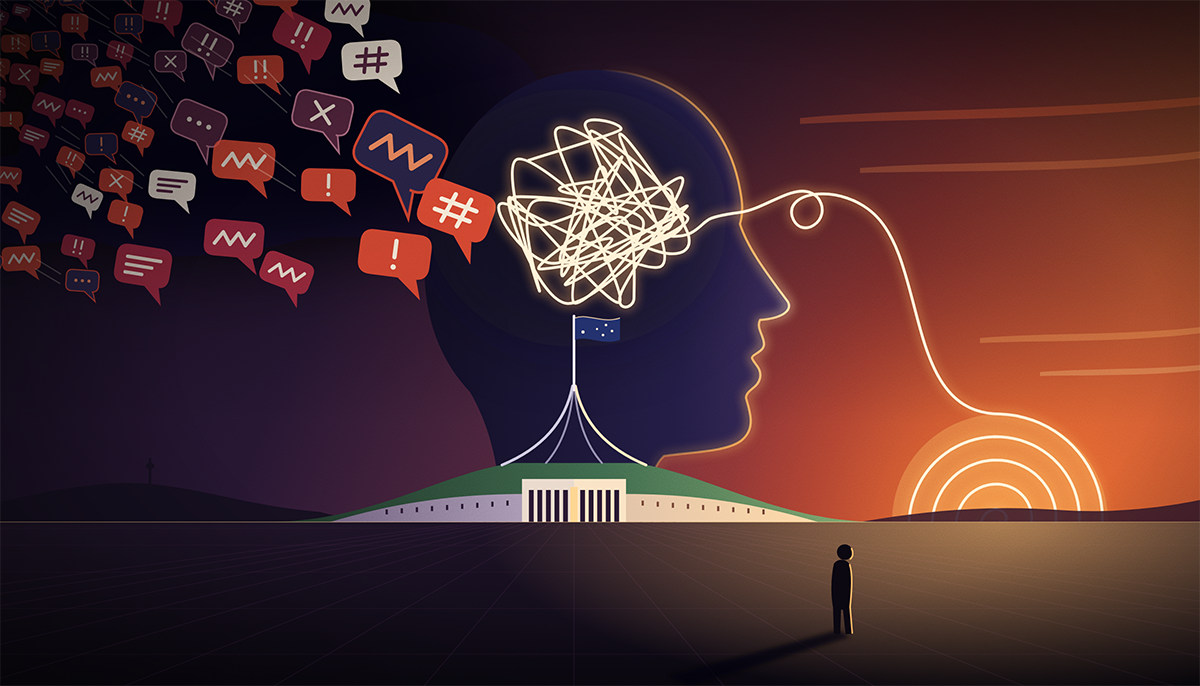
Yesterday in Canberra, I made a speech in the Australian Parliament to MPs and staff about politics and mental health. The event was to launch a report, one of the biggest of its kind, into the mental health of politicians. It makes for pretty grim reading. I also got the chance to meet the team of Helen Haines, the MP who recently had both her legs amputated after a horrific attack, and to send her a message of support as she recovers.
I love coming to Australia, and in a few days have been to all States apart from Tasmania, done several speeches and seven live shows, and met politicians from the Prime Minister and a host of Premiers down. Doubtless I will talk about it all on The Rest Is Politics next week, and it is really remarkable just how many people listen to me and Rory Stewart chewing the fat.
But for now, I would like to post the speech I made at the Parliamentary event to launch the report by the Better Politics Foundation. It is worth reading.
For now … here is the speech
I want to tell you about one of the best decisions I ever made. It came after the worst day of my life which, as a result of the decision, became one of the best.
The decision was, that when I returned to work as a journalist after a psychotic episode during which I was arrested for behaving strangely in a public place, hospitalised, medicated, advised to stop drinking, and told to rest for a fair old while, I decided to be totally open about what had happened.
British newspaperland in 1986 was a tough environment, macho, heavy smoking, heavy drinking, no place for faint hearts. But do you know what? The humanity and understanding from colleagues was amazing. They were a big part of my recovery.
When Tony Blair asked me to work for him almost a decade later, I told him I was worried the pressures of the job might lead me to another breakdown. I gave him the gory detail, the hearing voices, the arrest, the stripping off in a police cell and banging my head against a brick wall. He did look a bit worried when I told him Elvis was singing ABBA songs in one part of my befuddled brain, but then he said: “I’m not bothered if you’re not bothered.”
“What if I’m bothered?” I said.
“I’m still not bothered.”
To politics then, another tough world, where I became someone reported upon rather than reporting. I faced a lot of hostility from many media outlets, over many issues. But on the mental health part of my story, again, in the main, support and understanding.
So when I left the political frontline for the weird and varied life I lead now, I decided that if there was one area I could use the skills I had developed in my two careers to become an activist campaigner again, it was mental health.
I had long been interested in this area anyway, largely because my older brother Donald had been diagnosed with schizophrenia in his early 20s, and invalided out of the Scots Guards. He is the real reason I started to campaign on this. I became aware of the stigma and the taboo surrounding mental illness, and also the often terrible services, lack of research, the sense that mental health was always back of the queue when it came to policy and funding priorities.
Donald’s openness too, however, meant he had a better life than many with the same condition. He was a top bagpiper and landed a job in security at Glasgow University, doubling as their official piper, a position he held down for 27 years which gave him real purpose, and real pleasure to others. When he died aged 62 – twenty years younger than when our Dad died, which is about average for people on a lifetime of anti-psychotics – at the funeral he had a great turnout from the University. I thanked them in my eulogy, because they never treated him as “a schizophrenic,” but as “a valued colleague who has schizophrenia, and occasionally goes off the rails, usually when he stops the medication because he feels OK.”
So my family has been, in many ways, pretty lucky, including my son Calum, now thirteen years sober after a descent into alcoholism, not least thanks to AA, one of the greatest creations in the world, born of two men, Bill and Bob, helping each other to stay sober. But many are not lucky. Services often still woeful. The stigma all too real for people like the NHS nurse, of all people, who told me she would never reveal her mental health condition to her boss because she was sure it would mean no promotion, ever. I hope she was wrong. But she might not be. I have had continued issues with depression and anxiety, but I hope I have shown that it is possible to have those conditions, yet still live a fruitful, fulfilling, challenging life, and do difficult jobs well. My openness has been part of that.
A profile writer once said of me, that “Alastair Campbell has had a successful career despite a history of mental illness.” I dropped him a note. “How do you know it is not BECAUSE OF, rather than despite?” It’s what I think. It is what has given me persevilience, the title of the book I have just published on the new word I have invented, which is about getting good out of bad, turning setback into progress. It is how I face into my continuing bouts of depression today; use what I have learned to get through it better, faster.
Being a mental health campaigner and advocate has meant, invevitably, getting to know, and work with, Pat McGorry, who was named Australian of the Year for his leadership role in this field, and one of the drivers of the project we are here to launch today, the Better Politics Foundation report on politics and mental health, not from the policy perspective, so much as looking at the mental health of politicians themselves.
I’m sure one of the reasons so many took part in their survey is that they know and trust Pat, despite this Aussie of Irish heritage being, weirdly, a massive fan of a Welsh football club, Swansea City. Or perhaps because of!
The report makes grim reading. A combination of heavy workload, near constant abuse, little praise or support, and often a sense of powerlessness, is having a pretty dire impact on the mental health of Australian politicians. Seven out of ten saying the role has adversely affected their mental health or wellbeing. Incidents of self harm and suicidal thoughts rising. Wellbeing scores lower than people working in the blue light services. Stalkers and safety fears for themselves, their families and staff making it harder to keep the easy access to MPs in which Australia, like Britain, prides itself. And on safety, just as the U.K. has seen three politicians murdered in the last decade, Australians are still coming to terms with what happened to Helen Haines, a huge supporter of this project.
As I said earlier today to the National Press Club, the sorry tale revealed in this report damages not just the people concerned, but democracy itself. Of course it matters to them as individuals. But it should matter to us all, not least because the experience of politicians today deters people from thinking about politics as a calling tomorrow, further narrowing the pool of would be political leaders for the future.
Social media, and the cesspit of abuse, hate and misinformation it has become, especially since Musk bought X, is cited as the biggest contributor to damaged wellbeing. It comes ahead, even, of separation from family and physical safety, in the list of reasons politicians give for unhappiness. But the mainstream media don’t get a free pass here. The general demonisation of politics and politicians predates the tech bros.
Public service is a noble calling. Yet it has become all too commonplace, for media and public alike, to dehumanise politicians, just for being, or wanting to be, in politics. Reports to the police of threats and harassment faced by federal politicians have doubled in the last two years, from 555 to 1,009. The Better Politics Foundation has found a similar story in the UK, Ireland, Germany and beyond. If we want good politics, let’s start treating politicians better, and let’s see politicians take a lead by treating each other better. Disagree agreeably, to quote the slogan of a UK podcast which seems to be very popular in these parts.
It’s not all bad news. A huge majority of Australian politicians say they would still recommend to others that they run for office, and remain conscious of the privilege of public service. But almost three quarters say Parliament is the worst workplace they have ever operated in. I hear something similar about Westminster.
Now Aussies are often prone to talk of whingeing Poms and so some might be tempted to shout “whingeing politicians” at this. But the truth is the quality of our democracy pays a price when so many of our politicians feel this way. It hurts all of us, not just MPs, their feelings and their families.
I love politics. I also love my country. And I love your country too. On this trip as on every trip here, I have met wonderful people, seen wonderful places, had a great time. But at a time when there is so much badness in our world, and when in the most powerful democracy of all, that badness has reached the very top, Trump, who uses hate, intimidation, bullying, lying and abuse as permanent features of his populist, polarising, post-truth politics, we have to take seriously the threats to democracy, which are exacerbated when the quality of global political leadership is so debased. As was clear from the Dictators’ Trilateral in Shenzen, he clearly prefers autocrats to democrats.
You have had some great politicians down the years. Paul Keating and Julia Gillard are among my political heroes. We have had great politicians too. I have been lucky enough to know and work alongside some of them. And I have been blessed to know and work with great political leaders all over the world.
They do not grow on trees. They grow from their communities and their cultures. They grow through the calling of public service, and the depth of their beliefs and values. There is a risk that we drown out that call with the noise of negativity, the abuse, the hate, all the stuff that makes politicians ask “why am I doing this?” and would-be politicians thinking “why the hell would I bother?”
I AM bothered, that at a time when there is a global battle between democracy and autocracy, we are helping the drive to autocracy by treating our democratically elected politicians with contempt that in the main, they do not deserve.
Let this report be a wake-up call to all of us, that democracies need a healthy robust politics, and that needs healthy robust politicians who don’t fear walking down the street or looking at their social media feed, don’t fear that their families are going to get caught in the crossfire, who enjoy their life in politics.
I said that Persevilience is all about how we get good out of bad, rather than bad out of good, which is what those 3Ps of populism, polarisation and post-truth do. So we need 3 new Ps to defeat them … People, with Persevilience, and Principles.
That, to me, is what good journalism, good communications, and good politics are about. There is still plenty of it. But we need a whole lot more if we are to recover from the unhealthy malaise into which our politics and our media have fallen.
We need to look after ourselves, and look after each other.
Thank you.
