


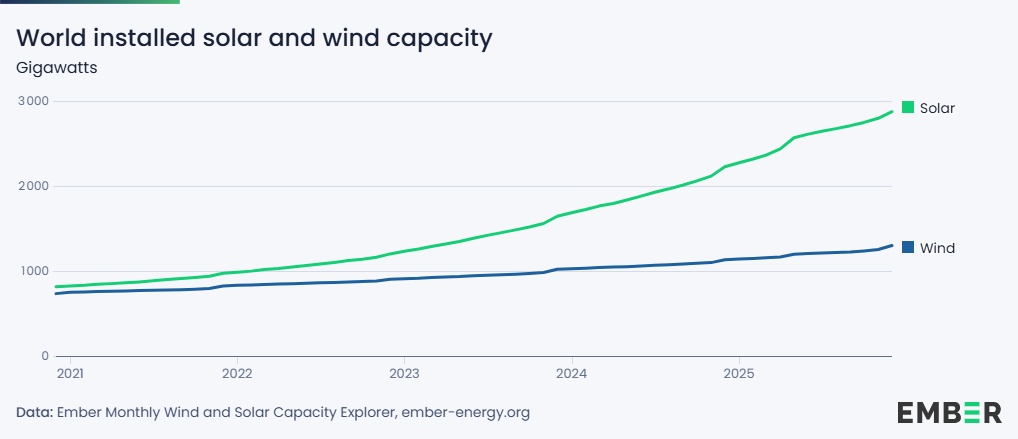

The energy think-tank, Ember, has unveiled data showcasing that the energy transition is alive and well as a record amount of new solar and wind capacity was added in 2025.
Experts at Ember note that the record surge in global solar and wind capacity in 2025 highlights not just the pace of the energy transition—but its growing role as a buffer against geopolitical instability, as tensions in the Middle East continue to disrupt fossil fuel markets.
“The continuing escalation in the Middle East is a stark reminder of the risks of dependence on imported oil and gas.”
Kingsmill Bond, Energy Strategist – Ember
The Ember energy report found that in 2025, a total of 814 gigawatts (GW) of new solar and wind were installed across the world, beating 2024’s 696 GW by more than 17%.
EXPLORE ADDITIONAL INSIGHTS IN OUR DATA DASHBOARD
Track how these trends compare with real-time energy market movements in our global energy and climate dashboard →
The record-breaking 2025 growth of solar and wind power
This means that the leading two renewable energy sources now have installed capacity of more than 4 terrawatts (TW) at 4,174 GW, showcasing how the two electricity sources are rapidly expanding.
“The scale and speed of solar’s expansion is unlike anything seen before in the power sector”, said Leonard Heberer, Energy Analyst at Ember.
Heberer adds to what many geopolitical and energy experts have started to point out in recent weeks, the recent escalation in the Middle East has once again exposed how dependence on concentrated supply routes—particularly oil and gas—remains vulnerable to geopolitical shocks.
“Along with accelerating capacity additions for wind, these technologies are on track to become the backbone of the global electricity supply”, he added. As they scale up, they will strengthen energy independence, reduce reliance on fragile fossil fuel supply chains, and help insulate consumers from price spikes in fossil fuel prices driven by geopolitical instability.
Solar’s dominance is reshaping the global electricity sector
Between the two renewable energy sources, solar has established itself as the leading one by quite a margin.
In 2025, almost four times as much solar capacity was added compared to wind capacity. For every 1 GW of wind capacity added, nearly 4 GW of solar was installed at 647 GW, which is up by 11% at 65 GW compared to 2024’s 582 GW of solar additions. The solar growth underscores how solar is playing a larger and more dominant role in the world’s electricity sector.
Worldwide, at 2,900 GW, there’s nearly 3 TW of solar capacity installed.
Wind power rebounds despite structural challenges
Even though wind power significantly trails solar, despite the ongoing challenges the sector finds itself in, it in itself posted a staggering 47% increase from 2024, growing by 167 GW to reach a total installed capacity of 1,300 GW.
The new solar and wind capacity added in 2025 can generate an estimated 1,046 terawatt hours (TWh) of electricity.
Kingsmill Bond, Ember’s Energy Strategist, said about its findings: “The continuing escalation in the Middle East is a stark reminder of the risks of dependence on imported oil and gas. Solar, wind, and batteries give importers a genuine path to energy security, one that is cheaper, faster to deploy and doesn’t come with geopolitical strings attached.”
Geopolitics: Energy security in a volatile world
This dynamic is already visible in recent oil price volatility, where supply risks linked to the region have driven sharp market movements where supply risks linked to the region—home to a significant share of global oil exports—have driven sharp market movements
“As they (solar and wind) scale up, they will strengthen energy independence, reduce reliance on fragile fossil fuel supply chains, and help insulate consumers from price spikes in fossil fuel prices driven by geopolitical instability”, Heberer added.
Explore how gas prices and global energy benchmarks are evolving in our live dashboard ↓
Renewables as a catalyst for energy security
The Ember analysis notes this is enough to displace more than one-seventh of global natural gas generation or almost 1.8 times Qatar’s annual LNG export volume. Based on the current market prices, this is equivalent to annual gas imports of around $138 billion.
Since the US and Israel military attacks on Iran in February, the world’s fifth largest oil producer, the output of all currently installed capacity of solar and wind has avoided the equivalent of 330 TWh of natural gas generation, worth potential savings of more than $40 billion.
Anders Lorenzen is the founding Editor of A greener life, a greener world.
Discover more from A greener life, a greener world
Subscribe to get the latest posts sent to your email.

