

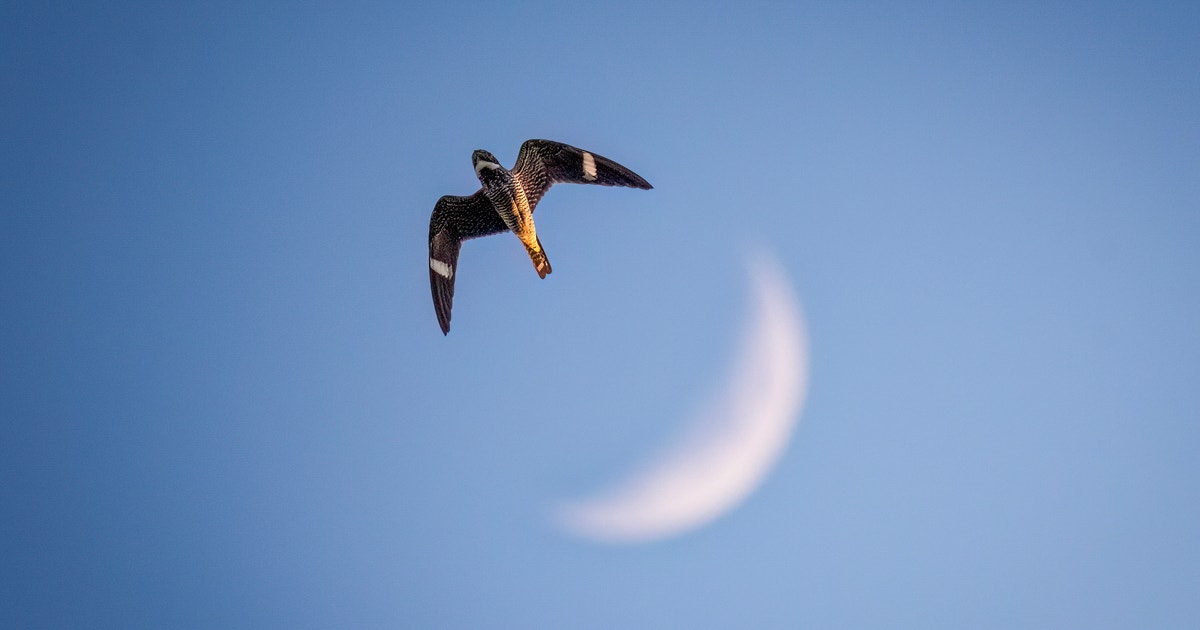
Peerrnt! The nasal cry is sharp enough to penetrate traffic noise on the streets below. Looking up from the sidewalk, we see the source: a pigeon-sized bird with long, angular wings, brown with a white slash across each pointed wingtip. Its jerky, zigzag flight action, with erratic fast-slow wingbeats, carries it high above the rooftops.
It’s a Common Nighthawk, but everything about its name is misleading. It’s not related to hawks, and it’s more active at dawn and dusk than at night. And although it’s still widespread, this species is becoming less common in North American skies.
Generally a nighthawk is seen at a distance and in motion. But even up close and at rest, it retains a look of mystery. Big head hunched down onto its shoulders, long wingtips folded back over the tail, it squats on the ground or on a horizontal branch, camouflaged in mottled brown. Its big, dark eyes betray no expression. Its short beak, trimmed by bristles, looks absurdly small—until it opens its mouth wide, revealing a cavernous opening as big as its head, perfect for scooping up large insects in flight.
A century ago, more Americans knew this bird, often by its nickname of “bullbat.” Its aerial acrobatics and whooshing display flights were common sights on summer evenings over open country—and over cities as well. Nighthawks had always nested on the ground, laying their two eggs on bare soil, and they discovered flat gravel roofs as worthy substitutes.
Their wide range and daylight activity made Common Nighthawks the most accessible representatives of the nightjars (family Caprimulgidae). Nightjars, as a group, are among the most poorly known of all birds. The scientific family name reveals long-standing confusion: “Caprimulgidae” translates roughly to “milkers of goats,” reflecting an ancient superstition that the Eurasian Nightjar, flitting through pastures at nightfall, was there to steal milk from the grazing animals. Even the word “nightjar” seems odd, but “jar” here refers to a jarring, discordant sound, like the churring song of the Eurasian species.
Mysterious though they are, nightjars live alongside humans on six continents, with almost 100 species known.
Mysterious though they are, nightjars live alongside humans on six continents, with almost 100 species known. About 10 are crepuscular like nighthawks, foraging at dawn and dusk, but most species are strictly nocturnal and seldom seen. All are shades of brown or gray-brown with mottled patterns. Males of a few have distinctive plumes, like the glorious Pennant-winged Nightjar of Africa or the Lyre-tailed Nightjar of South America, but most are quite similar and hard to separate even if seen well.
Scientists have bravely struggled to invent English descriptors to distinguish between these lookalike birds, but a name like “Tawny-collared Nightjar” means little when most of its relatives also have pale neck markings. Names applied to most members of the family today are boring and unhelpful (although the Diabolical Nightjar, from Sulawesi, earns a few points for intrigue). The best nightjar labels are in North America, where several were named for their voices.
Thus, Eastern Whip-poor-wills and Mexican Whip-poor-wills cry out something like whip-prr-WEELL! incessantly on moonlit summer nights. Chuck-will’s-widows chant their name in deep, throaty tones from southern forests. The whistled poor-WILL-ip of the Common Poorwill echoes in arid western canyons. Naturalists seeking the callers at night may see their eyeshine reflecting in headlight or flashlight beams, or see the birds foraging, swift shadows swooping about to capture insects in the air. Discovered in daylight, they sit motionless, relying on camouflage; if approached too closely, they flush from the ground, flying away low to seek another hiding place.
At one time, the majority of Americans probably were familiar with nighthawks by sight or with their nocturnal kin by sound. Today these birds are adding to their sense of mystery by performing a vanishing act, becoming even more elusive every year. By some estimates, Common Nighthawks have lost 50 percent of their total numbers since 1970. Populations and trends of other nightjars are hard to measure since it’s almost impossible to get accurate counts, but most are probably losing ground. This echoes a general decline in numbers of aerial insectivores—birds that catch flying insects in the air—and raises alarms for the future.
City-nesting nighthawks may be vanishing as flat gravel roofs are replaced by other materials, and their eggs or young may be vulnerable to predation by increasing urban colonies of crows. They and other nightjars are likely also affected by the general decrease in insect populations.
But we can take positive steps. In several cities, including Chicago, community programs monitor nighthawks annually, in peak breeding season in early summer or during fall migration in August and September. And efforts to halt insect declines, such as reining in overuse of pesticides and reducing unnecessary outdoor lighting, can be helpful for all aerial insectivores. Even if the nighthawks remain high overhead, even if their more secretive cousins remain nothing more than voices in the dark, they help to maintain a touch of avian mystery in our lives.
This story originally ran in the Summer 2026 issue as “Strangers in the Night.” To receive our print magazine, become a member by making a donation today.
