


By Bridget Shirvell
In the seventh instalment of our series, Advice and ideas on raising kids in the climate crisis,the author of Parenting in a Climate Crisis, Bridget Shirvell, explains how she learned that a simple walk can do wonders for our connection to nature and teaching kids about the simplicity of the natural world .
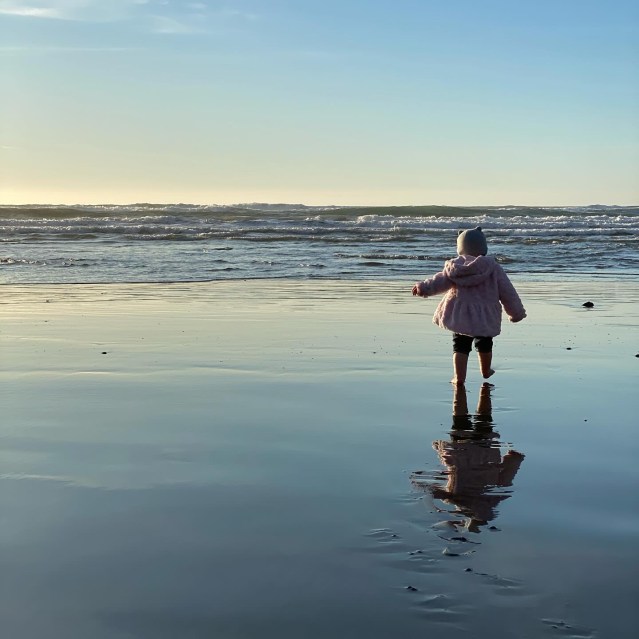
On a recent walk with my child, bundled in coats and moving slowly down the hill by our house, she stopped to point out a single curled maple leaf, underneath a sheet of ice on the side of the street. She hit her foot on the ice, trying to free it. “It’s trapped,” she said when she was unable to break it free. Our simple January morning walk became an invitation to notice the world again. She spent the next few days checking in on the leaf, until finally a brief warm spell set it free.
Getting outside for a walk is such a simple activity that it’s easy to overlook, but taking a walk with your child is a way to teach them about the seasons, restore a sense of calm on busy days, and connect with the natural world.
Why walks matter
At a time when children’s schedules are busier than ever, and when many kids spend more hours inside than any generation before them, stepping outdoors offers plenty our kids can’t get anywhere else.
Wellbeing
Even short walks lower stress, regulate mood, and support better sleep. The fresh air and gentle movement reset the nervous system in ways screens simply can’t.
Curiosity
Getting outside in different seasons forces kids to use their brains in new ways, supporting their cognitive development. They see the differences in the landscape from splashing in a stream in the summer to seeing that same stream with ice on it in the winter, which invites noticing and can spark curiosity. Kids become natural scientists, asking the questions that will shape their understanding of ecosystems and change.
Climate connection
Seeing seasonal shifts firsthand also helps children understand the environment as a living system. They begin to link what they read in books, see on screens, or learn in school to the world around them, such as that the sunlight looks different in winter than in summer, that certain birds stay year-round while others leave and return, and why some trees hold their leaves long into the season.
Movement
On days when gyms, playgrounds, or fields aren’t appealing, walking still offers meaningful physical activity. It’s gentle, accessible, and usually free.
How to make the most of your walks
You don’t need a nature preserve or a dramatic landscape. Something as simple as a local walking path or even a neighbourhood street can become an ecosystem through a child’s eyes.
Observe
Encourage kids to notice things around them, such as the changing colours or textures of leaves; have them listen to bird calls and the sounds of the season; and ask what it feels like outside.
Slowing down is the real skill. You can make it playful—“Let’s find three things we’ve never noticed before.”
Engage
If your child needs more structure, try a simple scavenger hunt, for instance, “Let’s see if we can find something red, something that crunches, something smooth.” If your child likes to draw, you could have them take a small sketchpad on your walk and encourage them to sketch something they see. Or if you have a kid who loves stories, have them create one with you about an animal or a tree you see on your walk.
You don’t want walking to become a task, but pointing out simple things helps kids notice the nature around them.
Make it a routine
Pick one day a week to make a walk a regular occurrence, maybe it’s a Saturday morning walk, or a walk after school before dinner on a particular day. Making it a ritual gives children a rhythm to the walk, and may even help them notice more things, such as what’s changing week to week. It doesn’t, and I can’t stress this enough: it has to be a long walk. Even ten minutes outside counts.
Walking as a form of parenting
One of the things I love most about taking a walk with my kid is how it makes space for conversation. Something about being side by side and moving rather than face to face, at say, the dinner table, makes my child more likely to talk about what’s on her mind, and the walk becomes a time for questions, emotional processing, and companionship.


Bridget Shirvell is a freelance journalist and the author of Parenting in a Climate Crisis. A handbook that explores the challenges and opportunities of raising children in an era of climate change. Her work has been featured in various publications, including The New York Times, Grist, and Fast Company, where she combines personal insights with expert perspectives to inspire and inform readers. Bridget is passionate about raising awareness and sparking meaningful conversations around climate action and the future of the next generation. You can follow her Substack here.
Discover more from A greener life, a greener world
Subscribe to get the latest posts sent to your email.

