


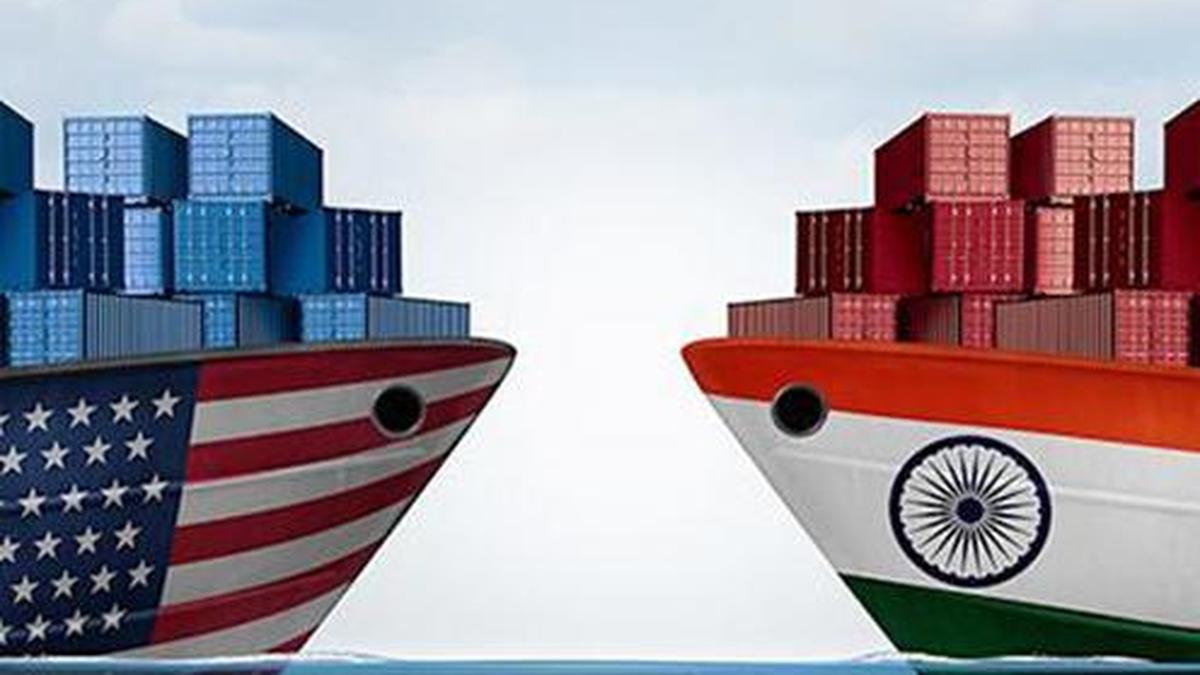
The Indian government has said that the recently announced trade deal with the US will provide opportunities to Indian farming sector to increase exports in its areas of strength.
In a written reply in the Lok Sabha on Tuesday, Jitin Prasada, Union Minister of State for Commerce and Industry, said the trade agreement with the US will provide opportunities to Indian farmers and fishermen to enhance their exports in their areas of strength such as marine products, basmati rice, spices, tea and coffee, oilseeds, and certain fruits.
It will also provide preferential tariff access to a big market for agro forestry-linked products such as vegetable saps, waxes, nuts, plating material, coconut, poppy seeds, vegetables and certain roots, along with processed fruit products such as juices, pulp and jams.
Over ₹14 lakh crore
The tariff concessions will create a conducive environment for Indian farmers to sell to a huge American annual import market of more than ₹14 lakh crore, he said.
India has fully protected its agricultural sectors through a carefully designed Exclusion Category, ensuring no tariff concessions are provided in the agreement on key products such as rice, wheat, poultry, dairy, soymeal, maize, millets, groundnuts, honey, tobacco, etc.
Overall, the terms of concessions in the agreement are expected to benefit Indian farmers and open new export opportunities, he said.
On products such as apples, walnuts and soybean oil where India imports in significant quantities due to domestic demand exceeding production, concession is limited and quota-based so that imports help in diversification of sourcing. The quotas are well within current global imports so that supply gaps are met without adversely affecting Indian farmers.
Similarly, in the backdrop of growing demand, animal feed related products such as DDGS and non-GM red sorghum have been considered in limited quantities and with partial tariff concessions so that there is no adverse impact on domestic feed crops.
Likewise, cotton has been offered in a calibrated quota-based concession considering India’s existing trade pattern of both importing and exporting cotton and cotton products to meet quality requirements, the Minister said.
Credit to farmers
To a query on institutional credit to farmers, Ramnath Thakur, Union Minister of State for Agriculture and Farmers’ Welfare, said ₹25.49 lakh crore of institutional credit has been disbursed to 17.09 crore farmers during 2023-24.
Of the total institutional credit disbursed during 2023-24, an amount of ₹14.40 lakh crore has been disbursed to 13.06 crore small and marginal farmers.
He said the Government is making adequate provision of funds to implement credit-linked schemes to ensure required credit reaches to targeted and deserving beneficiaries.
Farmer ID
In reply to a separate query, Thakur said the State Farmers Registry under the AgriStack DPI covers all the landholding farmers, including women farmers, livestock and fisheries and provides them a digital identity called Farmer ID. The Farmers Registry application also has the provision to onboard all the landholding farmers, as well as cultivators such as tenants and sharecroppers.
As of March 19, more than 9.20 crore Farmer IDs have been generated, he said.
Milk production
In a written reply to a question on milk production in India, Rajiv Ranjan Singh, Union Minister for Fisheries, Animal Husbandry and Dairying, said the total milk production in the country was 247.87 million tonnes (mt) in 2024-25. India’s total milk production was 230.58 mt in 2022-23, and 239.30 mt in 2023-24.
Citing the Working Group Report on ‘Crop Husbandry, Agriculture Inputs, Demand and Supply’ of NITI Aayog, which was submitted in 2024, he said the projected total milk demand (household and others) in India under business-as-usual scenario is 243 mt for 2025-26.
Foodgrains
In a written reply, Ramnath Thakur, Union Minister of State for Agriculture and Farmers’ Welfare, said the production of foodgrains in the country has consistently increased from 3156.16 lakh tonnes (lt) during 2021-22 to 3577.32 lt during 2024-25, reflecting an increase of 13.34 per cent in the production and availability of food grains in the country.
Rice production has increased from 1294.71 lt (2021-22) to 1501.84 lt (2024-25) showing increase of 207.13 lt (15.99 per cent). Wheat production has increased from 1077.42 lt during 2021-22 to 1179.45 lt during 2024-25, reflecting an increase of 9.46 per cent.
As per second advance estimates for 2025-26, the foodgrain production is estimated at record 3486.57 lt for kharif and rabi crops, excluding summer, he added.
Published on March 24, 2026

