


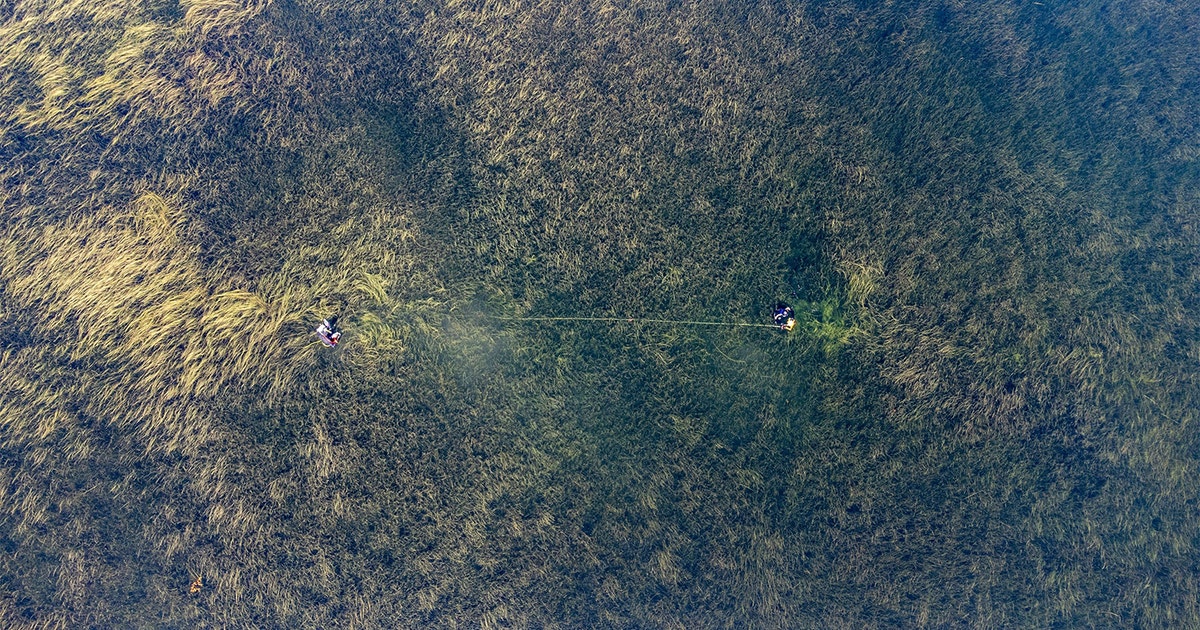
Researchers in Dalhousie University’s Future of Marine Ecosystems Lab incorporate Mi’kmaw best practices in their methodologies, particularly through working with Mi’kmaw community harvesters and knowledge holders in the documentation of eelgrass species and identifying ideal planting locations that might result in highest survivorship rates for the eelgrass. Researchers from the lab have also collaboratively planted eelgrass sods and shoots with Mi’kmaw land users.
Beginning in the late 1990s, Cree land users noted large declines in the once-abundant eelgrass beds in the James Bay region. Canada geese, which are a source of food and cultural significance to the Cree, rely heavily on eelgrass, so as the eelgrass declined, so did the geese. Researchers found that of the area’s main industrial sectors, hydroelectric development had the greatest impact on eelgrass degradation in Eeyou Istchee. Thus, in 2016, the Cree Nation, Hydro-Quebec, and the Niskamoon Corporation signed a research agreement to study the ecology of the coastal region of eastern James Bay and its use by waterfowl. This agreement aimed to prioritize the integration of Cree Traditional Ecological Knowledge with Western scientific research methods to conduct a comprehensive study of the coastal habitat with an emphasis on eelgrass and Canada geese. The research protocol also strongly promoted community involvement, specifying that coastal Cree land users must participate in all fieldwork.
Cree knowledge was integrated into this study in multiple ways, including semi-structured interviews conducted by researchers and the dissemination of Cree historical knowledge. For example, Cree knowledge holders provided insights on goose feeding behavior and flux in the riverine and coastal environments from the 1970s to the present day. Co-development was also prioritized in the research proposal, meaning that the research agenda had to be developed to meet the explicit needs of Cree community members. One of the ways in which this manifested was allowing Cree land users ultimate authority over coastal field activities.
Additionally, community engagement was prioritized throughout the course of this research project. Researchers and research partners conducted outreach at Cree schools and festive events, which aimed to increase engagement of Cree youth in natural science. Community members were also engaged through direct participation in field activities.
Finally, a notable aspect of this research process was the practicing of reciprocal relationships between researchers and Cree community members. Researchers shared meals with the Cree and stayed overnight at family camps during research excursions. Some land users also gifted geese to the researchers and showed them how to prepare the birds for consumption. These examples exemplify the importance of reciprocity in the knowledge exchange process in Indigenous traditional lifeways.
Eelgrass and seagrass ecosystems hold great ecological and cultural value. Due to a changing climate and multiple anthropogenic factors, eelgrass ecosystems around the world are in great decline. In order to combat this decline and work towards restoring eelgrass ecosystems, it is imperative to incorporate the viewpoints of all knowledgeable and affected individuals to find a lasting solution. In blending Indigenous and Western ways of knowing through Two-Eyed Seeing, these ways of knowing can inform one another. The partnerships between large research institutions and Indigenous Tribes presented above show the potential of Two-Eyed Seeing as a way to create a more holistic and comprehensive approach to conservation. With the hopeful expansion of Two-Eyed Seeing into different scientific fields, the definition of what science is can change from something that is simply about the gathering of knowledge but also the building of relationships that emphasize reciprocity.
Community Eelgrass Restoration Initiative. (2023, August 7). Community Eelgrass Restoration Initiative. https://eelgrass.ca/
Denny, S., & Paul, T. Kataq Mi’kmaq Ecological Knowledge: Bras d’Or Lakes Eels. (2012). Unama’ki Institute of Natural Resources.
Fink-Mercier, C., Leblanc, M. L., Noisette, F., O’Connor, M., Idrobo, J., Bélanger, S., del Giorgio, P. A., de Melo, M., Ehn, J. K., Giroux, J.-F., Gosselin, M., Leblon, B., Neumeier, U., Sorais, M., Humphries, M. M., Peck, C., Davis, K. E., Guzzi, A., Galindo, V., … Kuzyk, Z. Z. A. (2024). Cree-driven community-partnered research on coastal ecosystem change in subarctic Canada: a multiple knowledge approach. Arctic Science, 10(4), 731–748. https://doi.org/10.1139/as-2023-0061
Manca, F., Fernández-Llamazares, Á., De la Torre-Castro, M., Groom, R., Lepofsky, D., Pagès, J. F., Thomas, D. N., & Cabeza, M. (2026). Indigenous Peoples’ stewardship of seagrass ecosystems. Current Opinion in Environmental Sustainability, 83, 101686. https://doi.org/10.1016/j.cosust.2026.101686
Unama’ki Institute of Natural Resources | Cape Breton’s Mi’kmaq voice on natural resources and environmental concerns. (2024). In Uinr.ca. https://www.uinr.ca/

