

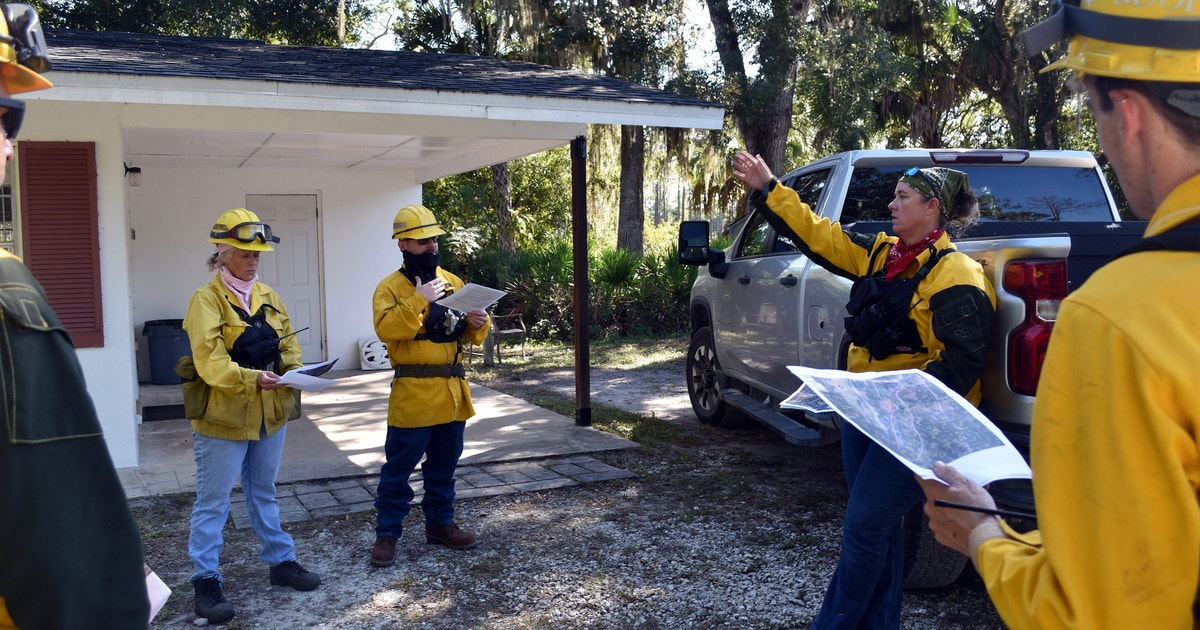
The ignition plan was set: Conduct a team test fire at Location A; red team will ignite a backing fire across all sections; yellow team will advance ignition from Locations B through H; and spotters will monitor flame behavior and wind conditions. A designated weather person will give hourly weather updates using a Kestrel, a handheld weather monitoring tool.
Fire is a critical force driving the ecology of South Florida. Most of Corkscrew Swamp Sanctuary’s habitats have evolved to depend on fire. Maintaining the Sanctuary’s 13,000 acres of wildlife habitat is a top priority because habitat loss—made worse by the escalating impact of climate change—is driving bird declines throughout the hemisphere.
With a state-issued burn permit in hand, the Sanctuary’s “burn boss,” Allyson Webb, communicates the critical ignition plan to her team and ensures everyone is briefed on their roles as they ready themselves with Nomex jackets, helmets, eye protection, gloves, and radios.
“This brown area shows our escape routes, and there is a safe zone near the picnic tables over there,” continues Webb, holding a map. Trucks, ATVs, and UTVs are loaded with gear, including rakes, drip torches, flappers, and more. There are a lot of moving parts, and Webb choreographs it with ease.
This one-acre fire is small compared to others she has conducted, but the prescription is complicated due to the presence of power lines and buildings nearby. For added safety, Webb works closely with the local fire department, which deploys two firefighters to the scene just before ignition.
Webb’s team uses a “water buffalo”—a trailer fitted with a 400-gallon water tank, small engine, pump, and hose that is pulled behind a tractor and can be used to put out flames. In addition, the fire department arrives in their “attack” truck, which is smaller than a standard fire engine and able to respond quickly with additional pumps, water, and dry chemicals, in case the crew needs assistance.
Once everyone is in place, Webb listens for the weather report on her handheld radio and readies her drip torch (a hand-held fuel canister) before tilting it toward the ground. The fire ignites, and the team fans out to their assigned locations. Within minutes, smoke fills the air and is carried up and away.
Webb has been a member of the land stewardship team since 2007 and the Sanctuary’s program lead since 2015. During this burn, her team includes staff and volunteers with varied experience: one volunteer has assisted with several fires while new team members are still learning how fire behaves around Florida’s combustible plants, such as sabal palms, saw palmettos, and wax myrtle. Webb explains every step along the way—a benefit for all involved, including the professional staff from the fire department who are still gaining experience with wildland fires.
She hops on the ATV and cruises around the burn unit along a firebreak that her team has carved out to contain the fire. As she surveys the results, Webb finds some trouble spots and keeps the crew informed.
Toward the end of the burn, the conservation team uses a drone to get a “bird’s-eye view” of fire behavior in real time, aid with post-fire monitoring, and more, cataloging fuel consumption, fire movement, and smoke behavior that will help inform the team the next time this unit is treated with prescribed fire.
After the fire is extinguished, Webb’s work continues through “mop-up,” which is the process of ensuring all hot spots stop smoldering and nothing reignites. That process can take days depending on the soil type and weather conditions.
“To me, a successful prescribed fire is multifaceted,” says Webb. Each fire has specific, measurable objectives for improving habitat while reducing the amount of fallen limbs and other debris that provide fuel for any fire.
“Our other focus is on the safety of personnel and equipment throughout operations,” she adds. “At the end of the day, if the fire is well executed, personnel and equipment are safe, and we continue to move the needle in a positive direction for ecosystem health, then the fire was a success for wildlife, plants, and people.”
For more than a century, Audubon has been working to secure and preserve the habitats birds rely on for their breeding, migration, and other essential needs. Prescribed fire allows land stewards to protect Sanctuary resources and the community from wildfire while reaping the benefits of fire in our ecosystem: reducing hazardous fuels, stimulating regeneration of plants, supporting biodiversity, and protecting forests and soils. Using frequent low-intensity fires to prevent high-intensity wildfires is one of the most important things Audubon can do for wildlife and people.
