

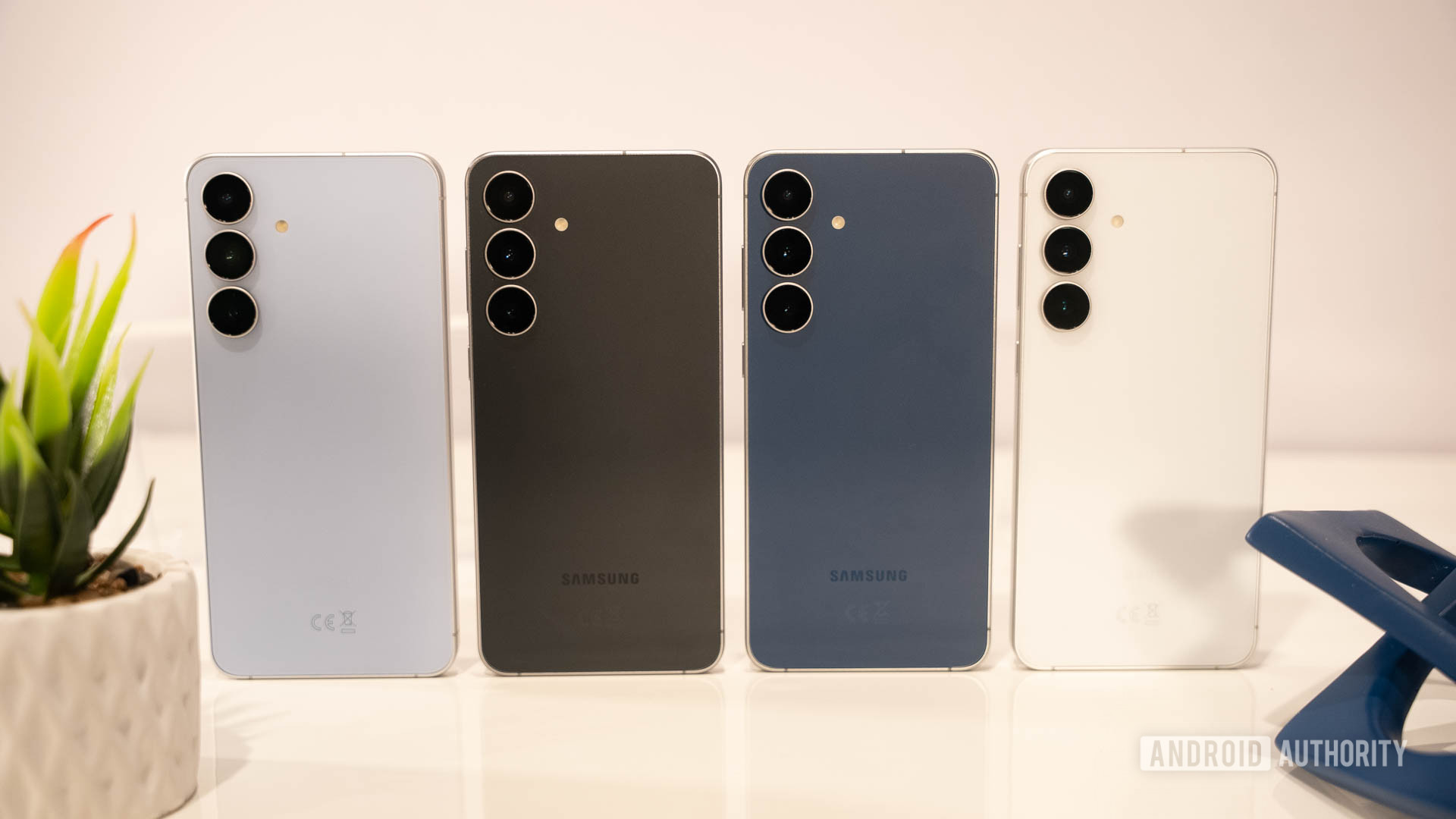

C. Scott Brown / Android Authority
The launch of the Samsung Galaxy S26 series is almost upon us, and while the phone may be doubling down on some new software features, the series is reported to have an important hardware change in store for us as well.
As in previous years, Samsung reportedly has two chips lined up for the Galaxy S26 series, which vary by model and region. Many global customers of the baseline and Plus handsets appear set to receive a Samsung Exynos 2600 chip in their phones. Meanwhile, US customers, select markets like China, and everyone who buys an Ultra worldwide will find their phone powered by a Qualcomm Snapdragon 8 Elite Gen 5. This isn’t confirmed yet, but it would line up with Samsung’s previous releases.
While we’ll have to wait until we have both variants in hand to confirm early performance expectations, we already know the official details of both flagship chips. So let’s dive into what’s different, what’s similar, and what this means for Galaxy fans and first-timers this year. For a quick overview, here are the lower-level specs.
| Snapdragon 8 Elite Gen 5 | Exynos 2600 | |
|---|---|---|
|
CPU |
Snapdragon 8 Elite Gen 5
2x Prime @ 4.6GHz |
Exynos 2600
1x C1-Ultra @ 3.8GHz |
|
SME? |
Snapdragon 8 Elite Gen 5
SME |
Exynos 2600
SME2 |
|
RAM |
Snapdragon 8 Elite Gen 5
LPDDR5X |
Exynos 2600
LPDDR5X |
|
GPU |
Snapdragon 8 Elite Gen 5
Adreno 840 |
Exynos 2600
Xclipse 960 |
|
NPU |
Snapdragon 8 Elite Gen 5
Hexagon |
Exynos 2600
32K MAC NPU |
|
Video decode |
Snapdragon 8 Elite Gen 5
H.264, H.265, VP9, AV1 |
Exynos 2600
H.264, H.265, VP9, AV1 |
|
Storage |
Snapdragon 8 Elite Gen 5
UFS 4.1 |
Exynos 2600
UFS 4.1 |
|
Modem |
Snapdragon 8 Elite Gen 5
Snapdragon X85 |
Exynos 2600
N/A – external |
|
Process |
Snapdragon 8 Elite Gen 5
TSMC 3nm N3P |
Exynos 2600
Samsung 2nm GAA |
Arm vs Arm CPUs duke it out
Right up front, the Exynos versus Snapdragon debate centers on the familiar use of in-house Arm Cortex and Qualcomm’s custom Oryon CPU cores built on the Arm architecture. While Oryon has held the performance lead for a while now, our time testing the MediaTek Dimensity 9500 shows that the single-core performance of the latest Arm C1-Ultra is not as far behind the third-gen Oryon big core (somewhere in the region of 10%). It appears that Arm has caught up with the core designs of its licensees.
However, Samsung’s setup is clocked slightly lower than MediaTek’s powerhouse. The Exynos 2600 offers 1x C1-Ultra at 3.8GHz, 3x C1-Pro at 3.25GHz, and 6x C1-Pro at 2.75GHz. This suggests Exynos’ single-core performance might be some way behind Snapdragon’s, but the extra core count might level the playing field in multi-core and everyday tasks. For comparison, the Snapdragon 8 Elite Gen 5 has 2x Oryon Prime cores at 4.6GHz and 6x Performance cores at 3.65GHz. However, these clocks might change slightly if the Galaxy S26 sports another “for Galaxy” variant of the 8 Elite Gen 5.
Will Exynos’ AI tweaks be enough to catch Snapdragon’s raw compute?
An equally interesting but more obscure difference between the two chips is support for CPU-level machine learning compute. Qualcomm’s Oryon cores support Arm’s first-gen SME extension, while the Exynos 2600 comes with SME2. SME and SME2 use dedicated cores that sit outside the CPU clusters but are connected to them, allowing them to crunch through AI instructions faster and more efficiently than a CPU alone.
The newer SME2 extension supports multi-vector instructions, weight compression, and tiny binary networks. This enables lighter AI workloads, such as text-to-speech or summarization models, to run faster on the CPU without booting up the dedicated NPU, which should save on power consumption and start-up latency.
Of course, Samsung will do its best to ensure feature parity across all its Galaxy S26 smartphones, so don’t expect these differences to translate into drastically different user experiences. However, we could well see slight differences in performance and battery life across demanding apps and lighter AI workloads, which might slightly favor Snapdragon on one hand and Exynos on the other.
Graphics and gaming

Robert Triggs / Android Authority
Another significant architectural difference between Exynos and Snapdragon is their choice of graphics processor — the key component for rendering your favorite games and even running some AI workloads.
Snapdragon sticks with its powerhouse Adreno, featuring its sliced architecture and high-bandwidth memory that boost its already industry-leading performance up a notch. Whether the compact phone form factor can push this GPU to its limits without overheating is an ongoing discussion. Samsung is onto its third-generation Xclipse model built on AMD’s RDNA architecture. While we don’t know an awful lot about either’s deeper workings, reports suggest that the latest Xclipse GPU moves up to a new RDNA architecture with a notable boost to compute performance and a peak clock speed in the region of 980MHz — closing in on Qualcomm’s 1.2GHz peak this generation (not that this comparison really matters).
Which Galaxy S26 chip do you think is better?
0 votes
Samsung is also closing the gap on a few other Qualcomm features. The chip debuts Exynos Neural Super Sampling (ENSS) technology, essentially AI-based resolution upscaling and frame generation, which should offer capabilities similar to Qualcomm’s Snapdragon Game Super Resolution, which doesn’t use AI as far as we’re aware. Samsung also notes the new GPU boasts 50% faster ray-tracing performance than its predecessor. Exynos was already very snappy in that regard, and that boost might well nudge it ahead of Qualcomm’s 8 Elite Gen 5 in these admittedly niche scenarios.
Crystal ball gazing at performance is always a risk, but I’d wager that the Snapdragon 8 Elite Gen 5 will still come out just ahead in standard rasterization — as it’s had a healthy lead here for a few generations now. However, whether that actually translates into a meaningful performance leads for real games remains to be seen. In my experience, last year’s flagship processors can easily lock 60, 90, and even 120fps in the most popular Android games, so this generation is probably overkill.
Other bits and pieces

Robert Triggs / Android Authority
There are plenty of other differences scattered across the chips, many of which are quite hard to compare directly. Samsung says its NPU is twice as powerful as last year, which is no doubt powering much of the phone’s renewed focus on AI features. Likewise, Qualcomm’s Hexagon NPU setup is apparently 37% faster than before, suggesting that Exynos is once again closing the gap with its biggest rival, but it’s very difficult to know which will actually come out ahead.
The latest Exynos also has another trick up its sleeve. It’s built on Samsung’s cutting-edge 2nm GAA process that, at least on the surface, should be smaller and potentially slightly more power-efficient. However, comparing nodes across manufacturers is fraught with difficulties and inconsistencies, so it’s not a given if there’s much meaningful advantage here either. Plus, TSMC’s 3nm manufacturing process is more mature and likely to have higher yields, which may allow Qualcomm to be that bit more ambitious with the performance of its design.
Speaking of design, the Exynos 2600 doesn’t come paired with an integrated modem, which is usually the more efficient route. This means the chip has the added silicon, engineering, and power expense of connecting up to separate Bluetooth, Wi-Fi, 5G, and other networking chips. As such, I wouldn’t place a huge wager on the Exynos setup necessarily being the more power-efficient option. We’ll just have to wait and see.
These are two very different chips but performance may not be miles apart.
Along with power consumption and raw performance, endurance and stress-induced throttling could well be a defining factor. Samsung is expected to implement Heat Pass Block (HPB) technology on the Exynos 2600 for superior heat dissipation. Qualcomm isn’t expected to benefit from it until next-gen’s Snapdragon 8 Elite Gen 6. The 8 Elite Gen 5 has been rather hot on handsets we’ve seen so far, so this could be a key differentiator. We’ll just have to see in real games.
Overall, we are likely looking at two very different chips powering the Samsung Galaxy S26 worldwide. Feature- and architecture-wise, these might be the furthest apart that the Exynos vs Snapdragon battle has ever been. And yet, after a few years lagging behind, signs suggest that Samsung may be closing at least some of the performance gap. A faster CPU, revamped GPU, and ambitious AI capabilities certainly sound promising on paper. We only have a little while longer to wait to see just how much, or little, the Exynos vs Snapdragon debate really matters this year.
Don’t want to miss the best from Android Authority?


Thank you for being part of our community. Read our Comment Policy before posting.
