

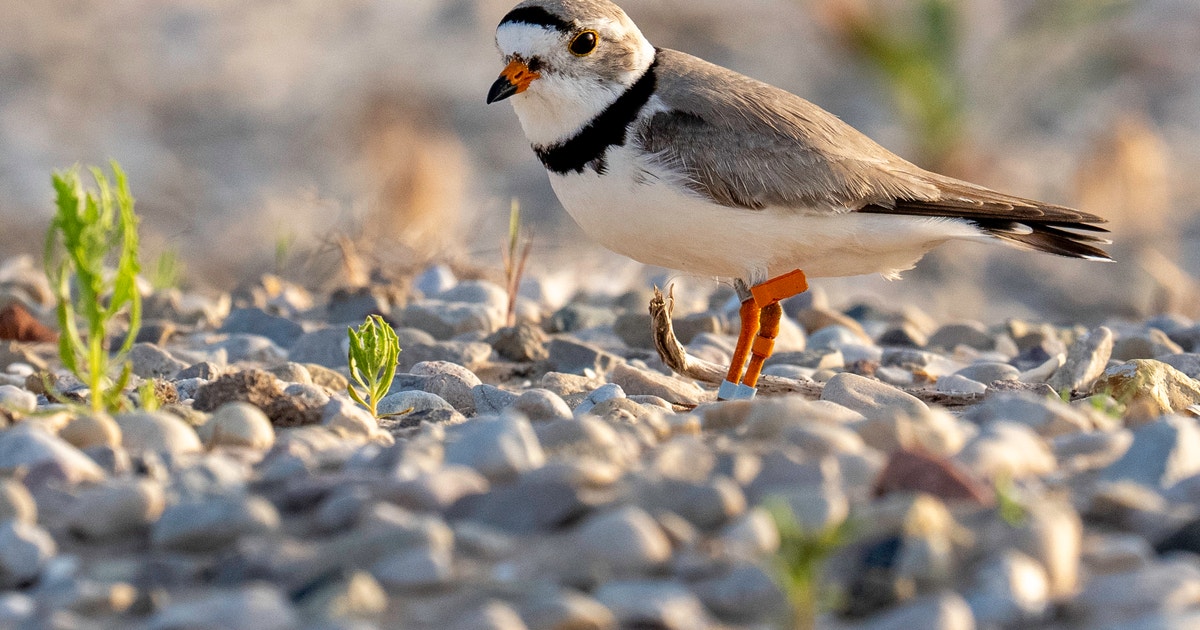
What’s involved with banding Piping Plover chicks? The banding team approaches cautiously, creating a circle around the chicks and gently capturing them with specially designed soft nets. The birds are tiny, barely bigger than a cotton ball. To not stress the chicks, the team works quickly, outfitting them with lightweight, uniquely coded plastic leg bands in the span of just a few minutes.
2026 marks the 10-year anniversary of Great Lakes Piping Plovers successfully nesting again on Green Bay—the first successful nesting in more than 75 years. Every chick banded and released today represents not only another bird contributing to the population, but another chapter in one of North America’s most inspiring wildlife recovery stories.
The discovery marked the first successful nesting on Green Bay in more than 75 years, and validated years of habitat restoration led by conservation partners. What was once considered an unlikely spot has since become one of the Great Lakes’ most important nesting sites, producing chicks that continue to strengthen the recovering population.
However, the Great Lakes population of Piping Plovers remains federally endangered. Just a few decades ago, only about a dozen breeding pairs remained across all five Great Lakes, placing the population on the brink of extinction.
Today, thanks to decades of habitat restoration, intensive monitoring, predator management, captive-rearing efforts, and countless hours contributed by conservation professionals, volunteers, and community partners, the population has climbed to 90 breeding pairs—the highest number recorded since the species was listed under the Endangered Species Act.
While that progress is encouraging, every chick still matters. The Great Lakes Piping Plovers need help, and conservationists are on the job, thanks to an incredible partnership that brings together the U.S. Fish and Wildlife Service, National Park Service, U.S. Forest Service, state DNRs, Great Lakes Tribes, Detroit Zoo, Audubon, Birds Canada, and Lake Superior State University, among others.
Before these chicks ever took their first steps across the beach, their parents successfully defended nests from predators, incubated their eggs for nearly a month, and raised them through the earliest and most vulnerable days of life. Each chick banded today is the result of countless hours of dedication—not only from the birds themselves, but from the conservation teams working year-round to protect their habitat.
Throughout the summer, trained volunteers and staff protect nesting sites, educate the public, and collect data to inform conservation planning. Audubon Great Lakes coordinates the effort here at Cat Island, where volunteers, staff, and partner staff monitor daily from early April through early August.
Returning adults like Obie demonstrate why protecting habitat is so important. Their continued return to Green Bay shows that restored habitat is providing safe places to nest and raise future generations.
For conservationists, seeing familiar adults return each spring—and later watching their chicks race across the beach—is powerful evidence that decades of conservation are making a difference.
As Cat Island celebrates a decade of successful nesting, the story serves as a reminder that conservation works. Through science, partnership, habitat restoration, and the commitment of countless people across the Great Lakes, a species once on the brink of disappearing from the region is steadily making its comeback.
Sometimes conservation success doesn’t look dramatic.
Sometimes it looks like a tiny chick—barely bigger than a cotton ball—running across the sand toward a brighter future.
How can you help protect Great Lakes Piping Plovers? Share the shore: stay far away from birds and nesting areas, keep dogs leashed, and spread the word about the plovers’ recovery journey! You can also sign the pledge here to protect these remarkable shorebirds. https://act.audubon.org/a/share-the-shore
