

Executive Summary (TL;DR)
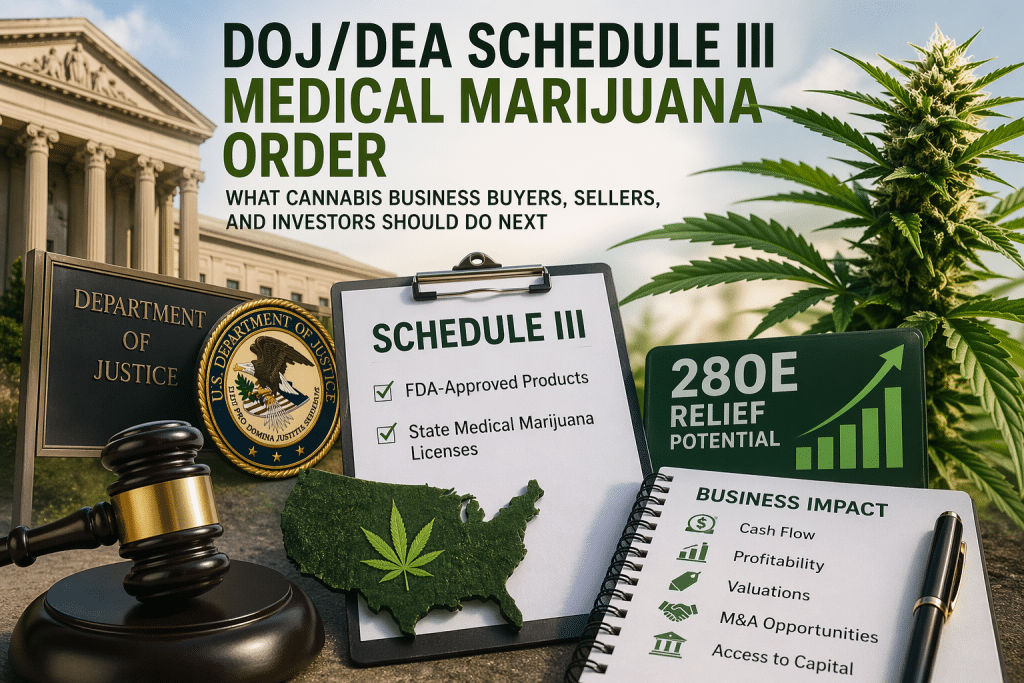
- The practical impact of the DOJ/DEA Schedule III medical marijuana order is narrow but potentially meaningful: it appears to create a federal Schedule III pathway for FDA-approved marijuana drug products and marijuana activity covered by qualifying state medical marijuana licenses.
- Buyers and investors should not treat this as full federal cannabis legalization. Adult-use-only activity, unlicensed activity, and activity outside a state medical marijuana license remain materially exposed to federal Controlled Substances Act risk.
- Sellers of state-licensed medical marijuana businesses should prepare better diligence files now because possible Section 280E relief, DEA registration eligibility, and improved cash flow could affect valuation discussions.
- Medical operators may need to evaluate DEA registration, security, reporting, quota, import/export, labeling, and recordkeeping obligations rather than assuming federal rescheduling reduces compliance work.
- Who should act now: cannabis business owners, business brokers, M&A advisors, buyers, lenders, landlords, and investors underwriting state-licensed medical cannabis assets.
Table of Contents
- Executive Summary
- Why the Schedule III Medical Marijuana Order Matters
- What Actually Changed
- What Did Not Change
- Business Implications for Sellers
- Business Implications for Buyers and Investors
- Valuation Lens: Why 280E Relief Could Move the Market
- Deal Process Overview: NDA to Close
- Due Diligence Checklist
- Myth vs. Fact
- 30/60/90-Day Execution Plan
- Next Steps on 420 Property
- Sources
- Disclaimer
Why the Schedule III Medical Marijuana Order Matters
The DOJ/DEA Schedule III medical marijuana order could become one of the most important federal cannabis business developments in years, but its significance depends on the details. For cannabis business buyers, sellers, and investors, the key is not simply “marijuana moved to Schedule III.” The more practical interpretation is narrower: certain FDA-approved marijuana drug products and certain state-licensed medical marijuana activity may now have a federally recognized Schedule III lane.
That distinction matters for valuation, lending, M&A, lease negotiations, diligence, tax planning, and exit timing.
For operators preparing to sell, this is a reason to tighten financial records, license files, corporate documents, and compliance evidence before going to market. Sellers can use 420 Property’s cannabis businesses for sale marketplace to understand how buyers are comparing licensed assets, but they should not assume that every cannabis license will be viewed the same way after the order.
For buyers and investors, the order may make medical-license assets more financeable and easier to underwrite, especially where cash flow improves because of potential Internal Revenue Code Section 280E relief. Still, the underwriting question remains highly specific: What license is held? Is it medical, adult-use, or dual-use? What activity is actually covered? Does the real estate support the licensed use? Is landlord consent required? Are there local zoning or municipal approval issues?
What Actually Changed
The practical reading is that DOJ/DEA has created an immediate Schedule III lane for two categories:
- FDA-approved drug products containing marijuana.
- Marijuana products and activity handled under qualifying state medical marijuana licenses.
The order appears to apply to marijuana, marijuana extracts, naturally derived delta-9 tetrahydrocannabinol (THC), and other marijuana-derived compounds outside the federal hemp definition when those products are either part of an FDA-approved drug product or covered by a state medical marijuana license.
For state-licensed medical operators, the most important near-term change is the possibility of a federal registration path. Cultivators, manufacturers, distributors, and dispensers operating under qualifying state medical marijuana licenses may be able to seek Drug Enforcement Administration (DEA) registration through an expedited process. The state medical license is expected to serve as conclusive evidence of state-law authorization, and DEA must grant registration unless it identifies public-interest or treaty-compliance concerns.
That is a major shift for business planning. A state medical marijuana license may become more than a state-level permission slip; it may also become the core evidence used to access a federal controlled-substance registration framework.
For buyers, that means the quality, scope, renewal status, transferability, and operating history of the medical license may become even more valuable. For sellers, it means the license file should be organized before the confidential information memorandum (CIM) is shared.
What Did Not Change
The adult-use cannabis market was not clearly federally normalized by this action.
The protected or rescheduled lane is framed around FDA-approved products and state medical marijuana licenses. Marijuana outside an FDA-approved product or outside a state medical marijuana license appears to remain Schedule I. That means adult-use-only operators, unlicensed operators, and activity outside the scope of a medical license still face federal Controlled Substances Act risk.
This also does not automatically create interstate commerce for cannabis. The order keeps federal controls in place and adds these substances to import/export permit requirements. Operators should expect DEA registration, reporting, recordkeeping, quota, security, labeling, and treaty-compliance overlays.
In plain English: medical marijuana may have received a serious federal legitimacy upgrade, but adult-use cannabis did not become federally legal.
That distinction should be reflected in every cannabis deal model.
Business Implications for Sellers
For sellers, the biggest strategic mistake would be going to market with a “Schedule III premium” but without the documents to support it.
A buyer will not simply pay more because a business says it is medical. Buyers will want to know whether the license is active, transferable or assignable, clean from an enforcement perspective, and tied to compliant real estate. They will also want to see how much of the revenue is actually within the protected medical lane.
Sellers should prepare the following before launching a process:
- State medical marijuana license documents, renewals, amendments, and ownership disclosures.
- Local approvals, zoning verification, municipal approval records, and certificates of occupancy.
- Lease, deed, landlord consent provisions, and use restrictions.
- Tax returns, profit and loss statements, balance sheets, sales reports, and inventory records.
- Normalized Seller’s Discretionary Earnings (SDE) or Earnings Before Interest, Taxes, Depreciation, and Amortization (EBITDA).
- Add-backs schedule with support for each adjustment.
- Track-and-trace records, such as METRC reports where applicable.
- Security plan, operations plan, standard operating procedures, and inspection history.
- Debt schedule, Uniform Commercial Code (UCC) filing/lien search results, and payoff information.
- Explanation of medical versus adult-use revenue, where applicable.
Sellers should also prepare a tax narrative, but not a tax conclusion. The order may indicate that holders of state medical marijuana licenses are no longer subject to Section 280E because 280E applies to Schedule I or II substances, not Schedule III substances. However, the order itself reportedly cautions that it is not a final tax determination. Sellers should not represent that tax treatment is settled unless their tax advisors are willing to support that position.
Business Implications for Buyers and Investors
For buyers and investors, the biggest opportunity may be underwriting medical cannabis assets with a different cash-flow profile. If 280E no longer applies to qualifying medical licensees, then ordinary and necessary business deductions could become available in ways that materially affect after-tax income.
That can influence:
- Cash flow available for debt service.
- Seller note feasibility.
- Borrowing capacity.
- Valuation multiples.
- Working capital needs.
- Earnout structures.
- Reinvestment capacity.
- Buyer return thresholds.
However, buyers should be careful. A business that is partially medical and partially adult-use may require a more nuanced analysis. If an operator holds both medical and adult-use authority, investors should confirm whether the federal Schedule III treatment applies to the entire operation, only medical activity, or only activity clearly within the medical license scope.
Buyers reviewing cannabis retail stores and dispensaries for sale should separate license value from business value. A dispensary may have strong revenue but weak documentation, limited lease control, uncertain transferability, or unresolved local compliance issues. In cannabis M&A, those issues can reduce price or delay closing even when revenue is attractive.
Valuation Lens: Why 280E Relief Could Move the Market
Section 280E has historically limited cannabis operators’ ability to deduct ordinary business expenses for federal income tax purposes when the business is trafficking in Schedule I or II controlled substances. If qualifying medical marijuana activity is treated as Schedule III, the 280E burden could be reduced or eliminated for those qualifying licensees.
That could materially affect valuations.
A simplified valuation lens:
| Driver | Before Potential 280E Relief | After Potential 280E Relief for Qualifying Medical Licensees | Deal Impact |
|---|---|---|---|
| Federal tax burden | Often unusually high | Potentially lower | Higher after-tax cash flow |
| Reported profitability | May understate operational quality after tax | Could normalize closer to non-cannabis businesses | Better buyer comparability |
| Debt capacity | Constrained by tax leakage | Potentially improved | More financing options |
| Valuation multiple | Discounted for tax and federal risk | Potentially higher for clean medical assets | Stronger seller leverage |
| Diligence burden | Already high | Still high, but more focused | Better-prepared sellers benefit |
| Adult-use exposure | High federal uncertainty | Still uncertain | Requires separate risk adjustment |
This does not mean every medical marijuana business is suddenly worth more. Valuation still depends on revenue quality, margins, license durability, local market competition, lease terms, customer concentration, compliance history, inventory controls, employee structure, and capital expenditure needs.
For smaller owner-operated businesses, SDE may remain the primary valuation measure. For larger or multi-location operators, EBITDA may be more relevant. In both cases, buyers will scrutinize add-backs, working capital, inventory valuation, owner compensation, related-party expenses, and nonrecurring costs.
Deal Process Overview: NDA to Close
Cannabis business sales already require more structure than ordinary small business transfers. The new Schedule III medical lane could increase buyer interest, but it may also create more complex diligence.
A typical process may look like this:
- Teaser and buyer screening: The seller or advisor shares a high-level summary without disclosing sensitive details.
- NDA: A nondisclosure agreement (NDA) is signed before sharing financials, license information, or location-specific details.
- CIM: The confidential information memorandum (CIM) explains the business, license, real estate, financial performance, growth opportunities, and risk factors.
- Indication of interest: Buyers provide preliminary valuation ranges and deal assumptions.
- LOI: A letter of intent (LOI) outlines price, structure, exclusivity, diligence timing, financing, transition period, and key contingencies.
- Due diligence: Buyer reviews financials, tax, licensing, real estate, compliance, inventory, personnel, vendor contracts, and legal issues.
- Definitive agreements: Parties negotiate asset purchase or stock purchase terms, reps and warranties, indemnities, covenants, and closing deliverables.
- Regulatory approvals: State and local approvals, license transfer or assignment approvals, landlord consent, and possibly DEA-related steps may be required.
- Closing and transition: Funds transfer, approvals are completed, inventory and systems are transitioned, and the seller supports operations for the agreed transition period.
The asset versus stock sale decision remains important. Asset sales may help buyers isolate liabilities, but license transfer rules may make a stock or equity transaction more practical in some states. Buyers and sellers should evaluate this with counsel before the LOI is finalized.
Due Diligence Checklist
A medical marijuana acquisition should not be underwritten only on revenue and license category. Buyers should verify whether the operating reality matches the legal and financial story.
| Diligence Area | What to Request | Why It Matters |
|---|---|---|
| State license | License certificate, renewals, ownership disclosures, disciplinary history | Confirms whether the business is actually within the qualifying medical lane |
| Local authorization | Zoning verification, municipal approval, conditional use permit, certificate of occupancy | Cannabis operations often depend on local permission, not just state licensing |
| DEA registration path | Registration strategy, counsel memo, application timing, scope of activity | Determines whether the operator may access the federal Schedule III framework |
| Tax position | Tax returns, 280E workpapers, advisor memos, estimated tax impact | Potential relief may affect cash flow but should not be assumed without support |
| Financial quality | P&L, balance sheet, bank statements, point-of-sale reports, inventory reports | Supports SDE, EBITDA, and working capital calculations |
| Add-backs | Owner salary, one-time expenses, personal expenses, related-party charges | Inflated add-backs can distort valuation |
| Real estate | Lease/deed, landlord consent, use restrictions, rent escalations, option terms | License value may be tied to a specific location |
| Compliance | Inspection reports, violations, remediation, standard operating procedures | Compliance failures can delay approvals or reduce value |
| Inventory | Inventory reports, aging, testing status, track-and-trace reconciliation | Cannabis inventory can create valuation, compliance, and closing issues |
| Liens and debt | UCC/lien search, payoff letters, secured creditor consents | Buyers need clean title to assets and clarity on obligations |
| Contracts | Vendor, management, branding, IP, equipment, security, software agreements | Hidden obligations may affect post-closing operations |
| Personnel | Employee roster, compensation, key-person risk, contractor agreements | Transition risk matters in regulated operations |
| Insurance | Policies, claims history, exclusions | Cannabis exclusions may create uncovered risks |
| Litigation | Claims, threatened disputes, administrative proceedings | Unresolved disputes can change price or structure |
| Transition plan | Seller support period, training, vendor introductions, regulatory handoff | A smooth transition protects going-concern value |
Myth vs. Fact
| Myth | Fact |
|---|---|
| “Schedule III means cannabis is federally legal now.” | The order appears limited to FDA-approved marijuana products and qualifying state medical marijuana license activity. Adult-use-only marijuana remains federally risky. |
| “Every cannabis business gets 280E relief.” | The clearest benefit is for qualifying medical licensees. Adult-use-only operators may not receive the same treatment. |
| “Medical operators can ignore DEA compliance.” | Schedule III still involves federal controlled-substance controls, including registration, recordkeeping, reporting, security, and possible quota obligations. |
| “Interstate commerce is open.” | The order does not automatically create free interstate cannabis commerce. Import/export and treaty-related controls remain relevant. |
| “Valuations automatically go up.” | Valuation may improve for clean medical assets, but buyers will still discount for compliance gaps, weak leases, poor records, and uncertain tax positions. |
| “A state license is enough for closing.” | Buyers still need to verify license transferability, local approval, landlord consent, liens, tax exposure, and operating compliance. |
30/60/90-Day Execution Plan
First 30 Days: Clarify Eligibility and Exposure
Operators should identify whether their activity is medical, adult-use, dual-use, FDA-approved, hemp, or outside the protected lane. This should include a license-by-license review, not a general assumption.
Sellers should create a data room with license documents, local approvals, lease documents, tax filings, financial statements, inventory reports, and compliance records. Buyers should update acquisition checklists to distinguish medical-license assets from adult-use-only assets.
Business brokers and M&A advisors should update buyer screening questions, CIM templates, and valuation narratives to address 280E, DEA registration, and license-scope issues.
Days 31–60: Model the Financial Impact
Operators should work with tax counsel and accountants to model 280E scenarios. The model should show historical results, adjusted results, cash tax changes, working capital needs, and debt-service capacity.
Buyers should run separate valuation cases:
- Base case with current tax treatment.
- Medical Schedule III case with potential 280E relief.
- Partial-relief case for dual-use operators.
- Downside case if implementation is delayed, challenged, or limited.
Sellers should not simply raise asking prices. They should support valuation expectations with clean financials, defensible add-backs, and a credible explanation of how the order applies to their license and operations.
Days 61–90: Prepare for Transactions and Registration
Medical operators should evaluate DEA registration strategy, application timing, and compliance infrastructure. Even if the process is expedited, federal registration can create operational obligations that need planning.
Sellers preparing to list should confirm whether landlord consent, local approval, or state change-of-control approval is required. Buyers should identify closing conditions early, including license transfer or assignment approval, lease assignment, UCC/lien releases, inventory reconciliation, and transition support.
Investors tracking all cannabis and hemp listings on 420 Property should prioritize opportunities where the license, real estate, financial records, and compliance history tell the same story.
Next Steps on 420 Property
The near-term winners from the DOJ/DEA Schedule III medical marijuana order may include state-licensed medical operators, FDA-drug developers, research institutions, ancillary compliance providers, lenders, and investors focused on medical-license assets. But the opportunity is not automatic. It will favor operators with clean records, durable licenses, compliant real estate, and professional transaction preparation.
For sellers, now is the time to organize records, validate the license scope, and prepare buyer-ready diligence materials before bringing a business to market.
For buyers and investors, now is the time to compare licensed opportunities, evaluate real estate constraints, and build underwriting models that separate medical-license upside from adult-use uncertainty.
Use 420 Property to explore:
The bottom line: medical marijuana may have gained a more credible federal pathway, but successful deals will still depend on disciplined diligence, careful tax analysis, real estate control, license verification, and experienced transaction support.
This article is for educational purposes only and does not constitute legal, financial, tax, or business brokerage advice. Always consult qualified professionals before making decisions, and verify all requirements with the appropriate authorities and counterparties.
