


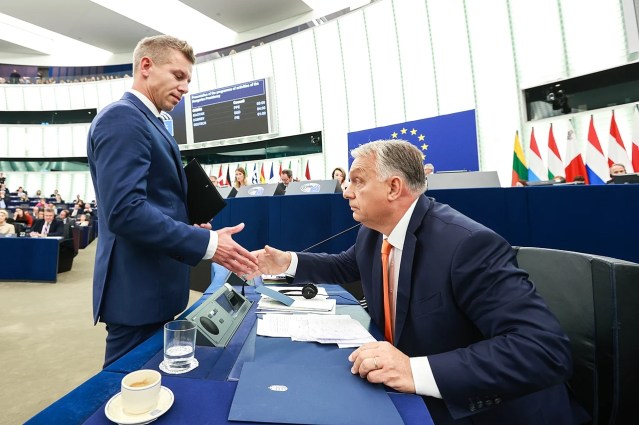
On Sunday evening, it was clear that Viktor Orbán’s 16-year rule had come to a resounding end as opposition leader Péter Agyar had been swept into power by dealing a landslide blow to Orbán’s now former ruling party.
With around 80% of the votes counted, Agyar’s party, Tisza, which was only formed in 2020 and has not yet featured in any previous Hungarian election, is on course to win 138 of the 190 parliamentary seats.
“Hungary will once again become a European country”
Péter Agyar – 12th of April 2026
Wind power under Orbán
Under the leadership of Orbán, Hungary has spent much of the past decade out of step with Europe’s renewable energy transition, being widely a blocker rather than an enabler of the European Union’s (EU) climate and energy agenda.
While wind power has expanded rapidly across the continent, new onshore projects in Hungary have been effectively frozen—held back by the Orbán government.
While Magyar and Tisza have shared very little about their wider energy, climate and environmental policies, there are reasons to assume that the incoming government will depart from Orbán’s wind power policies.
Three arguments for a shift to wind power
There are three core pillars that point to the fact that the new Hungarian government, if not directly embracing wind power, then at least has not put in place blockers.
A policy increasingly at odds with Europe
When Magyar gave his victory speech to a jubilant young crowd on Sunday evening, he declared that Hungary would “Once again become a European country”, paving the way for stronger ties with the EU. Wind power is a key energy source in the EU’s energy strategy.
Across the EU, the cost of installing and generating onshore wind has come drastically down and has emerged as one of the cheapest and fastest-growing sources of new electricity generation. Hungary’s neighbours, from Croatia to the west and Romania and Ukraine to the east, are rapidly expanding their wind power portfolio, which could give Hungary good interconnection and collaboration options.
But while the majority of the European continent has seen a wind power revolution in the past decade, the picture in Hungary is one of a contrasting picture.
An anti-corruption lens on energy policy
The second layer is Magyar’s strong commitment to anti-corruption, which aligns with his economic stance. His emphasis on transparency and anti-corruption adds another layer.
Restrictive zoning rules have effectively prevented turbines from being built near most settlements and have brought new onshore wind development to a near standstill. The policy has persisted despite rising energy prices, growing electrification needs and increasing pressure to decarbonise. At the same time, under Orbán, Hungary moved closer towards Russia, becoming ever more reliant on Russian oil and gas.
Wind power and free market economics
With Magyar having declared to identify with free-market economics, this gives further ammunition to the view that, in purely market economics, it makes sense to embrace wind power.
Policies that appear economically counterintuitive—particularly those that restrict competitive sectors—inevitably attract scrutiny in such a framework. Hungary’s long-standing constraints on wind power have often raised questions about whether the country’s energy mix has been shaped as much by political and structural considerations as by market logic.
A government committed to reducing distortions may therefore view wind policy not just as an energy issue, but as part of a broader effort to normalise economic governance.
Related analysis
Read our analysis on how Hungary’s neighbour are rapidly transitioning away from Russian fossil fuels towards clean energy ↓
What would further alignment with the EU look like?
Energy policy under Viktor Orbán has been characterised by a strong emphasis on sovereignty and long-term bilateral relationships, particularly with Russia. This has reinforced a more centralised and state-influenced energy model.
A shift under Agyar could mark a gradual reorientation and emphasise and promote: align with EU energy policy, reduce reliance on russian oil and gas, diversify energy sources, speed up the energy transition and embrace private sector energy investments
What would change look like?
In the coming months, signs of change to Hungary’s wider energy landscape and a favourable position for wind would be indicated by reforming zoning and permitting rules, onshore wind auctions, grid investments and further private investments.
None of these changes is guaranteed, and it is possible that it would not be at the top of the priorities for the incoming government. Grid constraints, planning complexity and local opposition could all slow progress. But compared to many aspects of the energy transition, wind policy is unusually binary: restrictions either remain in place, or they are lifted.
Anders Lorenzen is the founding Editor of A greener life, a greener world.
Discover more from A greener life, a greener world
Subscribe to get the latest posts sent to your email.
